Revizo / Microsoft / SC-100

MICROSOFT CERTIFICATION STUDY GUIDE

SC-100 practice questions.
Prepare with a clearer plan.

Validates skills in designing cybersecurity strategies and architectures for Microsoft solutions.

Download Revizo
Revizo certification practice question on iPhone

What to know about SC-100.

Validates skills in designing cybersecurity strategies and architectures for Microsoft solutions.

Format
Multiple choice questions
Duration
120 minutes
Passing score
700/1000
Recommended experience
2+ years of cybersecurity architecture experience

Exam details are based on the available Microsoft catalogue information. Confirm current requirements with the exam provider before booking.

How to prepare for SC-100.

Use the provider's current objectives as your source of truth, then organise your Revizo sessions around the Microsoft technologies, product capabilities and implementation decisions named in the certification. The SC-100 exam is listed as Multiple choice questions; your starting point should reflect 2+ years of cybersecurity architecture experience.

01

Map the official objectives.

Read the current Microsoft objectives and make a short list of the areas you need to revisit before booking SC-100.

02

Practise one area at a time.

Select SC-100 in Revizo and use focused question sessions to test one topic or decision type at a time, rather than relying on a single long cram session.

03

Review, then repeat.

Use your results to return to incorrect answers, revisit the official material behind them and repeat short SC-100 practice sessions until the gaps are clearer.

FREE PRACTICE PREVIEW

Read the first 20
SC-100 questions.

Review each question, its correct answer and any available source explanation before continuing your certification study in Revizo.

FIRST 20 QUESTIONS

Answers & available explanations

QUESTION 1

Your company has a Microsoft 365 ES subscription.
The Chief Compliance Officer plans to enhance privacy management in the working environment.
You need to recommend a solution to enhance the privacy management. The solution must meet the following requirements:
✑ Identify unused personal data and empower users to make smart data handling decisions.
✑ Provide users with notifications and guidance when a user sends personal data in Microsoft Teams.
✑ Provide users with recommendations to mitigate privacy risks.
What should you include in the recommendation?

  1. AA. communication compliance in insider risk management
  2. BB. Microsoft Viva Insights
  3. CC. Privacy Risk Management in Microsoft Priva
  4. DD. Advanced eDiscovery
Show answer & explanation

Correct answer: C

ExplanationExplanation: Privacy Risk Management in Microsoft Priva gives you the capability to set up policies that identify privacy risks in your Microsoft 365 environment and enable easy remediation. Privacy Risk Management policies are meant to be internal guides and can help you: Detect overexposed personal data so that users can secure it. Spot and limit transfers of personal data across departments or regional borders. Help users identify and reduce the amount of unused personal data that you store. Incorrect: Not B: Microsoft Viva Insights provides personalized recommendations to help you do your best work. Get insights to build better work habits, such as following through on commitments made to collaborators and protecting focus time in the day for uninterrupted, individual work. Not D: The Microsoft Purview eDiscovery (Premium) solution builds on the existing Microsoft eDiscovery and analytics capabilities. eDiscovery (Premium) provides an end-to-end workflow to preserve, collect, analyze, review, and export content that's responsive to your organization's internal and external investigations. Reference: https://docs.microsoft.com/en-us/privacy/priva/risk-management

QUESTION 2

You have an Azure subscription that has Microsoft Defender for Cloud enabled.
Suspicious authentication activity alerts have been appearing in the Workload protections dashboard.
You need to recommend a solution to evaluate and remediate the alerts by using workflow automation. The solution must minimize development effort.
What should you include in the recommendation?

  1. AA. Azure Monitor webhooks
  2. BB. Azure Event Hubs
  3. CC. Azure Functions apps
  4. DD. Azure Logics Apps
Show answer & explanation

Correct answer: D

ExplanationExplanation: The workflow automation feature of Microsoft Defender for Cloud feature can trigger Logic Apps on security alerts, recommendations, and changes to regulatory compliance. Note: Azure Logic Apps is a cloud-based platform for creating and running automated workflows that integrate your apps, data, services, and systems. With this platform, you can quickly develop highly scalable integration solutions for your enterprise and business-to-business (B2B) scenarios. Incorrect: Not C: Using Azure Functions apps would require more effort. Reference: https://docs.microsoft.com/en-us/azure/defender-for-cloud/workflow-automation

QUESTION 3

Your company is moving a big data solution to Azure.
The company plans to use the following storage workloads:
✑ Azure Storage blob containers
✑ Azure Data Lake Storage Gen2

Azure Storage file shares -

✑ Azure Disk Storage
Which two storage workloads support authentication by using Azure Active Directory (Azure AD)? Each correct answer presents a complete solution.
NOTE: Each correct selection is worth one point.

  1. AA. Azure Storage file shares
  2. BB. Azure Disk Storage
  3. CC. Azure Storage blob containers
  4. DD. Azure Data Lake Storage Gen2
Show answer & explanation

Correct answer: C, D

ExplanationExplanation: C: Azure Storage supports using Azure Active Directory (Azure AD) to authorize requests to blob data. With Azure AD, you can use Azure role-based access control (Azure RBAC) to grant permissions to a security principal, which may be a user, group, or application service principal. The security principal is authenticated by Azure AD to return an OAuth 2.0 token. The token can then be used to authorize a request against the Blob service. You can scope access to Azure blob resources at the following levels, beginning with the narrowest scope: * An individual container. At this scope, a role assignment applies to all of the blobs in the container, as well as container properties and metadata. * The storage account. * The resource group. * The subscription. * A management group. D: You can securely access data in an Azure Data Lake Storage Gen2 (ADLS Gen2) account using OAuth 2.0 with an Azure Active Directory (Azure AD) application service principal for authentication. Using a service principal for authentication provides two options for accessing data in your storage account: A mount point to a specific file or path Direct access to data - Incorrect: Not A: To enable AD DS authentication over SMB for Azure file shares, you need to register your storage account with AD DS and then set the required domain properties on the storage account. To register your storage account with AD DS, create an account representing it in your AD DS. Reference: https://docs.microsoft.com/en-us/azure/storage/blobs/authorize-access-azure-active-directory https://docs.microsoft.com/en-us/azure/databricks/data/data-sources/azure/adls-gen2/azure-datalake-gen2-sp-access

QUESTION 4

HOTSPOT -
Your company is migrating data to Azure. The data contains Personally Identifiable Information (PII).
The company plans to use Microsoft Information Protection for the PII data store in Azure.
You need to recommend a solution to discover PII data at risk in the Azure resources.
What should you include in the recommendation? To answer, select the appropriate options in the answer area.
NOTE: Each correct selection is worth one point.
Hot Area:
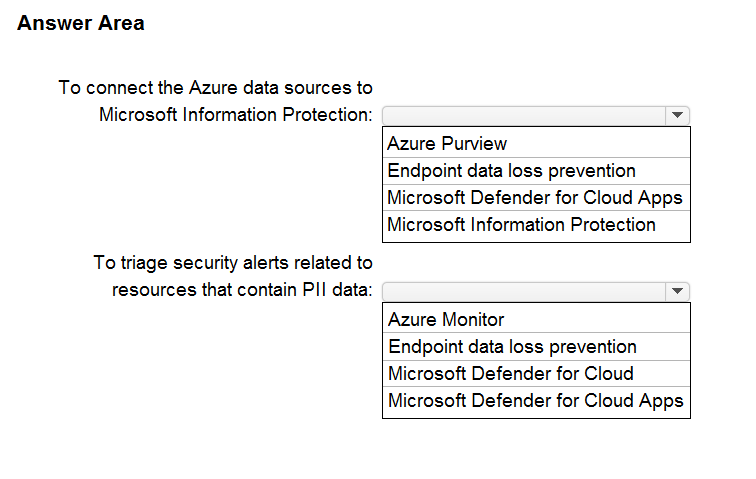
Item 1

  1. AA. Azure Purview
  2. BB. Endpoint data loss prevention
  3. CC. Microsoft Defender for Cloud Apps
  4. DD. Microsoft Information Protection

Item 2

  1. AA. Azure Monitor
  2. BB. Endpoint data loss prevention
  3. CC. Microsoft Defender for Cloud
  4. DD. Microsoft Defender for Cloud Apps
Show answer & explanation

Correct answer: Item 1: A · Item 2: C

ExplanationExplanation: Box 1: Azure Purview - Microsoft Purview is a unified data governance service that helps you manage and govern your on-premises, multi-cloud, and software-as-a-service (SaaS) data. Microsoft Purview allows you to: Create a holistic, up-to-date map of your data landscape with automated data discovery, sensitive data classification, and end-to-end data lineage. Enable data curators to manage and secure your data estate. Empower data consumers to find valuable, trustworthy data. Box 2: Microsoft Defender for Cloud Microsoft Purview provides rich insights into the sensitivity of your data. This makes it valuable to security teams using Microsoft Defender for Cloud to manage the organization's security posture and protect against threats to their workloads. Data resources remain a popular target for malicious actors, making it crucial for security teams to identify, prioritize, and secure sensitive data resources across their cloud environments. The integration with Microsoft Purview expands visibility into the data layer, enabling security teams to prioritize resources that contain sensitive data. Reference: https://docs.microsoft.com/en-us/azure/purview/overview https://docs.microsoft.com/en-us/azure/purview/how-to-integrate-with-azure-security-products

QUESTION 5

You have a Microsoft 365 E5 subscription and an Azure subscription.
You are designing a Microsoft deployment.
You need to recommend a solution for the security operations team. The solution must include custom views and a dashboard for analyzing security events.
What should you recommend using in Microsoft Sentinel?

  1. AA. notebooks
  2. BB. playbooks
  3. CC. workbooks
  4. DD. threat intelligence
Show answer & explanation

Correct answer: C

ExplanationExplanation: After you connected your data sources to Microsoft Sentinel, you get instant visualization and analysis of data so that you can know what's happening across all your connected data sources. Microsoft Sentinel gives you workbooks that provide you with the full power of tools already available in Azure as well as tables and charts that are built in to provide you with analytics for your logs and queries. You can either use built-in workbooks or create a new workbook easily, from scratch or based on an existing workbook. Reference: https://docs.microsoft.com/en-us/azure/sentinel/get-visibility

QUESTION 6

Your company has a Microsoft 365 subscription and uses Microsoft Defender for Identity.
You are informed about incidents that relate to compromised identities.
You need to recommend a solution to expose several accounts for attackers to exploit. When the attackers attempt to exploit the accounts, an alert must be triggered.
Which Defender for Identity feature should you include in the recommendation?

  1. AA. sensitivity labels
  2. BB. custom user tags
  3. CC. standalone sensors
  4. DD. honeytoken entity tags
Show answer & explanation

Correct answer: D

ExplanationExplanation: Honeytoken entities are used as traps for malicious actors. Any authentication associated with these honeytoken entities triggers an alert. Incorrect: Not B: custom user tags - After you apply system tags or custom tags to users, you can use those tags as filters in alerts, reports, and investigation. Reference: https://docs.microsoft.com/en-us/microsoft-365/security/defender-identity/entity-tags

QUESTION 7

Your company is moving all on-premises workloads to Azure and Microsoft 365.
You need to design a security orchestration, automation, and response (SOAR) strategy in Microsoft Sentinel that meets the following requirements:
✑ Minimizes manual intervention by security operation analysts
✑ Supports triaging alerts within Microsoft Teams channels
What should you include in the strategy?

  1. AA. KQL
  2. BB. playbooks
  3. CC. data connectors
  4. DD. workbooks
Show answer & explanation

Correct answer: B

ExplanationExplanation: Playbooks in Microsoft Sentinel are based on workflows built in Azure Logic Apps, a cloud service that helps you schedule, automate, and orchestrate tasks and workflows across systems throughout the enterprise. A playbook is a collection of these remediation actions that can be run from Microsoft Sentinel as a routine. A playbook can help automate and orchestrate your threat response; it can be run manually or set to run automatically in response to specific alerts or incidents, when triggered by an analytics rule or an automation rule, respectively. Incorrect: Not A: Kusto Query Language is a powerful tool to explore your data and discover patterns, identify anomalies and outliers, create statistical modeling, and more. The query uses schema entities that are organized in a hierarchy similar to SQL's: databases, tables, and columns. Not D: Workbooks provide a flexible canvas for data analysis and the creation of rich visual reports within the Azure portal. They allow you to tap into multiple data sources from across Azure, and combine them into unified interactive experiences. Workbooks allow users to visualize the active alerts related to their resources. Reference: https://docs.microsoft.com/en-us/azure/sentinel/automate-responses-with-playbooks https://docs.microsoft.com/en-us/azure/azure-monitor/visualize/workbooks-overview

QUESTION 8

You have an Azure subscription that contains virtual machines, storage accounts, and Azure SQL databases.
All resources are backed up multiple times a day by using Azure Backup.
You are developing a strategy to protect against ransomware attacks.
You need to recommend which controls must be enabled to ensure that Azure Backup can be used to restore the resources in the event of a successful ransomware attack.
Which two controls should you include in the recommendation? Each correct answer presents a complete solution.
NOTE: Each correct selection is worth one point.

  1. AA. Enable soft delete for backups.
  2. BB. Require PINs for critical operations.
  3. CC. Encrypt backups by using customer-managed keys (CMKs).
  4. DD. Perform offline backups to Azure Data Box.
  5. EE. Use Azure Monitor notifications when backup configurations change.
Show answer & explanation

Correct answer: A, B

ExplanationExplanation: A. Enable Soft Delete for Backups: Soft delete adds an additional layer of protection for your backup data. Even if a backup is deleted (whether accidentally or maliciously), it is retained for an additional period (14 days by default for Azure VMs and 30 days for Azure Blob Storage). During this retention period, the backup data can be recovered, ensuring that you can restore from these backups even if they are targeted in a ransomware attack. B. Require PINs for Critical Operations: This control adds an extra layer of security by requiring a PIN for critical operations, such as deleting backup data or changing backup configurations. This can prevent malicious actors from easily performing destructive actions, even if they have compromised your environment. It's a form of multi-factor authentication that ensures only authorized users can perform sensitive operations on your backups. Reference: https://docs.microsoft.com/en-us/azure/security/fundamentals/backup-plan-to-protect-against-ransomware

QUESTION 9

HOTSPOT -
You are creating the security recommendations for an Azure App Service web app named App1. App1 has the following specifications:
✑ Users will request access to App1 through the My Apps portal. A human resources manager will approve the requests.
✑ Users will authenticate by using Azure Active Directory (Azure AD) user accounts.
You need to recommend an access security architecture for App1.
What should you include in the recommendation? To answer, select the appropriate options in the answer area.
NOTE: Each correct selection is worth one point.
Hot Area:
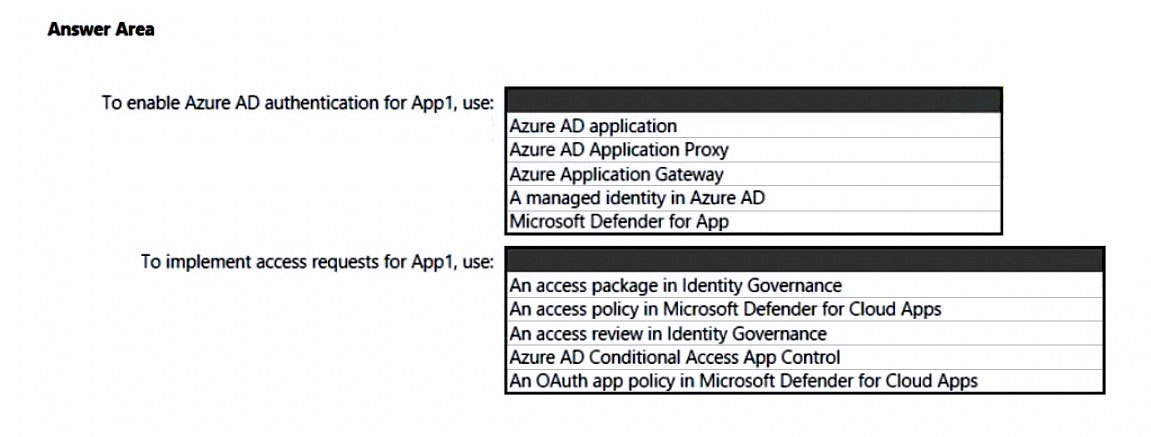
Item 1

  1. AA. Azure AD application
  2. BB. Azure AD Application Proxy
  3. CC. Azure Application Gateway
  4. DD. A managed identity in Azure AD
  5. EE. Microsoft Defender for App

Item 2

  1. AA. An access package in Identity Governance
  2. BB. An access policy in Microsoft Defender for Cloud Apps
  3. CC. An access review in Identity Governance
  4. DD. Azure AD Conditional Access App Control
  5. EE. An OAuth app policy in Microsoft Defender for Cloud Apps
Show answer & explanation

Correct answer: Item 1: A · Item 2: A

ExplanationExplanation: Azure AD application. (https://docs.microsoft.com/en-us/azure/active-directory/manage-apps/what-is-application-management) An access package in identity governance. (https://docs.microsoft.com/en-us/azure/active-directory/governance/entitlement-management-access-package-create)

QUESTION 10

HOTSPOT -
Your company uses Microsoft Defender for Cloud and Microsoft Sentinel.
The company is designing an application that will have the architecture shown in the following exhibit.
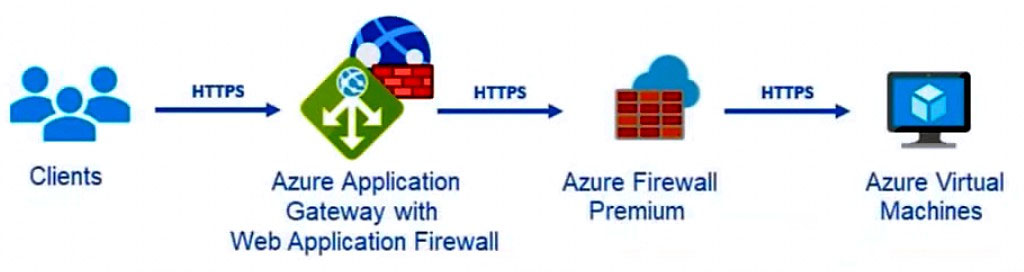
You are designing a logging and auditing solution for the proposed architecture. The solution must meet the following requirements:
✑ Integrate Azure Web Application Firewall (WAF) logs with Microsoft Sentinel.
✑ Use Defender for Cloud to review alerts from the virtual machines.
What should you include in the solution? To answer, select the appropriate options in the answer area.
NOTE: Each correct selection is worth one point.
Hot Area:
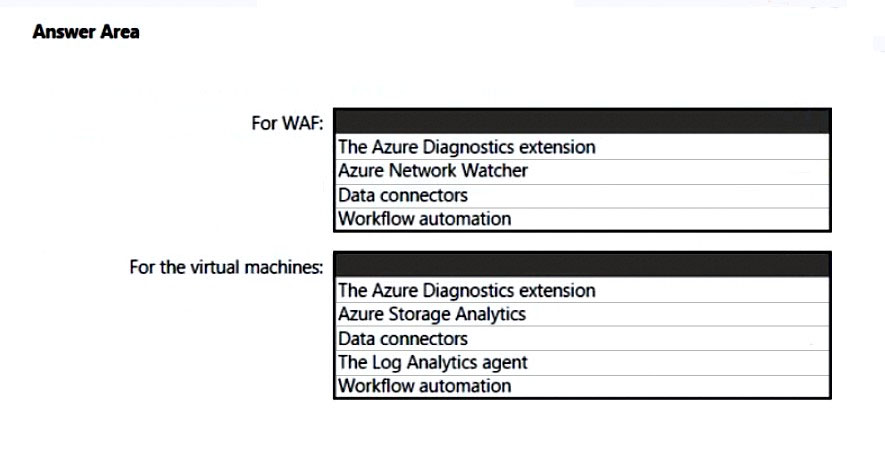
Item 1

  1. AA. The Azure Diagnostics extension
  2. BB. Azure Network Watcher
  3. CC. Data connectors
  4. DD. Workflow automation

Item 2

  1. AA. The Azure Diagnostics extension
  2. BB. Azure Storage Analytics
  3. CC. Data connectors
  4. DD. The Log Analytics agent
  5. EE. Workflow automation
Show answer & explanation

Correct answer: Item 1: C · Item 2: D

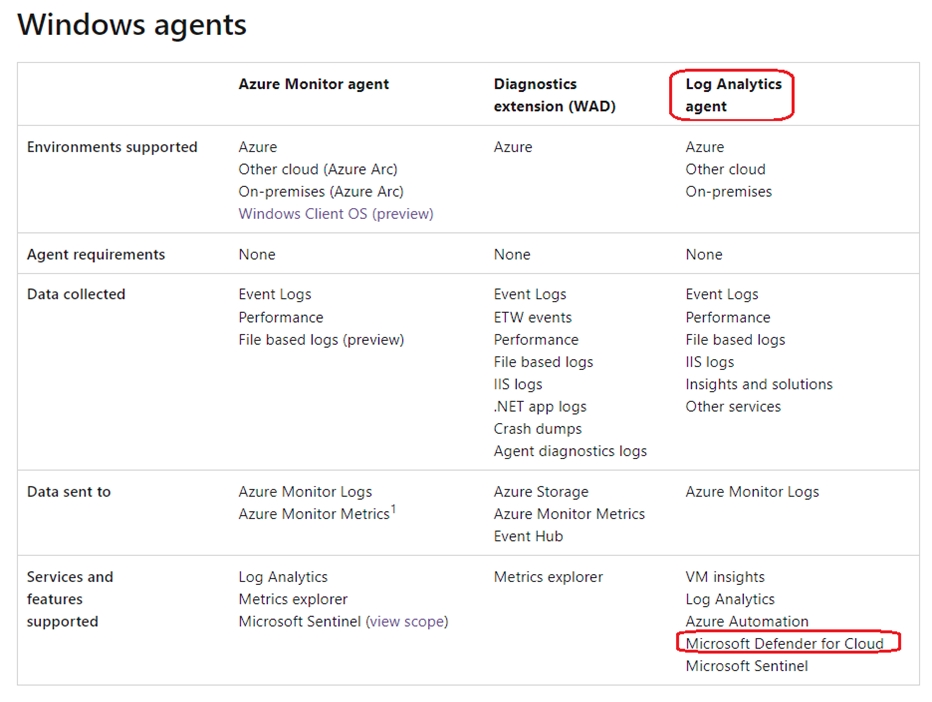
ExplanationExplanation: Box 1: Data connectors - Microsoft Sentinel connector streams security alerts from Microsoft Defender for Cloud into Microsoft Sentinel. Launch a WAF workbook (see step 7 below) The WAF workbook works for all Azure Front Door, Application Gateway, and CDN WAFs. Before connecting the data from these resources, log analytics must be enabled on your resource. To enable log analytics for each resource, go to your individual Azure Front Door, Application Gateway, or CDN resource: 1. Select Diagnostic settings. 2. Select + Add diagnostic setting. 3. In the Diagnostic setting page (details skipped) 4. On the Azure home page, type Microsoft Sentinel in the search bar and select the Microsoft Sentinel resource. 5. Select an already active workspace or create a new workspace. 6. On the left side panel under Configuration select Data Connectors. 7. Search for Azure web application firewall and select Azure web application firewall (WAF). Select Open connector page on the bottom right. 8. Follow the instructions under Configuration for each WAF resource that you want to have log analytic data for if you haven't done so previously. 9. Once finished configuring individual WAF resources, select the Next steps tab. Select one of the recommended workbooks. This workbook will use all log analytic data that was enabled previously. A working WAF workbook should now exist for your WAF resources. Box 2: The Log Analytics agent - Use the Log Analytics agent to integrate with Microsoft Defender for cloud. The Log Analytics agent is required for solutions, VM insights, and other services such as Microsoft Defender for Cloud. Note: The Log Analytics agent in Azure Monitor can also be used to collect monitoring data from the guest operating system of virtual machines. You may choose to use either or both depending on your requirements. Azure Log Analytics agent - Use Defender for Cloud to review alerts from the virtual machines. The Azure Log Analytics agent collects telemetry from Windows and Linux virtual machines in any cloud, on-premises machines, and those monitored by System Center Operations Manager and sends collected data to your Log Analytics workspace in Azure Monitor. Incorrect: The Azure Diagnostics extension does not integrate with Microsoft Defender for Cloud. Reference: https://docs.microsoft.com/en-us/azure/web-application-firewall/waf-sentinel https://docs.microsoft.com/en-us/azure/defender-for-cloud/enable-data-collection https://docs.microsoft.com/en-us/azure/azure-monitor/agents/agents-overview

QUESTION 11

Your company has a third-party security information and event management (SIEM) solution that uses Splunk and Microsoft Sentinel.
You plan to integrate Microsoft Sentinel with Splunk.
You need to recommend a solution to send security events from Microsoft Sentinel to Splunk.
What should you include in the recommendation?

  1. AA. a Microsoft Sentinel data connector
  2. BB. Azure Event Hubs
  3. CC. a Microsoft Sentinel workbook
  4. DD. Azure Data Factory
Show answer & explanation

Correct answer: B

ExplanationExplanation: Microsoft defines Azure Event Hubs as “a big data streaming platform and event ingestion service”. Most services inside of Azure, and some services outside of Azure, integrate with Event Hubs. Reference: https://lantern.splunk.com/Data_Descriptors/Microsoft/Getting_started_with_Microsoft_Azure_Event_Hub_data

QUESTION 12

A customer follows the Zero Trust model and explicitly verifies each attempt to access its corporate applications.
The customer discovers that several endpoints are infected with malware.
The customer suspends access attempts from the infected endpoints.
The malware is removed from the endpoints.
Which two conditions must be met before endpoint users can access the corporate applications again? Each correct answer presents part of the solution.
NOTE: Each correct selection is worth one point.

  1. AA. The client access tokens are refreshed.
  2. BB. Microsoft Intune reports the endpoints as compliant.
  3. CC. A new Azure Active Directory (Azure AD) Conditional Access policy is enforced.
  4. DD. Microsoft Defender for Endpoint reports the endpoints as compliant.
Show answer & explanation

Correct answer: A, B

ExplanationExplanation: A. The client access tokens are refreshed. B. Microsoft Intune reports the endpoints as compliant.

QUESTION 13

HOTSPOT -
You have a Microsoft 365 subscription and an Azure subscription. Microsoft 365 Defender and Microsoft Defender for Cloud are enabled.
The Azure subscription contains a Microsoft Sentinel workspace. Microsoft Sentinel data connectors are configured for Microsoft 365, Microsoft 365 Defender,
Defender for Cloud, and Azure.
You plan to deploy Azure virtual machines that will run Windows Server.
You need to enable extended detection and response (EDR) and security orchestration, automation, and response (SOAR) capabilities for Microsoft Sentinel.
How should you recommend enabling each capability? To answer, select the appropriate options in the answer area.
NOTE: Each correct selection is worth one point.
Hot Area:
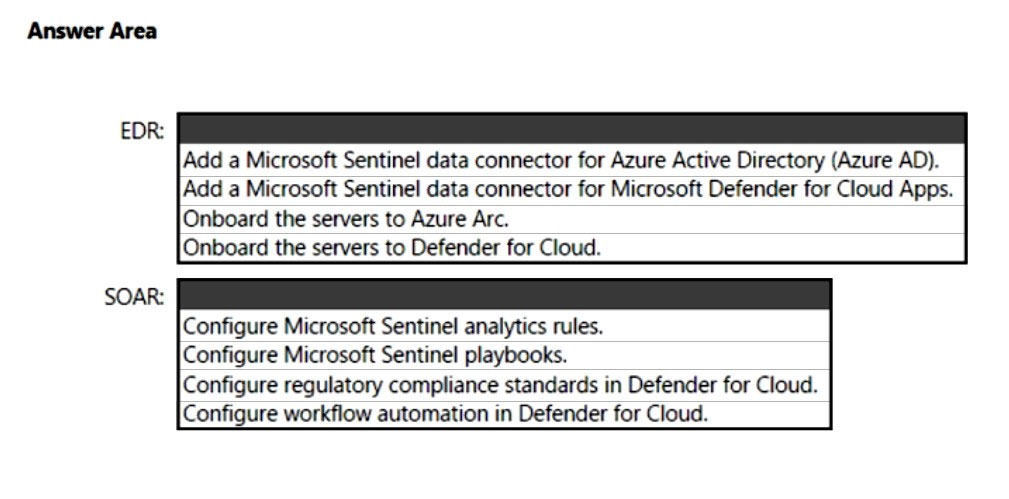
Item 1

  1. AA. Add a Microsoft Sentinel data connector for Azure Active Directory (Azure AD).
  2. BB. Add a Microsoft Sentinel data connector for Microsoft Defender for Cloud Apps.
  3. CC. Onboard the servers to Azure Arc.
  4. DD. Onboard the servers to Defender for Cloud.

Item 2

  1. AA. Configure Microsoft Sentinel analytics rules.
  2. BB. Configure Microsoft Sentinel playbooks.
  3. CC. Configure regulatory compliance standards in Defender for Cloud.
  4. DD. Configure workflow automation in Defender for Cloud.
Show answer & explanation

Correct answer: Item 1: D · Item 2: B

ExplanationExplanation: Box 1: Onboard the servers to Defender for Cloud. Extended detection and response (XDR) is a new approach defined by industry analysts that are designed to deliver intelligent, automated, and integrated security across domains to help defenders connect seemingly disparate alerts and get ahead of attackers. As part of this announcement, we are unifying all XDR technologies under the Microsoft Defender brand. The new Microsoft Defender is the most comprehensive XDR in the market today and prevents, detects, and responds to threats across identities, endpoints, applications, email, IoT, infrastructure, and cloud platforms. Box 2: Configure Microsoft Sentinel playbooks. As a SOAR platform, its primary purposes are to automate any recurring and predictable enrichment, response and remediation tasks that are the responsibility of Security Operations Centers (SOC/SecOps). Leveraging SOAR frees up time and resources for more in-depth investigation of and hunting for advanced threats. Automation takes a few different forms in Microsoft Sentinel, from automation rules that centrally manage the automation of incident handling and response to playbooks that run predetermined sequences of actions to provide robust and flexible advanced automation to your threat response tasks. Reference: https://www.microsoft.com/security/blog/2020/09/22/microsoft-unified-siem-xdr-modernize-security-operations/ https://techcommunity.microsoft.com/t5/microsoft-sentinel-blog/become-a-microsoft-sentinel-automation-ninja/ba-p/3563377

QUESTION 14

You have a customer that has a Microsoft 365 subscription and uses the Free edition of Azure Active Directory (Azure AD).
The customer plans to obtain an Azure subscription and provision several Azure resources.
You need to evaluate the customer's security environment.
What will necessitate an upgrade from the Azure AD Free edition to the Premium edition?

  1. AA. Azure AD Privileged Identity Management (PIM)
  2. BB. role-based authorization
  3. CC. resource-based authorization
  4. DD. Azure AD Multi-Factor Authentication
Show answer & explanation

Correct answer: A

ExplanationExplanation: Azure AD Privileged Identity Management (PIM) PIM is correct. MFA can be enable on AAD Free using Security Defaults.

QUESTION 15

You are designing the security standards for a new Azure environment.
You need to design a privileged identity strategy based on the Zero Trust model.
Which framework should you follow to create the design?

  1. AA. Microsoft Security Development Lifecycle (SDL)
  2. BB. Enhanced Security Admin Environment (ESAE)
  3. CC. Rapid Modernization Plan (RaMP)
  4. DD. Microsoft Operational Security Assurance (OSA)
Show answer & explanation

Correct answer: C

ExplanationExplanation: RaMP initiatives for Zero Trust. To rapidly adopt Zero Trust in your organization, RaMP offers technical deployment guidance organized in these initiatives. In particular, meet these deployment objectives to protect your privileged identities with Zero Trust. 1. Deploy secured privileged access to protect administrative user accounts. 2. Deploy Azure AD Privileged Identity Management (PIM) for a time-bound, just-in-time approval process for the use of privileged user accounts. Note 1: RaMP guidance takes a project management and checklist approach: * User access and productivity 1. Explicitly validate trust for all access requests Identities - Endpoints (devices) Apps - Network - * Data, compliance, and governance 2. Ransomware recovery readiness 3. Data * Modernize security operations 4. Streamline response 5. Unify visibility 6. Reduce manual effort Note 2: As an alternative to deployment guidance that provides detailed configuration steps for each of the technology pillars being protected by Zero Trust principles, Rapid Modernization Plan (RaMP) guidance is based on initiatives and gives you a set of deployment paths to more quickly implement key layers of protection. By providing a suggested mapping of key stakeholders, implementers, and their accountabilities, you can more quickly organize an internal project and define the tasks and owners to drive them to conclusion. By providing a checklist of deployment objectives and implementation steps, you can see the bigger picture of infrastructure requirements and track your progress. Incorrect: Not B: Enhanced Security Admin Environment (ESAE) The Enhanced Security Admin Environment (ESAE) architecture (often referred to as red forest, admin forest, or hardened forest) is an approach to provide a secure environment for Windows Server Active Directory (AD) administrators. Microsoft's recommendation to use this architectural pattern has been replaced by the modern privileged access strategy and rapid modernization plan (RAMP) guidance as the default recommended approach for securing privileged users. The ESAE hardened administrative forest pattern (on-prem or cloud-based) is now considered a custom configuration suitable only for exception cases listed below. What are the valid ESAE use cases? While not a mainstream recommendation, this architectural pattern is valid in a limited set of scenarios. In these exception cases, the organization must accept the increased technical complexity and operational costs of the solution. The organization must have a sophisticated security program to measure risk, monitor risk, and apply consistent operational rigor to the usage and maintenance of the ESAE implementation. Example scenarios include: Isolated on-premises environments - where cloud services are unavailable such as offline research laboratories, critical infrastructure or utilities, disconnected operational technology (OT) environments such as Supervisory control and data acquisition (SCADA) / Industrial Control Systems (ICS), and public sector customers that are fully reliant on on-premises technology. Highly regulated environments " industry or government regulation may specifically require an administrative forest configuration. High level security assurance is mandated - organizations with low risk tolerance that are willing to accept the increased complexity and operational cost of the solution. Reference: https://docs.microsoft.com/en-us/security/zero-trust/zero-trust-ramp-overview https://docs.microsoft.com/en-us/security/zero-trust/user-access-productivity-validate-trust#identities https://docs.microsoft.com/en-us/security/compass/esae-retirement

QUESTION 16

A customer has a hybrid cloud infrastructure that contains a Microsoft 365 E5 subscription and an Azure subscription.
All on-premises servers in the perimeter network are prevented from connecting directly to the internet.
The customer recently recovered from a ransomware attack.
The customer plans to deploy Microsoft Sentinel.
You need to recommend solutions to meet the following requirements:
✑ Ensure that the security operations team can access the security logs and the operation logs.
✑ Ensure that the IT operations team can access only the operations logs, including the event logs of the servers in the perimeter network.
Which two solutions should you include in the recommendation? Each correct answer presents a complete solution.
NOTE: Each correct selection is worth one point.

  1. AA. a custom collector that uses the Log Analytics agent
  2. BB. the Azure Monitor agent
  3. CC. resource-based role-based access control (RBAC)
  4. DD. Azure Active Directory (Azure AD) Conditional Access policies
Show answer & explanation

Correct answer: B, C

ExplanationExplanation: A: You can collect data in custom log formats to Microsoft Sentinel with the Log Analytics agent. Note: You can use the Log Analytics agent to collect data in text files of nonstandard formats from both Windows and Linux computers. Once collected, you can either parse the data into individual fields in your queries or extract the data during collection to individual fields. You can connect your data sources to Microsoft Sentinel using custom log formats. C: Microsoft Sentinel uses Azure role-based access control (Azure RBAC) to provide built-in roles that can be assigned to users, groups, and services in Azure. Use Azure RBAC to create and assign roles within your security operations team to grant appropriate access to Microsoft Sentinel. The different roles give you fine-grained control over what Microsoft Sentinel users can see and do. Azure roles can be assigned in the Microsoft Sentinel workspace directly (see note below), or in a subscription or resource group that the workspace belongs to, which Microsoft Sentinel inherits. Incorrect: A: You can collect data in custom log formats to Microsoft Sentinel with the Log Analytics agent. Note: You can use the Log Analytics agent to collect data in text files of nonstandard formats from both Windows and Linux computers. Once collected, you can either parse the data into individual fields in your queries or extract the data during collection to individual fields. You can connect your data sources to Microsoft Sentinel using custom log formats. Reference: https://docs.microsoft.com/en-us/azure/azure-monitor/agents/agents-overview https://docs.microsoft.com/en-us/azure/sentinel/connect-custom-logs?tabs=DCG https://docs.microsoft.com/en-us/azure/sentinel/roles

QUESTION 17

Your company is developing a serverless application in Azure that will have the architecture shown in the following exhibit.
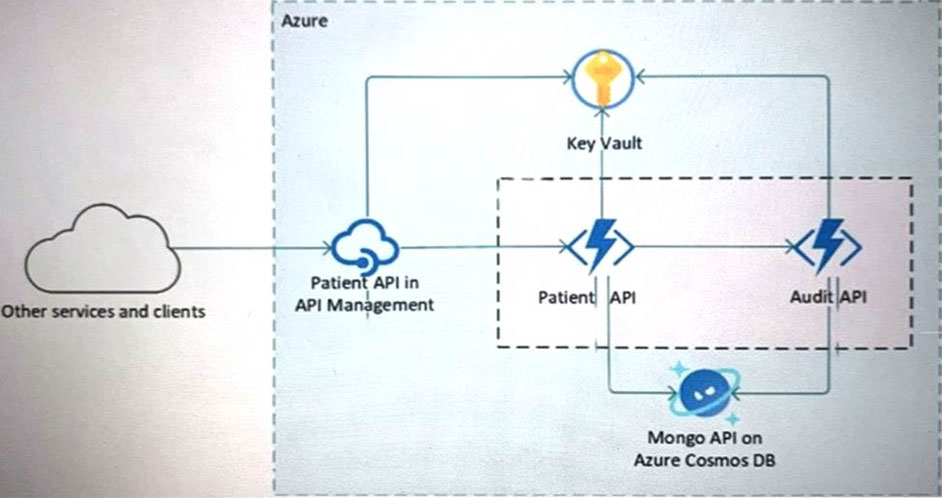
You need to recommend a solution to isolate the compute components on an Azure virtual network.
What should you include in the recommendation?

  1. AA. Azure Active Directory (Azure AD) enterprise applications
  2. BB. an Azure App Service Environment (ASE)
  3. CC. Azure service endpoints
  4. DD. an Azure Active Directory (Azure AD) application proxy
Show answer & explanation

Correct answer: B

ExplanationExplanation: The Azure App Service Environment v2 is an Azure App Service feature that provides a fully isolated and dedicated environment for securely running App Service apps at high scale. This capability can host your: Windows web apps - Linux web apps - Docker containers - Mobile apps - Functions - App Service environments (ASEs) are appropriate for application workloads that require: Very high scale. Isolation and secure network access. High memory utilization. Customers can create multiple ASEs within a single Azure region or across multiple Azure regions. This flexibility makes ASEs ideal for horizontally scaling stateless application tiers in support of high requests per second (RPS) workloads. Reference: https://docs.microsoft.com/en-us/azure/app-service/environment/intro

QUESTION 18

HOTSPOT
-

You are planning the security levels for a security access strategy.

You need to identify which job roles to configure at which security levels. The solution must meet security best practices of the Microsoft Cybersecurity Reference Architectures (MCRA).

Which security level should you configure for each job role? To answer, select the appropriate options in the answer area.

NOTE: Each correct selection is worth one point.
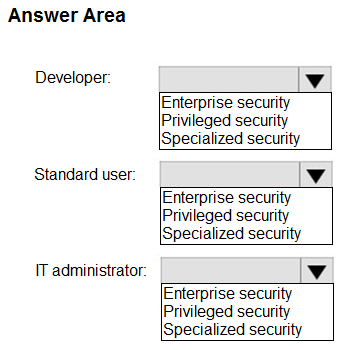
Item 1

  1. AA. Enterprise security
  2. BB. Privileged security
  3. CC. Specialized security

Item 2

  1. AA. Enterprise security
  2. BB. Privileged security
  3. CC. Specialized security

Item 3

  1. AA. Enterprise security
  2. BB. Privileged security
  3. CC. Specialized security
Show answer & explanation

Correct answer: Item 1: C · Item 2: A · Item 3: B

ExplanationExplanation: 1. Specialized security 2. Enterprise security 3. Privileged security https://learn.microsoft.com/en-us/security/privileged-access-workstations/privileged-access-security-levels#specialized Specialized security provides increased security controls for roles with an elevated business impact (if compromised by an attacker or malicious insider). Specialized roles typically include: - Developers of business critical systems. https://learn.microsoft.com/en-us/security/privileged-access-workstations/privileged-access-security-levels#enterprise Enterprise security is suitable for all enterprise users and productivity scenarios. In the progression of the rapid modernization plan, enterprise also serves as the starting point for specialized and privileged access as they progressively build on the security controls in enterprise security.

QUESTION 19

Your company plans to apply the Zero Trust Rapid Modernization Plan (RaMP) to its IT environment.

You need to recommend the top three modernization areas to prioritize as part of the plan.

Which three areas should you recommend based on RaMP? Each correct answer presents part of the solution.

NOTE: Each correct selection is worth one point.

  1. AA. data, compliance, and governance
  2. BB. infrastructure and development
  3. CC. user access and productivity
  4. DD. operational technology (OT) and IoT
  5. EE. modern security operations
Show answer & explanation

Correct answer: A, C, E

ExplanationExplanation: A. data, compliance, and governance. C. user access and productivity. E. modern security operations. Reference: https://learn.microsoft.com/en-us/security/zero-trust/zero-trust-ramp-overview

QUESTION 20

HOTSPOT
-

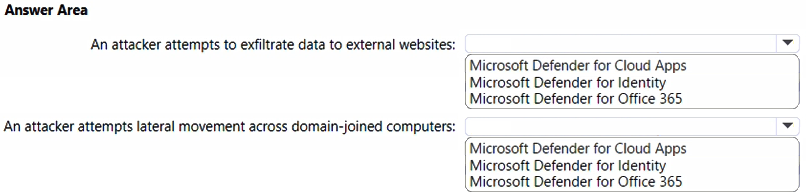
For a Microsoft cloud environment, you are designing a security architecture based on the Microsoft Cybersecurity Reference Architectures (MCRA).

You need to protect against the following external threats of an attack chain:

•An attacker attempts to exfiltrate data to external websites.
•An attacker attempts lateral movement across domain-joined computers.

What should you include in the recommendation for each threat? To answer, select the appropriate options in the answer area.

NOTE: Each correct selection is worth one point.
Item 1

  1. AA. Microsoft Defender for Cloud Apps
  2. BB. Microsoft Defender for Identity
  3. CC. Microsoft Defender for Office 365

Item 2

  1. AA. Microsoft Defender for Cloud Apps
  2. BB. Microsoft Defender for Identity
  3. CC. Microsoft Defender for Office 365
Show answer & explanation

Correct answer: Item 1: A · Item 2: B

ExplanationExplanation: 1. Microsoft Defender for Cloud Apps. 2. Microsoft Defender for Identity. https://learn.microsoft.com/en-us/defender-for-identity/what-is Microsoft Defender for Identity (formerly Azure Advanced Threat Protection, also known as Azure ATP) is a cloud-based security solution that leverages your on-premises Active Directory signals to identify, detect, and investigate advanced threats, compromised identities, and malicious insider actions directed at your organization.

Build a focused SC-100 practice routine.

Choose SC-100 in Revizo and work through original, question-by-question practice on your iPhone. Review results, revisit what needs attention and keep your next session tied to one specific certification objective.

Practise SC-100 with Revizo

SC-100 practice questions.

Is Revizo the official Microsoft exam?

No. Revizo is an independent iPhone app for certification practice. Refer to the provider's official resources for current exam policies and registration.

How should I use these SC-100 practice questions?

Use the exam code to select the matching certification in Revizo, then build short, focused sessions around the areas you want to review.

Are Revizo questions copied from live examinations?

No. Revizo provides original practice questions for certification study. Use the provider's official objectives, documentation and policies as the source of truth for your preparation.

What should I use alongside SC-100 practice questions?

Use the current Microsoft objectives, documentation and registration guidance as your source of truth. Revizo is designed to support focused practice, not replace the provider's official materials.

Where can I confirm current SC-100 requirements?

Check the official Microsoft exam page for the latest objectives, registration details and policies.