Focus
MICROSOFT CERTIFICATION STUDY GUIDE
AZ-104 practice questions.
Prepare with a clearer plan.
Validates skills in managing Azure resources, identities, governance, and networking.
Download Revizo
What to know about AZ-104.
Validates skills in managing Azure resources, identities, governance, and networking.
- Format
- Multiple choice questions
- Duration
- 120 minutes
- Passing score
- 700/1000
- Recommended experience
- 6 months of Azure administration experience
Exam details are based on the available Microsoft catalogue information. Confirm current requirements with the exam provider before booking.
Plan AZ-104 around operational responsibilities.
Revise by following the work of an Azure administrator: identity, governance, compute, networking, storage and monitoring. Use official objectives to confirm the current scope.
Focus
Azure resources
Compute, storage and network configuration in administrator scenarios.Focus
Operations
Monitoring, recovery, maintenance and reliable day-to-day management.AZ-104 is an administrator certification, not an architecture-design exam. Prioritise operational scenarios and current Microsoft Learn objectives.
How to prepare for AZ-104.
Use the provider's current objectives as your source of truth, then organise your Revizo sessions around the Microsoft technologies, product capabilities and implementation decisions named in the certification. The AZ-104 exam is listed as Multiple choice questions; your starting point should reflect 6 months of Azure administration experience.
Map the official objectives.
Read the current Microsoft objectives and make a short list of the areas you need to revisit before booking AZ-104.
Practise one area at a time.
Select AZ-104 in Revizo and use focused question sessions to test one topic or decision type at a time, rather than relying on a single long cram session.
Review, then repeat.
Use your results to return to incorrect answers, revisit the official material behind them and repeat short AZ-104 practice sessions until the gaps are clearer.
FREE PRACTICE PREVIEW
Read the first 20
AZ-104 questions.
Review each question, its correct answer and any available source explanation before continuing your certification study in Revizo.
FIRST 20 QUESTIONS
Answers & available explanations
QUESTION 1
Your company has serval departments. Each department has a number of virtual machines (VMs).
The company has an Azure subscription that contains a resource group named RG1.
All VMs are located in RG1.
You want to associate each VM with its respective department.
What should you do?
Show answer & explanation
Correct answer: C
ExplanationReference:
https://docs.microsoft.com/en-us/azure/azure-resource-manager/resource-group-using-tags
https://docs.microsoft.com/en-us/azure/azure-resource-manager/resource-group-using-tags
QUESTION 2
Note: The question is included in a number of questions that depicts the identical set-up. However, every question has a distinctive result. Establish if the solution satisfies the requirements.
Your company has an Azure Active Directory (Azure AD) subscription.
You want to implement an Azure AD conditional access policy.
The policy must be configured to require members of the Global Administrators group to use Multi-Factor Authentication and an Azure AD-joined device when they connect to Azure AD from untrusted locations.
Solution: You access the multi-factor authentication page to alter the user settings.
Does the solution meet the goal?
Show answer & explanation
Correct answer: B
Explanation
QUESTION 3
Note: The question is included in a number of questions that depicts the identical set-up. However, every question has a distinctive result. Establish if the solution satisfies the requirements.
Your company has an Azure Active Directory (Azure AD) subscription.
You want to implement an Azure AD conditional access policy.
The policy must be configured to require members of the Global Administrators group to use Multi-Factor Authentication and an Azure AD-joined device when they connect to Azure AD from untrusted locations.
Solution: You access the Azure portal to alter the session control of the Azure AD conditional access policy.
Does the solution meet the goal?
Show answer & explanation
Correct answer: B
Explanation
QUESTION 4
Note: The question is included in a number of questions that depicts the identical set-up. However, every question has a distinctive result. Establish if the solution satisfies the requirements.
Your company has an Azure Active Directory (Azure AD) subscription.
You want to implement an Azure AD conditional access policy.
The policy must be configured to require members of the Global Administrators group to use Multi-Factor Authentication and an Azure AD-joined device when they connect to Azure AD from untrusted locations.
Solution: You access the Azure portal to alter the grant control of the Azure AD conditional access policy.
Does the solution meet the goal?
Show answer & explanation
Correct answer: A
Explanation
QUESTION 5
You are planning to deploy an Ubuntu Server virtual machine to your company's Azure subscription.
You are required to implement a custom deployment that includes adding a particular trusted root certification authority (CA).
Which of the following should you use to create the virtual machine?
Show answer & explanation
Correct answer: C
ExplanationOnce Cloud-init.txt has been created, you can deploy the VM with az vm create cmdlet, using the --custom-data parameter to provide the full path to the cloud- init.txt file.
Reference:
https://docs.microsoft.com/en-us/azure/virtual-machines/linux/tutorial-automate-vm-deployment
Reference:
https://docs.microsoft.com/en-us/azure/virtual-machines/linux/tutorial-automate-vm-deployment
QUESTION 6
Note: The question is included in a number of questions that depicts the identical set-up. However, every question has a distinctive result. Establish if the solution satisfies the requirements.
Your company makes use of Multi-Factor Authentication for when users are not in the office. The Per Authentication option has been configured as the usage model.
After the acquisition of a smaller business and the addition of the new staff to Azure Active Directory (Azure AD) obtains a different company and adding the new employees to Azure Active Directory (Azure AD), you are informed that these employees should also make use of Multi-Factor Authentication.
To achieve this, the Per Enabled User setting must be set for the usage model.
Solution: You reconfigure the existing usage model via the Azure portal.
Does the solution meet the goal?
Show answer & explanation
Correct answer: B
ExplanationSince it is not possible to change the usage model of an existing provider as it is right now, you have to create a new one and reactivate your existing server with activation credentials from the new provider.
Reference:
https://365lab.net/2015/04/11/switch-usage-model-in-azure-multi-factor-authentication-server/
Reference:
https://365lab.net/2015/04/11/switch-usage-model-in-azure-multi-factor-authentication-server/
QUESTION 7
Note: The question is included in a number of questions that depicts the identical set-up. However, every question has a distinctive result. Establish if the solution satisfies the requirements.
Your company's Azure solution makes use of Multi-Factor Authentication for when users are not in the office. The Per Authentication option has been configured as the usage model.
After the acquisition of a smaller business and the addition of the new staff to Azure Active Directory (Azure AD) obtains a different company and adding the new employees to Azure Active Directory (Azure AD), you are informed that these employees should also make use of Multi-Factor Authentication.
To achieve this, the Per Enabled User setting must be set for the usage model.
Solution: You reconfigure the existing usage model via the Azure CLI.
Does the solution meet the goal?
Show answer & explanation
Correct answer: B
ExplanationSince it is not possible to change the usage model of an existing provider as it is right now, you have to create a new one and reactivate your existing server with activation credentials from the new provider.
Reference:
https://365lab.net/2015/04/11/switch-usage-model-in-azure-multi-factor-authentication-server/
Reference:
https://365lab.net/2015/04/11/switch-usage-model-in-azure-multi-factor-authentication-server/
QUESTION 8
Note: The question is included in a number of questions that depicts the identical set-up. However, every question has a distinctive result. Establish if the solution satisfies the requirements.
Your company's Azure solution makes use of Multi-Factor Authentication for when users are not in the office. The Per Authentication option has been configured as the usage model.
After the acquisition of a smaller business and the addition of the new staff to Azure Active Directory (Azure AD) obtains a different company and adding the new employees to Azure Active Directory (Azure AD), you are informed that these employees should also make use of Multi-Factor Authentication.
To achieve this, the Per Enabled User setting must be set for the usage model.
Solution: You create a new Multi-Factor Authentication provider with a backup from the existing Multi-Factor Authentication provider data.
Does the solution meet the goal?
Show answer & explanation
Correct answer: A
ExplanationSince it is not possible to change the usage model of an existing provider as it is right now, you have to create a new one and reactivate your existing server with activation credentials from the new provider.
Reference:
https://365lab.net/2015/04/11/switch-usage-model-in-azure-multi-factor-authentication-server/
Reference:
https://365lab.net/2015/04/11/switch-usage-model-in-azure-multi-factor-authentication-server/
QUESTION 9
Note: The question is included in a number of questions that depicts the identical set-up. However, every question has a distinctive result. Establish if the solution satisfies the requirements.
Your company has an Azure Active Directory (Azure AD) tenant named weyland.com that is configured for hybrid coexistence with the on-premises Active
Directory domain.
You have a server named DirSync1 that is configured as a DirSync server.
You create a new user account in the on-premise Active Directory. You now need to replicate the user information to Azure AD immediately.
Solution: You run the Start-ADSyncSyncCycle -PolicyType Initial PowerShell cmdlet.
Does the solution meet the goal?
Show answer & explanation
Correct answer: A
ExplanationReference:
https://blog.kloud.com.au/2016/03/08/azure-ad-connect-manual-sync-cycle-with-powershell-start-adsyncsynccycle/
https://blog.kloud.com.au/2016/03/08/azure-ad-connect-manual-sync-cycle-with-powershell-start-adsyncsynccycle/
QUESTION 10
Note: The question is included in a number of questions that depicts the identical set-up. However, every question has a distinctive result. Establish if the solution satisfies the requirements.
Your company has an Azure Active Directory (Azure AD) tenant named weyland.com that is configured for hybrid coexistence with the on-premises Active
Directory domain.
You have a server named DirSync1 that is configured as a DirSync server.
You create a new user account in the on-premise Active Directory. You now need to replicate the user information to Azure AD immediately.
Solution: You use Active Directory Sites and Services to force replication of the Global Catalog on a domain controller.
Does the solution meet the goal?
Show answer & explanation
Correct answer: B
Explanation
QUESTION 11
Note: The question is included in a number of questions that depicts the identical set-up. However, every question has a distinctive result. Establish if the solution satisfies the requirements.
Your company has an Azure Active Directory (Azure AD) tenant named weyland.com that is configured for hybrid coexistence with the on-premises Active
Directory domain.
You have a server named DirSync1 that is configured as a DirSync server.
You create a new user account in the on-premise Active Directory. You now need to replicate the user information to Azure AD immediately.
Solution: You restart the NetLogon service on a domain controller.
Does the solution meet the goal?
Show answer & explanation
Correct answer: B
Explanation
QUESTION 12
Your company has a Microsoft Azure subscription.
The company has datacenters in Los Angeles and New York.
You are configuring the two datacenters as geo-clustered sites for site resiliency.
You need to recommend an Azure storage redundancy option.
You have the following data storage requirements:
✑ Data must be stored on multiple nodes.
✑ Data must be stored on nodes in separate geographic locations.
✑ Data can be read from the secondary location as well as from the primary location.
Which of the following Azure stored redundancy options should you recommend?
Show answer & explanation
Correct answer: B
ExplanationRA-GRS allows you to have higher read availability for your storage account by providing ג€read onlyג€ access to the data replicated to the secondary location. Once you enable this feature, the secondary location may be used to achieve higher availability in the event the data is not available in the primary region. This is an
ג€opt-inג€ feature which requires the storage account be geo-replicated.
Reference:
https://docs.microsoft.com/en-us/azure/storage/common/storage-redundancy
ג€opt-inג€ feature which requires the storage account be geo-replicated.
Reference:
https://docs.microsoft.com/en-us/azure/storage/common/storage-redundancy
QUESTION 13
Note: The question is included in a number of questions that depicts the identical set-up. However, every question has a distinctive result. Establish if the solution satisfies the requirements.
Your company has an azure subscription that includes a storage account, a resource group, a blob container and a file share.
A colleague named Jon Ross makes use of a solitary Azure Resource Manager (ARM) template to deploy a virtual machine and an additional Azure Storage account.
You want to review the ARM template that was used by Jon Ross.
Solution: You access the Virtual Machine blade.
Does the solution meet the goal?
Show answer & explanation
Correct answer: B
ExplanationYou should use the Resource Group blade
Reference:
https://docs.microsoft.com/en-us/azure/azure-resource-manager/resource-manager-export-template
Reference:
https://docs.microsoft.com/en-us/azure/azure-resource-manager/resource-manager-export-template
QUESTION 14
Note: The question is included in a number of questions that depicts the identical set-up. However, every question has a distinctive result. Establish if the solution satisfies the requirements.
Your company has an azure subscription that includes a storage account, a resource group, a blob container and a file share.
A colleague named Jon Ross makes use of a solitary Azure Resource Manager (ARM) template to deploy a virtual machine and an additional Azure Storage account.
You want to review the ARM template that was used by Jon Ross.
Solution: You access the Resource Group blade.
Does the solution meet the goal?
Show answer & explanation
Correct answer: A
ExplanationTo view a template from deployment history:
1. Go to the resource group for your new resource group. Notice that the portal shows the result of the last deployment. Select this link.
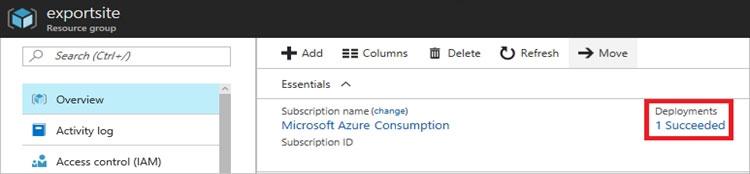
2. You see a history of deployments for the group. In your case, the portal probably lists only one deployment. Select this deployment.
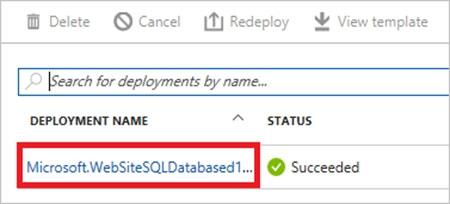
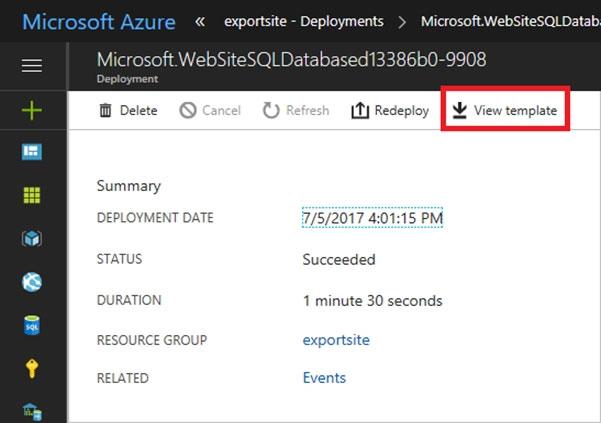
3. The portal displays a summary of the deployment. The summary includes the status of the deployment and its operations and the values that you provided for parameters. To see the template that you used for the deployment, select View template.
Reference:
https://docs.microsoft.com/en-us/azure/azure-resource-manager/resource-manager-export-template
1. Go to the resource group for your new resource group. Notice that the portal shows the result of the last deployment. Select this link.
2. You see a history of deployments for the group. In your case, the portal probably lists only one deployment. Select this deployment.
3. The portal displays a summary of the deployment. The summary includes the status of the deployment and its operations and the values that you provided for parameters. To see the template that you used for the deployment, select View template.
Reference:
https://docs.microsoft.com/en-us/azure/azure-resource-manager/resource-manager-export-template
QUESTION 15
Note: The question is included in a number of questions that depicts the identical set-up. However, every question has a distinctive result. Establish if the solution satisfies the requirements.
Your company has an azure subscription that includes a storage account, a resource group, a blob container and a file share.
A colleague named Jon Ross makes use of a solitary Azure Resource Manager (ARM) template to deploy a virtual machine and an additional Azure Storage account.
You want to review the ARM template that was used by Jon Ross.
Solution: You access the Container blade.
Does the solution meet the goal?
Show answer & explanation
Correct answer: B
ExplanationYou should use the Resource Group blade
Reference:
https://docs.microsoft.com/en-us/azure/azure-resource-manager/resource-manager-export-template
Reference:
https://docs.microsoft.com/en-us/azure/azure-resource-manager/resource-manager-export-template
QUESTION 16
Your company has three virtual machines (VMs) that are included in an availability set.
You try to resize one of the VMs, which returns an allocation failure message.
It is imperative that the VM is resized.
Which of the following actions should you take?
Show answer & explanation
Correct answer: C
ExplanationIf the VM you wish to resize is part of an availability set, then you must stop all VMs in the availability set before changing the size of any VM in the availability set.
The reason all VMs in the availability set must be stopped before performing the resize operation to a size that requires different hardware is that all running VMs in the availability set must be using the same physical hardware cluster. Therefore, if a change of physical hardware cluster is required to change the VM size then all VMs must be first stopped and then restarted one-by-one to a different physical hardware clusters.
Reference:
https://azure.microsoft.com/es-es/blog/resize-virtual-machines/
QUESTION 17
You have an Azure virtual machine (VM) that has a single data disk. You have been tasked with attaching this data disk to another Azure VM.
You need to make sure that your strategy allows for the virtual machines to be offline for the least amount of time possible.
Which of the following is the action you should take FIRST?
Show answer & explanation
Correct answer: C
ExplanationStopping is unnecessary - so why even take the VM offline in the first place. Detaching the disk from the source VM is enough.
QUESTION 18
Your company has an Azure subscription.
You need to deploy a number of Azure virtual machines (VMs) using Azure Resource Manager (ARM) templates. You have been informed that the VMs will be included in a single availability set.
You are required to make sure that the ARM template you configure allows for as many VMs as possible to remain accessible in the event of fabric failure or maintenance.
Which of the following is the value that you should configure for the platformFaultDomainCount property?
Show answer & explanation
Correct answer: D
ExplanationThe number of fault domains for managed availability sets varies by region - either two or three per region.
Reference:
https://docs.microsoft.com/en-us/azure/virtual-machines/windows/manage-availability
Reference:
https://docs.microsoft.com/en-us/azure/virtual-machines/windows/manage-availability
QUESTION 19
Your company has an Azure subscription.
You need to deploy a number of Azure virtual machines (VMs) using Azure Resource Manager (ARM) templates. You have been informed that the VMs will be included in a single availability set.
You are required to make sure that the ARM template you configure allows for as many VMs as possible to remain accessible in the event of fabric failure or maintenance.
Which of the following is the value that you should configure for the platformUpdateDomainCount property?
Show answer & explanation
Correct answer: B
Explanation'Each virtual machine in your availability set is assigned an update domain and a fault domain by the underlying Azure platform. Each availability set can be configured with up to three fault domains and twenty update domains.' https://docs.microsoft.com/en-us/azure/virtual-machines/availability-set-overview
QUESTION 20
DRAG DROP -
You have downloaded an Azure Resource Manager (ARM) template to deploy numerous virtual machines (VMs). The ARM template is based on a current VM, but must be adapted to reference an administrative password.
You need to make sure that the password cannot be stored in plain text.
You are preparing to create the necessary components to achieve your goal.
Which of the following should you create to achieve your goal? Answer by dragging the correct option from the list to the answer area.
Select and Place:
Item 1
Item 2
Show answer & explanation
Correct answer: Item 1: A · Item 2: D
Explanation1. An Azure Key Vault: you can store the administrative password in an Azure Key Vault, which provides secure storage and management of cryptographic keys, certificates, and secrets. Storing the password in a Key Vault ensures that it is not stored in plain text and provides an additional layer of security to protect the password.2. An access policy: You should create an access policy to control access to the Key Vault secrets. An access policy specifies who can perform operations on the secrets stored in the Key Vault. You can grant permissions to users, applications, and services to access the Key Vault and its secrets, and you can specify the level of access that they have. By creating an access policy, you can control who has access to the administrative password and ensure that it is used only by authorized entities.Therefore, to achieve your goal, you should create an Azure Key Vault to store the administrative password, and an access policy to control access to the Key Vault secrets.
Build a focused AZ-104 practice routine.
Choose AZ-104 in Revizo and work through original, question-by-question practice on your iPhone. Review results, revisit what needs attention and keep your next session tied to one specific certification objective.
Practise AZ-104 with RevizoAZ-104 practice questions.
Is Revizo the official Microsoft exam?
No. Revizo is an independent iPhone app for certification practice. Refer to the provider's official resources for current exam policies and registration.
How should I use these AZ-104 practice questions?
Use the exam code to select the matching certification in Revizo, then build short, focused sessions around the areas you want to review.
Are Revizo questions copied from live examinations?
No. Revizo provides original practice questions for certification study. Use the provider's official objectives, documentation and policies as the source of truth for your preparation.
What should I use alongside AZ-104 practice questions?
Use the current Microsoft objectives, documentation and registration guidance as your source of truth. Revizo is designed to support focused practice, not replace the provider's official materials.
Where can I confirm current AZ-104 requirements?
Check the official Microsoft exam page for the latest objectives, registration details and policies.