Map the official objectives.
Read the current Microsoft objectives and make a short list of the areas you need to revisit before booking AI-200.
MICROSOFT CERTIFICATION STUDY GUIDE
Validates ability to design, build, and implement AI solutions on Azure, with a focus on back-end services, scalable architectures, and the full development lifecycle.
Download Revizo
Validates ability to design, build, and implement AI solutions on Azure, with a focus on back-end services, scalable architectures, and the full development lifecycle.
Exam details are based on the available Microsoft catalogue information. Confirm current requirements with the exam provider before booking.
Use the provider's current objectives as your source of truth, then organise your Revizo sessions around the Microsoft technologies, product capabilities and implementation decisions named in the certification. The AI-200 exam is listed as Multiple choice questions; your starting point should reflect 1+ years of Azure development experience.
Read the current Microsoft objectives and make a short list of the areas you need to revisit before booking AI-200.
Select AI-200 in Revizo and use focused question sessions to test one topic or decision type at a time, rather than relying on a single long cram session.
Use your results to return to incorrect answers, revisit the official material behind them and repeat short AI-200 practice sessions until the gaps are clearer.
FREE PRACTICE PREVIEW
Review each question, its correct answer and any available source explanation before continuing your certification study in Revizo.
Answers & available explanations
QUESTION 1
You maintain multiple versions of a container image in Azure Container Registry.
The production deployment must always run the exact same image build even if tags are changed later.
You need to ensure predictable and immutable image selection during deployment.
What should you do?
Correct answer: D
QUESTION 2
A container in an AKS cluster repeatedly restarts.
Pod events show probe failures, although node-level CPU and memory metrics are normal.
You need to diagnose the cause of the repeating restarts.
What should you do first?
Correct answer: D
QUESTION 3
You develop a message-processing service deployed to Azure Container Apps. The service reads messages from an Azure Service Bus queue.
The solution must minimize costs by ensuring NO compute resources are consumed when the queue is empty.
You need to configure scaling for the service.
Which two actions should you perform? Each correct answer presents part of the solution.
NOTE: Each correct selection is worth one point.
Correct answer: B, C
QUESTION 4
You configure ACR Tasks to automate image builds.
Container images must rebuild when:
Application updates occur.
Base image updates occur, such as when the underlying OS image is updated.
Regular scheduled rebuilds are required.
You need to configure ACR Tasks to support automated image rebuilds.
Which three triggers should you configure? Each correct answer presents part of the solution.
NOTE: Each correct selection is worth one point.
Correct answer: A, B, D
QUESTION 5
DRAG DROP -
You are developing several microservices to run on Azure Container Apps.
The microservices must allow HTTPS access by using a custom domain.
You need to configure the custom domain in Azure Container Apps.
In which order should you perform the actions? To answer, move all actions from the list of actions to the answer area and arrange them in the correct order.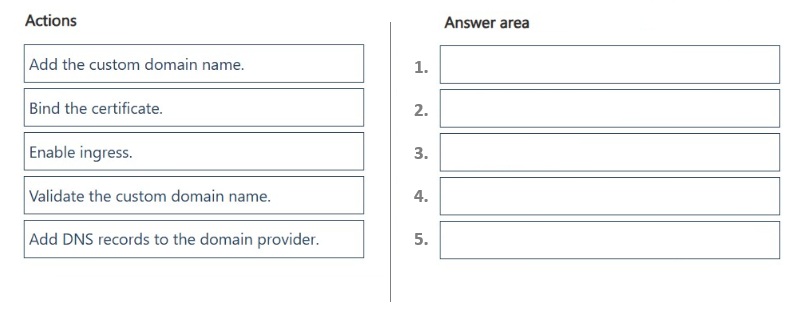
Correct answer: Item 1: C · Item 2: A · Item 3: E · Item 4: D · Item 5: B
QUESTION 6
You plan to deploy an Azure Container app.
You need to configure the container app to support session affinity.
Which ingress type and revision mode should you assign to the container app?
Correct answer: D
QUESTION 7
DRAG DROP
-
You deploy an API to Azure Container Apps.
The solution must provide the following functionality:
• Support the concurrent activation of multiple application versions.
• Allocate a specific percentage of incoming requests to a secondary version.
You need to configure revision behavior.
Which configurations should you use? To answer, move the appropriate configurations to the correct requirements. You may use each configuration once, more than once, or not at all. You may need to move the split bar between panes or scroll to view content.
NOTE: Each correct selection is worth one point.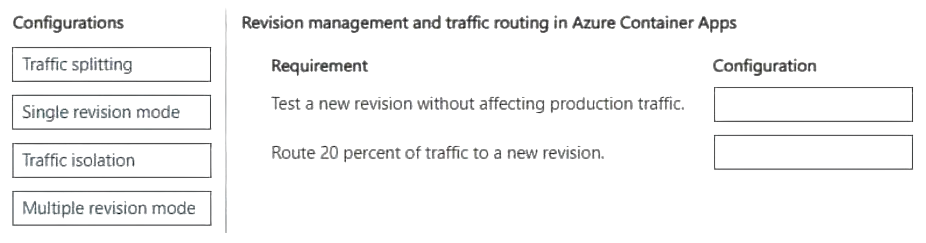
Correct answer: Item 1: D · Item 2: A
QUESTION 8
DRAG DROP
-
You plan to create a Docker image that runs an ASP.NET Core application named ContosoApp. You have a setup script named setupScript.ps1 and a series of application files including ContosoApp.dll.
You need to create a Dockerfile document that meets the following requirements:
• Call setupScript.ps1 when the container is built.
• Run ContosoApp.dll when the container starts.
The Dockerfile document must be created in the same folder where ContosoApp.dll and setupScript.ps1 are stored.
Which five commands should you use to develop the solution? To answer, move the appropriate commands from the list of commands to the answer area and arrange them in the correct order.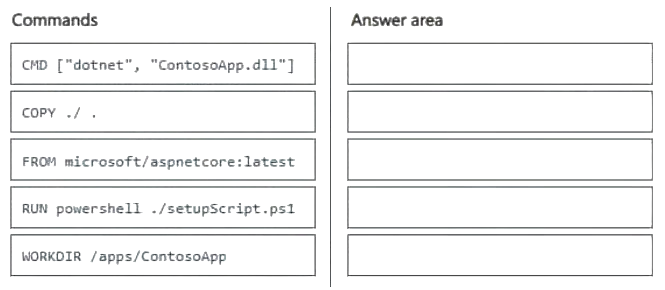
Correct answer: Item 1: C · Item 2: E · Item 3: B · Item 4: D · Item 5: A
QUESTION 9
DRAG DROP
-
You are preparing a container image for deployment to production.
The container image build and deployment process must ensure the following:
• The image is uniquely versioned.
• Secure authentication is used when pushing the image to Azure Container Registry (ACR).
• The image is stored in ACR for deployment.
You need to ensure that the container image build-and-push process meets the requirements.
Which action should you perform for each requirement? To answer, move the appropriate actions to the correct requirements. You may use each action once, more than once, or not at all. You may need to move the split bar between panes or scroll to view content.
NOTE: Each correct selection is worth one point.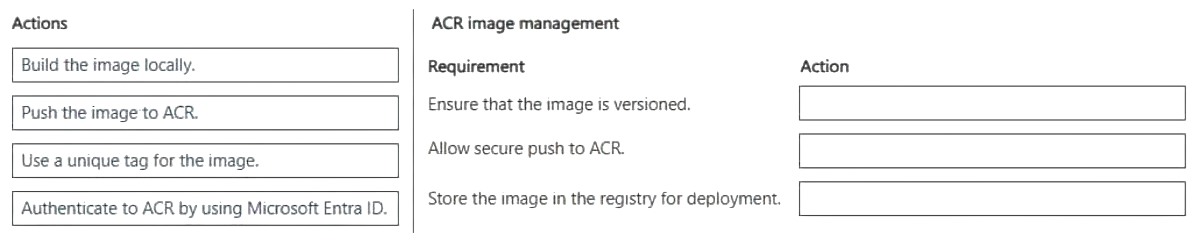
Correct answer: Item 1: C · Item 2: D · Item 3: B
QUESTION 10
DRAG DROP
-
You plan to deploy a web application to AKS.
The solution must:
• Scale out the application by adding more pods during peak CPU usage.
• Expose the application internally within the cluster only.
You need to configure a Kubernetes resource for each requirement.
Which resources should you configure? To answer, move the appropriate resources to the correct requirements. You may use each resource once, more than once, or not at all. You may need to move the split bar between panes or scroll to view content.
NOTE: Each correct selection is worth one point.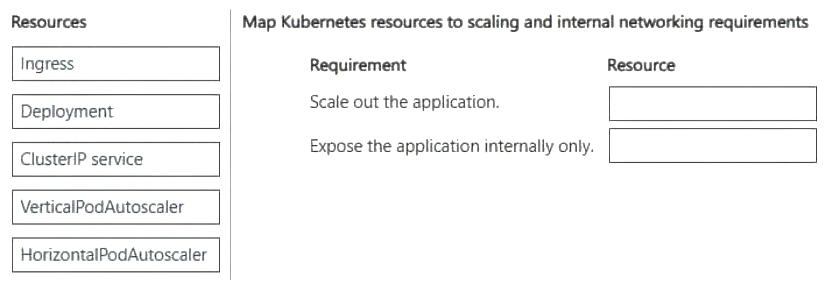
Correct answer: Item 1: E · Item 2: C
QUESTION 11
You deploy a new revision of an app in ACA.
You need to gradually shift production traffic to the revision while monitoring performance. In addition, you need to be able to quickly roll back.
Which two actions should you perform? Each correct answer presents part of the solution.
NOTE: Each correct selection is worth one point.
Correct answer: C, E
QUESTION 12
HOTSPOT
-
You plan to deploy an Azure Container Apps app named App1. App1 will use an access key to connect to a backend API.
The solution must store the key outside of the App1 environment and minimize maintenance efforts.
You need to configure secure key storage for App1.
Which configurations should you use? To answer, select the appropriate options in the answer area.
NOTE: Each correct selection is worth one point.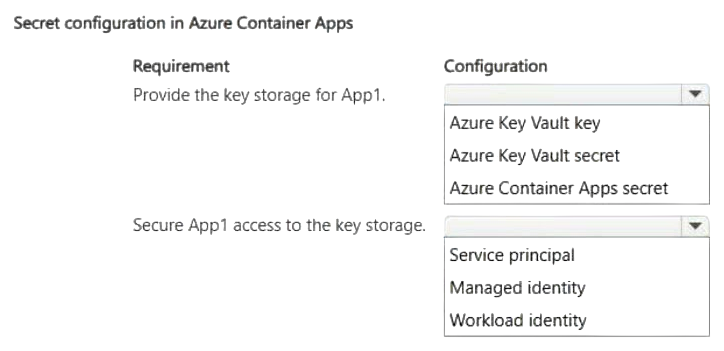
Correct answer: Item 1: B · Item 2: B
QUESTION 13
You have container source code stored in a Git repository.
The container registry must automatically build and store a new container image whenever a developer commits code to the Git repository.
You must minimize the use of an external build infrastructure.
You need to configure Azure Container Registry (ACR) to manage the build process natively and automatically.
Which two ACR components should you use? Each correct answer presents part of the solution.
NOTE: Each correct selection is worth one point.
Correct answer: A, D
QUESTION 14
DRAG DROP
-
You have an existing AKS cluster and a container image stored in Azure Container Registry.
You must deploy a new version without interrupting traffic.
You need to perform a rolling update by using a manifest file.
Which three actions should you perform in sequence? To answer, move the appropriate actions from the list of actions to the answer area and arrange them in the correct order.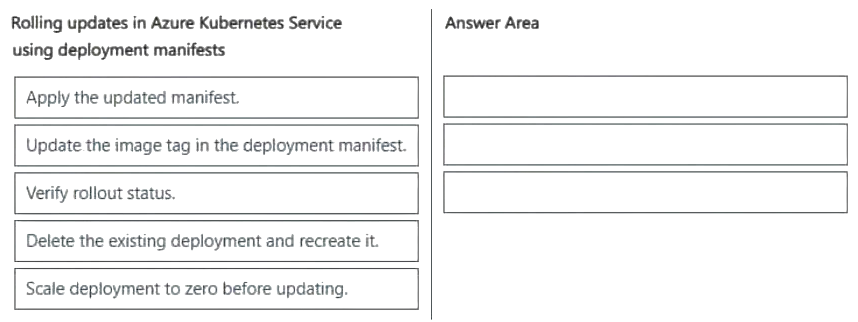
Correct answer: Item 1: B · Item 2: A · Item 3: C
QUESTION 15
DRAG DROP
-
You are deploying an AI service to ACA.
The service must retrieve secrets securely from Key Vault by using managed identity.
You need to configure secure access.
Which three actions should you perform in sequence? To answer, move the appropriate actions from the list of actions to the answer area and arrange them in the correct order.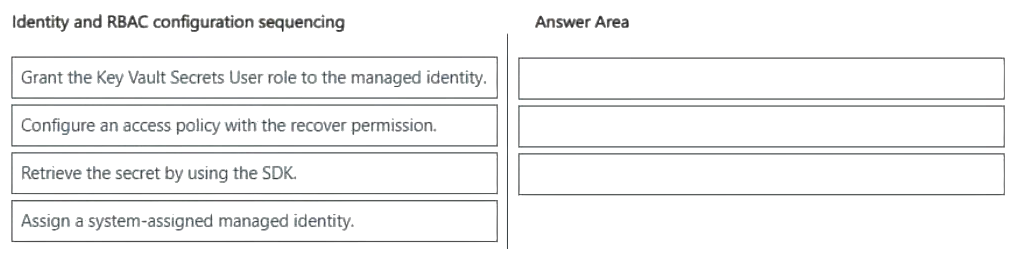
Correct answer: Item 1: D · Item 2: A · Item 3: C
QUESTION 16
HOTSPOT
-
This is a case study. Case studies are not timed separately from other exam sections. You can use as much exam time as you would like to complete each case study. However, there might be additional case studies or other exam sections. Manage your time to ensure that you can complete all the exam sections in the time provided. Pay attention to the Exam Progress at the top of the screen so you have sufficient time to complete any exam sections that follow this case study.
To answer the case study questions, you will need to reference information that is provided in the case. Case studies and associated questions might contain exhibits or other resources that provide more information about the scenario described in the case. Information provided in an individual question does not apply to the other questions in the case study.
A Review Screen will appear at the end of this case study. From the Review Screen, you can review and change your answers before you move to the next exam section. After you leave this case study, you will NOT be able to return to it.
To start the case study
-
To display the first question in this case study, select the 'Next' button. To the left of the question, a menu provides links to information such as business requirements, the existing environment, and problem statements. Please read through all this information before answering any questions. When you are ready to answer a question, select the 'Question' button to return to the question.
Background
-
Fabrikam Inc. is a global retail analytics company that provides AI-driven demand forecasting and product recommendation services to online retailers. The company is modernizing its solution to run entirely on Microsoft Azure.
The platform ingests transaction data, generates embeddings for semantic retrieval, performs vector similarity search, and returns product recommendations through containerized microservices. Developers use Python and Azure SDKs. Operations teams manage container orchestration, scaling, monitoring, and security.
The solution must meet strict performance, scalability, and security requirements.
Current environment
-
Application architecture
-
• The Recommendation engine is a customer-facing HTTP API running as a containerized Python application. The engine is deployed to Azure Container Apps (ACA).
• Embeddings are stored in Azure Database for PostgreSQL by using pgvector.
• Semantic retrieval uses metadata filtering combined with vector similarity search.
• Azure Managed Redis is used as a caching layer.
• Front-end and API workloads are deployed to Azure Container Apps (ACA).
• Batch model retraining workloads run in Azure Kubernetes Service (AKS).
Container and CI/CD
-
• Container images are stored in Azure Container Registry (ACR).
• CI/CD uses ACR Tasks to build images on commit.
• ACA environments support revision management.
• AKS workloads are deployed by using Kubernetes manifest files stored in Git.
Monitoring
-
• Logs are collected in Azure Monitor.
• Teams inspect container logs and Kubernetes events when troubleshooting.
• Developers write KQL queries to analyze latency spikes.
Business requirements
-
Customer experience: Maintain a seamless, low-latency recommendation experience for end-users, even during unpredictable seasonal traffic spikes.
Operational cost efficiency: Minimize compute expenditures by deallocating resources during periods of inactivity and by preventing runaway scaling costs.
Data integrity and freshness: Ensure that product recommendations always reflect the most current catalog metadata and pricing to prevent customer dissatisfaction.
Security and compliance: Adhere to a Zero Trust security model by eliminating long-lived credentials and centralizing the management of all sensitive secrets.
Global scalability: Support the rapid ingestion of millions of new product embeddings daily without degrading query performance for existing retailers.
Technical requirements
-
Performance: Semantic search latency must remain under 200 milliseconds at peak load.
Database optimization: Use pgvector for embeddings and implement metadata filtering to reduce compute overhead. Configure compute and memory appropriately for vector workloads to ensure high-dimensional index residency in RAM and efficient mathematical throughput. Vector similarity calculations must be performed only against products that satisfy mandatory metadata constraints.
Database performance: Database connections must support high concurrency with minimal latency through the implementation of connection optimization.
Data load strategy: To ensure maximum ingestion throughput, secondary indexes must be applied only after bulk loading of embeddings is complete.
Caching: Redis cache entries must expire automatically after 10 minutes. Implement a reactive mechanism to invalidate cache entries upon metadata updates.
Identity: Use managed identities for all service-to-service and service-to-database authentication. Plain-text credentials in configuration files are strictly prohibited.
Secret management: All secrets must be stored centrally. Secrets must be rotated automatically by using a centralized lifecycle policy.
Scaling: Use Kubernetes event-driven autoscaling (KEDA) for event-driven scaling. The Recommendation API must scale based on HTTP traffic, while batch jobs must scale based on queue length and support scale-to-zero.
CI/CD: All images must be stored in Azure Container Registry. Use ACR Tasks to automate image builds triggered by source code commits.
Monitoring: Use KQL to analyze performance telemetry and troubleshoot microservice connectivity failures. Inspect logs and events when troubleshooting AKS and ACA.
You need to configure the database resources for the Azure Database for PostgreSQL instance.
How should you complete the configuration to meet the business and technical requirements? To answer, select the appropriate options in the answer area.
NOTE: Each correct selection is worth one point.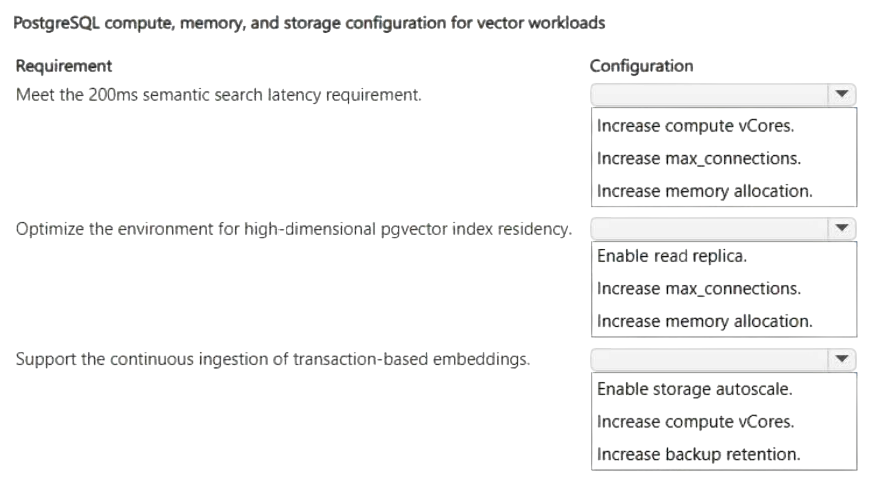
Correct answer: Item 1: A · Item 2: C · Item 3: A
QUESTION 17
HOTSPOT
-
This is a case study. Case studies are not timed separately from other exam sections. You can use as much exam time as you would like to complete each case study. However, there might be additional case studies or other exam sections. Manage your time to ensure that you can complete all the exam sections in the time provided. Pay attention to the Exam Progress at the top of the screen so you have sufficient time to complete any exam sections that follow this case study.
To answer the case study questions, you will need to reference information that is provided in the case. Case studies and associated questions might contain exhibits or other resources that provide more information about the scenario described in the case. Information provided in an individual question does not apply to the other questions in the case study.
A Review Screen will appear at the end of this case study. From the Review Screen, you can review and change your answers before you move to the next exam section. After you leave this case study, you will NOT be able to return to it.
To start the case study
-
To display the first question in this case study, select the 'Next' button. To the left of the question, a menu provides links to information such as business requirements, the existing environment, and problem statements. Please read through all this information before answering any questions. When you are ready to answer a question, select the 'Question' button to return to the question.
Background
-
Fabrikam Inc. is a global retail analytics company that provides AI-driven demand forecasting and product recommendation services to online retailers. The company is modernizing its solution to run entirely on Microsoft Azure.
The platform ingests transaction data, generates embeddings for semantic retrieval, performs vector similarity search, and returns product recommendations through containerized microservices. Developers use Python and Azure SDKs. Operations teams manage container orchestration, scaling, monitoring, and security.
The solution must meet strict performance, scalability, and security requirements.
Current environment
-
Application architecture
-
• The Recommendation engine is a customer-facing HTTP API running as a containerized Python application. The engine is deployed to Azure Container Apps (ACA).
• Embeddings are stored in Azure Database for PostgreSQL by using pgvector.
• Semantic retrieval uses metadata filtering combined with vector similarity search.
• Azure Managed Redis is used as a caching layer.
• Front-end and API workloads are deployed to Azure Container Apps (ACA).
• Batch model retraining workloads run in Azure Kubernetes Service (AKS).
Container and CI/CD
-
• Container images are stored in Azure Container Registry (ACR).
• CI/CD uses ACR Tasks to build images on commit.
• ACA environments support revision management.
• AKS workloads are deployed by using Kubernetes manifest files stored in Git.
Monitoring
-
• Logs are collected in Azure Monitor.
• Teams inspect container logs and Kubernetes events when troubleshooting.
• Developers write KQL queries to analyze latency spikes.
Business requirements
-
Customer experience: Maintain a seamless, low-latency recommendation experience for end-users, even during unpredictable seasonal traffic spikes.
Operational cost efficiency: Minimize compute expenditures by deallocating resources during periods of inactivity and by preventing runaway scaling costs.
Data integrity and freshness: Ensure that product recommendations always reflect the most current catalog metadata and pricing to prevent customer dissatisfaction.
Security and compliance: Adhere to a Zero Trust security model by eliminating long-lived credentials and centralizing the management of all sensitive secrets.
Global scalability: Support the rapid ingestion of millions of new product embeddings daily without degrading query performance for existing retailers.
Technical requirements
-
Performance: Semantic search latency must remain under 200 milliseconds at peak load.
Database optimization: Use pgvector for embeddings and implement metadata filtering to reduce compute overhead. Configure compute and memory appropriately for vector workloads to ensure high-dimensional index residency in RAM and efficient mathematical throughput. Vector similarity calculations must be performed only against products that satisfy mandatory metadata constraints.
Database performance: Database connections must support high concurrency with minimal latency through the implementation of connection optimization.
Data load strategy: To ensure maximum ingestion throughput, secondary indexes must be applied only after bulk loading of embeddings is complete.
Caching: Redis cache entries must expire automatically after 10 minutes. Implement a reactive mechanism to invalidate cache entries upon metadata updates.
Identity: Use managed identities for all service-to-service and service-to-database authentication. Plain-text credentials in configuration files are strictly prohibited.
Secret management: All secrets must be stored centrally. Secrets must be rotated automatically by using a centralized lifecycle policy.
Scaling: Use Kubernetes event-driven autoscaling (KEDA) for event-driven scaling. The Recommendation API must scale based on HTTP traffic, while batch jobs must scale based on queue length and support scale-to-zero.
CI/CD: All images must be stored in Azure Container Registry. Use ACR Tasks to automate image builds triggered by source code commits.
Monitoring: Use KQL to analyze performance telemetry and troubleshoot microservice connectivity failures. Inspect logs and events when troubleshooting AKS and ACA.
You need to deploy a batch retraining workload.
How should you complete the scaling configuration? To answer, select the appropriate options in the answer area.
NOTE: Each correct selection is worth one point.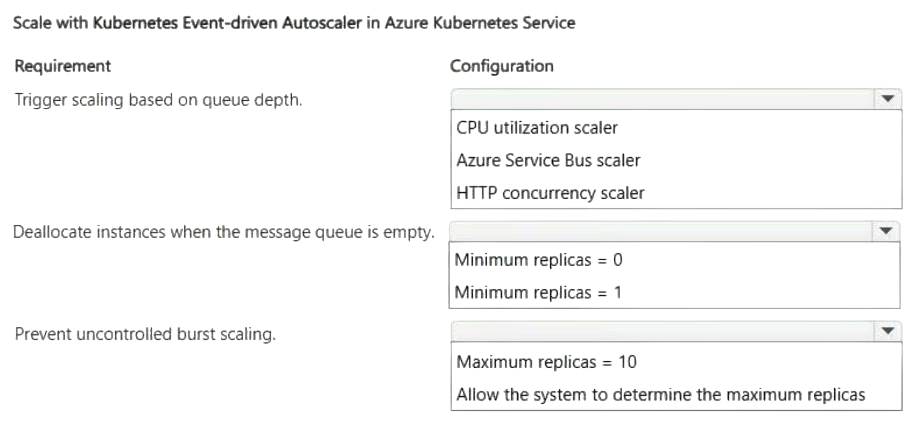
Correct answer: Item 1: B · Item 2: A · Item 3: A
QUESTION 18
HOTSPOT
-
You are developing a microservices-based application that uses Azure Container Apps. The application consists of several containerized services that handle tasks, such as processing orders, managing inventory, and generating reports.
You must secure the container apps. All apps must reside in the same virtual network, share the same Dapr configuration, and share the same logging location.
Apps must support the configuration of the amount of memory and compute resources available to containers.
You need to configure the Azure Container App.
How should you complete the CLI command? To answer, select the appropriate options in the answer area.
NOTE: Each correct selection is worth one point.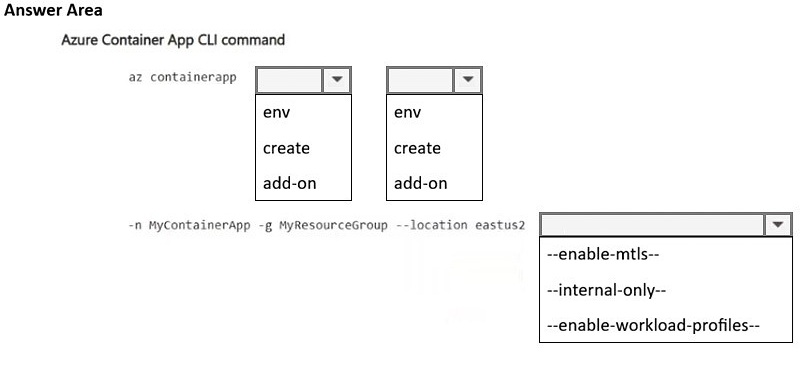
Correct answer: Item 1: A · Item 2: B · Item 3: C
QUESTION 19
DRAG DROP
-
You are designing a solution that will use two Azure Functions apps: App1 and App2. App1 is Windows-based and will be deployed as code. App2 is Linux-based and will be deployed as a container image. Estimates show that the duration of the request processing for both apps will range from 1 to 10 minutes.
You plan to implement App1 and App2 by using the hosting plan to satisfy the following requirements:
• Request processing can complete within the estimated time range.
• The autoscaling behavior is event-driven.
• The upper scaling limit is maximized.
You need to create the hosting plan for the implementation.
Which hosting plan should you create? To answer, move the appropriate hosting plans to the correct apps. You may use each hosting plan once, more than once, or not at all. You may need to move the split bar between panes or scroll to view content.
NOTE: Each correct selection is worth one point.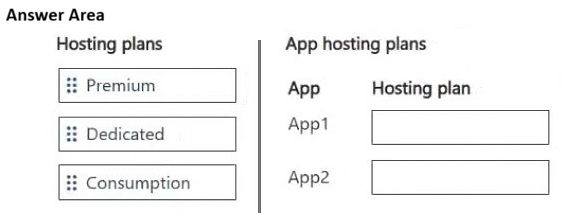
Correct answer: Item 1: C · Item 2: A
QUESTION 20
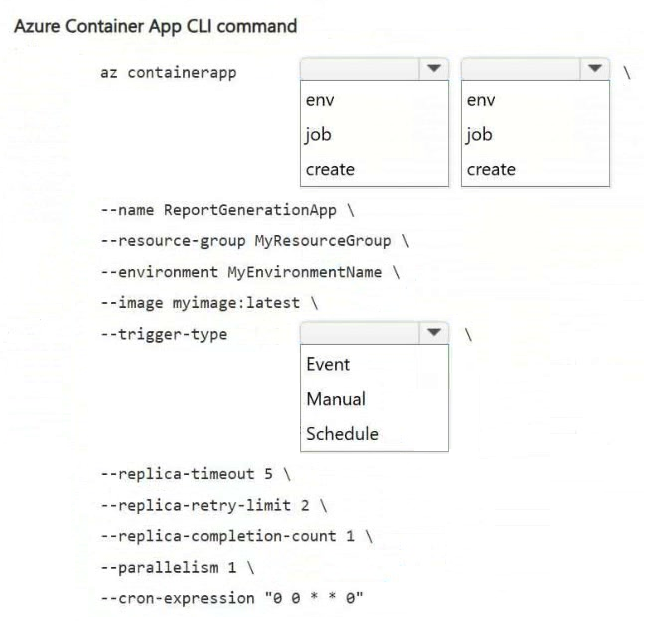
Correct answer: Item 1: B · Item 2: C · Item 3: C
Choose AI-200 in Revizo and work through original, question-by-question practice on your iPhone. Review results, revisit what needs attention and keep your next session tied to one specific certification objective.
Practise AI-200 with RevizoNo. Revizo is an independent iPhone app for certification practice. Refer to the provider's official resources for current exam policies and registration.
Use the exam code to select the matching certification in Revizo, then build short, focused sessions around the areas you want to review.
No. Revizo provides original practice questions for certification study. Use the provider's official objectives, documentation and policies as the source of truth for your preparation.
Use the current Microsoft objectives, documentation and registration guidance as your source of truth. Revizo is designed to support focused practice, not replace the provider's official materials.
Check the official Microsoft exam page for the latest objectives, registration details and policies.