Map the official objectives.
Read the current Microsoft objectives and make a short list of the areas you need to revisit before booking AB-250.
MICROSOFT CERTIFICATION STUDY GUIDE
Validates ability to design, implement, and operate AI-powered contact center solutions using Dynamics 365 Contact Center, including channels, agents, work distribution, representative experience, and analytics.
Download Revizo
Validates ability to design, implement, and operate AI-powered contact center solutions using Dynamics 365 Contact Center, including channels, agents, work distribution, representative experience, and analytics.
Exam details are based on the available Microsoft catalogue information. Confirm current requirements with the exam provider before booking.
Use the provider's current objectives as your source of truth, then organise your Revizo sessions around the Microsoft technologies, product capabilities and implementation decisions named in the certification. The AB-250 exam is listed as Multiple choice and scenario-based questions (single and multiple response); your starting point should reflect Experience as a contact center engineer or solutions professional with Dynamics 365 Contact Center and service-oriented autonomous agents.
Read the current Microsoft objectives and make a short list of the areas you need to revisit before booking AB-250.
Select AB-250 in Revizo and use focused question sessions to test one topic or decision type at a time, rather than relying on a single long cram session.
Use your results to return to incorrect answers, revisit the official material behind them and repeat short AB-250 practice sessions until the gaps are clearer.
FREE PRACTICE PREVIEW
Review each question, its correct answer and any available source explanation before continuing your certification study in Revizo.
Answers & available explanations
QUESTION 1
DRAG DROP -
A company uses security roles to ensure that its customer service representatives (CSRs) have access only to the features and data required to perform their duties.
However, default roles currently grant excessive permissions to CSRs.
The company requires that access be limited as follows:
Reduce permissions to just the features and data that are required for each CSR role.
Allow non-administrators to assign roles to CSRs without full system access.
You need to configure the minimal security access for each requirement.
Which action should you perform first for each requirement? To answer, move the appropriate actions to the correct requirements. You may use each action once, more than once, or not at all. You may need to move the split bar between panes or scroll to view content.
NOTE: Each correct selection is worth one point.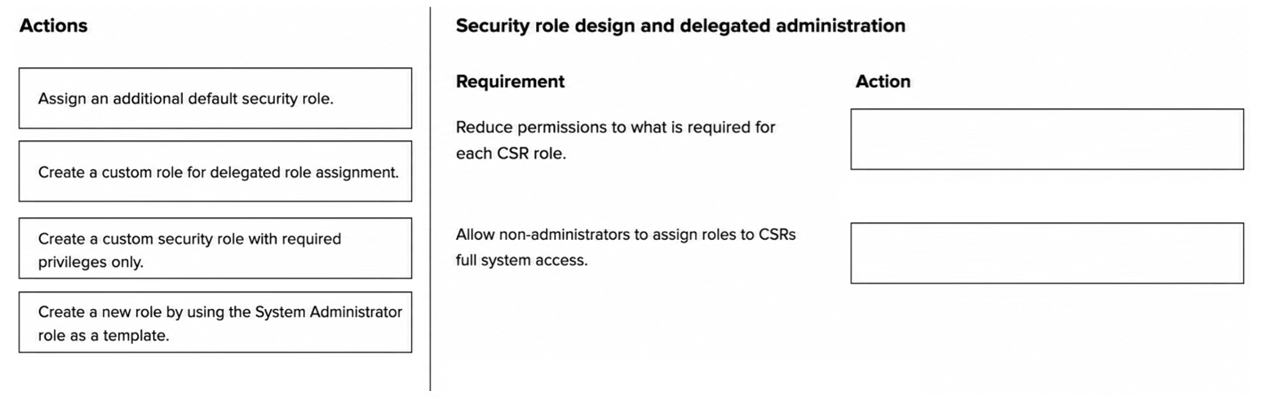
Correct answer: Item 1: C · Item 2: B
QUESTION 2
A company plans to deploy a new customized voice channel from development to test. The voice channel customizations include skills-based routing and a Copilot Studio voice agent.
The deployment package must:
Include only the components needed for the release.
Support controlled import into downstream environments.
You need to prepare to release the voice channel and all supported parts.
What should you do?
Correct answer: A
QUESTION 3
HOTSPOT -
A company wants to move Dynamics 365 Contact Center customizations from a development environment to a test environment.
The company must avoid rebuilding the customizations and hard-coding environment-specific values into the deployment package.
You need to prepare the deployment.
Which actions should you perform? To answer, select the appropriate options in the answer area.
NOTE: Each correct selection is worth one point.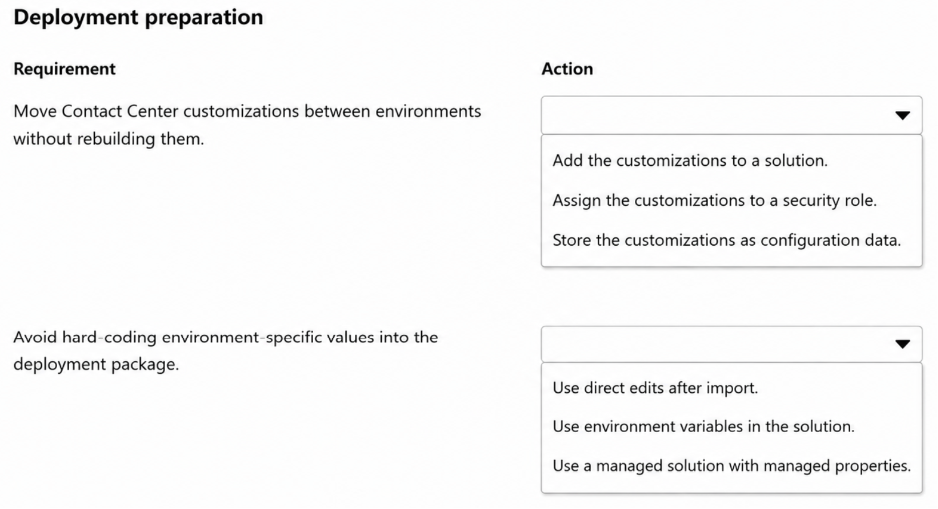
Correct answer: Item 1: A · Item 2: B
QUESTION 4
DRAG DROP -
A company uses separate development and production environments for Dynamics 365 Contact Center. The development environment includes updated communication channels and modified routing behavior for assigning work items to customer service representatives (CSRs).
After recent updates, production does NOT reflect the expected behavior. New interaction entry points are unavailable. Work items are NOT being assigned according to the updated logic.
The company requires a solution that ensures:
Interaction entry points behave consistently between environments.
Work assignment behavior reflects the latest configuration changes.
You need to manage how omnichannel configurations are applied across environments.
Which action should you perform for each requirement? To answer, move the appropriate actions to the correct requirements. You may use each action once, more than once, or not at all. You may need to move the split bar between panes or scroll to view content.
NOTE: Each correct selection is worth one point.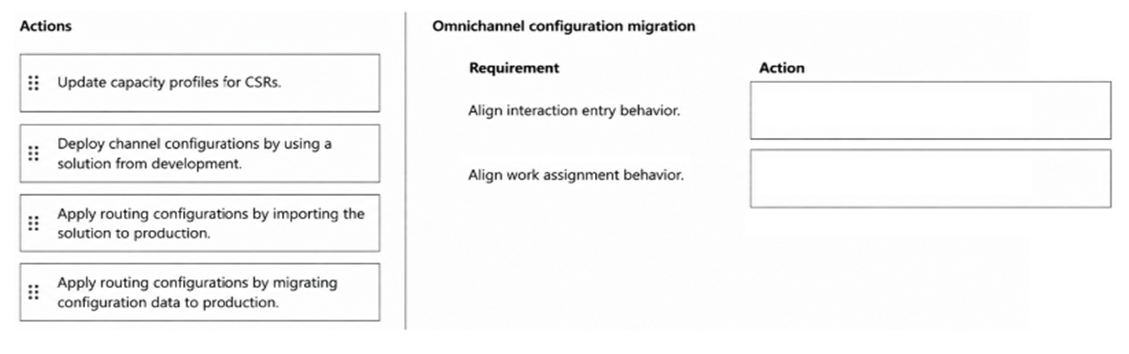
Correct answer: Item 1: B · Item 2: D
QUESTION 5
A company plans to introduce an autonomous AI agent that identifies customer intent to customer service representatives in phases.
The rollout must be controlled and support phased adoption based on business readiness. The rollout must NOT enable the agent for all workloads at the same time.
You need to implement the rollout.
What are two actions you can perform? Each correct answer presents a complete solution.
NOTE: Each correct selection is worth one point.
Correct answer: A, C
QUESTION 6
DRAG DROP -
A company uses separate development, test, and production environments for Dynamics 365 Contact Center.
The company plans to move approved customizations downstream by using a repeatable ALM process. The process must package the changes and restrict direct editing in target environments.
You need to package Contact Center customizations for the deployment process.
Which action should you perform for each requirement? To answer, move the appropriate actions to the correct requirements. You may use each action once, more than once, or not at all. You may need to move the split bar between panes or scroll to view content.
NOTE: Each correct selection is worth one point.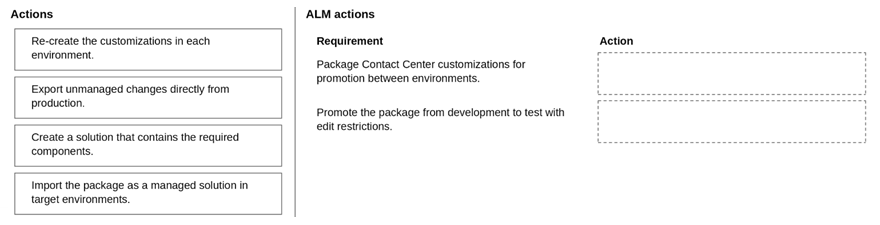
Correct answer: Item 1: C · Item 2: D
QUESTION 7
A company synchronizes users from Microsoft Entra ID to the Dynamics 365 Contact Center environment.
Some users who have Microsoft Entra IDs cannot access Contact Center features.
You need to enable access for the users with the right permissions needed for Contact Center.
What should you do?
Correct answer: D
QUESTION 8
A company uses a third-party CRM as its primary system.
Customer service representatives must use Dynamics 365 Contact Center features without leaving the CRM system.
You need to set up Contact Center to meet the requirement.
What should you do?
Correct answer: B
QUESTION 9
DRAG DROP -
A company creates custom security roles for service representatives.
Users in the same job function must have consistent permissions. One individual requires access aligned to that individual's persona.
You need to configure access for the users.
Which actions should you perform? To answer, move the appropriate actions to the correct requirements. Each action may be used once, more than once, or not at all. You may need to move the split bar between panes or scroll to view content.
NOTE: Each correct selection is worth one point.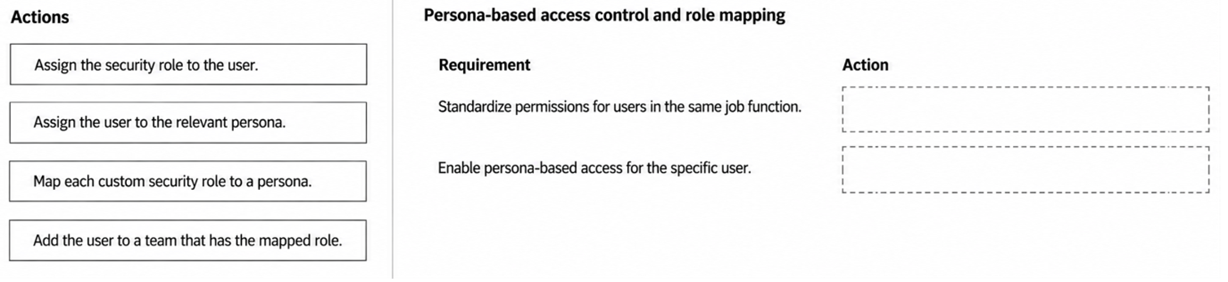
Correct answer: Item 1: C · Item 2: B
QUESTION 10
A company uses Dynamics 365 Customer Service to manage knowledge articles.
The company deploys a customer self-service portal.
Customers report that they cannot find any knowledge articles in the portal. Customer service representatives can access articles internally.
Customers must be able to access knowledge articles. The solution must:
Ensure knowledge articles are visible in the portal.
Ensure only approved and published content is exposed.
Avoid exposing draft or internal-only articles.
You need to ensure that knowledge articles are available in the portal according to the requirements.
Which two actions should you perform? Each correct answer presents part of the solution.
Correct answer: B, D
QUESTION 11
This is a case study. Case studies are not timed separately from other exam sections. You can use as much exam time as you would like to complete each case study. However, there might be additional case studies or other exam sections. Manage your time to ensure that you can complete all the exam sections in the time provided. Pay attention to the Exam Progress at the top of the screen so you have sufficient time to complete any exam sections that follow this case study.
To answer the case study questions, you will need to reference information that is provided in the case. Case studies and associated questions might contain exhibits or other resources that provide more information about the scenario described in the case. Information provided in an individual question does not apply to the other questions in the case study.
A Review Screen will appear at the end of this case study. From the Review Screen, you can review and change your answers before you move to the next exam section. After you leave this case study, you will NOT be able to return to it.
To start the case study.
To display the first question in this case study, select the 'Next' button. To the left of the question, a menu provides links to information such as business requirements, the existing environment, and problem statements. Please read through all this information before answering any questions. When you are ready to answer a question, select the 'Question' button to return to the question.
Background -
Fabrikam, Inc. is a mid-sized global company that provides outsourced customer support services for retail and telecommunications clients. The company operates multiple regional contact centers. Fabrikam, Inc. is transitioning to a unified cloud-based platform by implementing Microsoft Dynamics 365 Contact Center.
The goal is to improve customer satisfaction, reduce average handling time, and increase workforce productivity while enabling AI-assisted customer interactions.
Fabrikam, Inc. has an established Microsoft ecosystem, including Microsoft Azure and Microsoft Power Platform. The company requires that all implementations follow best practices for scalability, maintainability, and governance, while aligning with internal governance and security standards.
Current environment -
Contact Center infrastructure -
• Fabrikam, Inc. currently uses an outdated on-premises telephony system that does NOT integrate with modern CRM systems.
• The company is migrating to Dynamics 365 Contact Center to support voice-based interactions.
• Azure resources are centrally managed by the IT team.
• Azure Application Insights is provisioned but not yet connected to any contact center workload.
• Microsoft Entra ID is used for identity and access management.
Application lifecycle management (ALM)
• The company maintains separate development, test, and production environments in Microsoft Dataverse.
• Solutions are deployed as managed or unmanaged depending on the environment.
• Configuration data must be moved between environments without manual recreation.
• The IT team requires repeatable and governed deployment processes.
Users and roles -
• Customer service representatives (CSRs) handle inbound customer calls.
• Supervisors monitor performance and manage workforce scheduling.
• Administrators configure and maintain the system.
• Roles are defined for CSRs, supervisors, and administrators, but permissions are not consistently enforced.
• Access must be restricted based on user responsibilities to enforce least privilege.
Business requirements -
Voice channel -
• Customers must be able to contact customer support through an inbound voice channel.
• Incoming calls must be routed to available CSRs based on predefined criteria.
• Customer input must be collected through an automated interaction before routing.
• Some inquiries must be resolved without involving a human representative.
• When escalation is required, CSRs must receive relevant information collected earlier in the interaction.
Workforce management (WFM)
• Supervisors must define shifts and assign schedules for CSRs.
• CSRs must receive interactions during their scheduled shifts only.
• Some shifts must allow for times that do NOT accept phone calls.
• WFM capabilities must be enabled within the contact center solution.
AI and automation -
• The solution must support AI-driven capabilities to handle frequently asked customer questions.
• The system must support generative AI for natural, conversational interactions.
• When an issue cannot be resolved automatically, escalation paths must be defined.
Routing and work assignment -
• Customer interactions must be managed through a structured process to ensure consistent handling.
• Information collected during the voice agent interactions must be available to CSRs.
• CSRs must be assigned to handle interactions based on their expertise.
Analytics and monitoring -
• The company must monitor conversation performance and identify and troubleshoot issues affecting customer experience.
• The solution must provide detailed diagnostic information to support troubleshooting across the interaction lifecycle.
• Supervisors must be able to analyze interaction quality and identify trends and bottlenecks.
Technical requirements -
Voice channel configuration -
• Dynamics 365 Contact Center must be used to support voice-based customer interactions.
• The solution must support inbound calling through configured phone numbers.
• Voice interactions must be routed in a way that follows best practices for scalability and consistent performance.
IVR and voice agents -
• IVR flows must support both naturally spoken input and keypad input.
• Voice agents must be configured by using Copilot Studio.• AI agents must be able to retrieve customer data from backend systems when needed.
Security and access -
• Access must be restricted based on user responsibilities and follow the principle of least privilege.
• CSRs must access records relevant to only the interactions they handle.
• Supervisors must have visibility into CSR performance and schedules.
• Administrators must have full access to configure and manage the solution.
ALM and deployment -
• Production deployments must use managed solutions.
• Configuration data must be moved between environments by using supported tools and without manual recreation.
• Deployment processes should be automated to ensure consistency and reliability.
Issues -
• The current system lacks integration between voice interactions and CRM systems.• CSRs receive calls outside of their scheduled shifts.• Fabrikam, Inc. has no consistent process for deploying configurations across environments.• AI capabilities are underused, resulting in increased interaction volumes.• Some customers interact from a noisy environment, which makes it difficult for CSRs and agents to serve them efficiently.• Supervisors lack visibility into detailed conversation diagnostics.• Access permissions are not consistently aligned with user responsibilities, causing access inconsistencies.
You need to resolve inconsistent access across user personas.
What should you do?
Correct answer: B
QUESTION 12
DRAG DROP -
This is a case study. Case studies are not timed separately from other exam sections. You can use as much exam time as you would like to complete each case study. However, there might be additional case studies or other exam sections. Manage your time to ensure that you can complete all the exam sections in the time provided. Pay attention to the Exam Progress at the top of the screen so you have sufficient time to complete any exam sections that follow this case study.
To answer the case study questions, you will need to reference information that is provided in the case. Case studies and associated questions might contain exhibits or other resources that provide more information about the scenario described in the case. Information provided in an individual question does not apply to the other questions in the case study.
A Review Screen will appear at the end of this case study. From the Review Screen, you can review and change your answers before you move to the next exam section. After you leave this case study, you will NOT be able to return to it.
To start the case study.
To display the first question in this case study, select the 'Next' button. To the left of the question, a menu provides links to information such as business requirements, the existing environment, and problem statements. Please read through all this information before answering any questions. When you are ready to answer a question, select the 'Question' button to return to the question.
Background -
Fabrikam, Inc. is a mid-sized global company that provides outsourced customer support services for retail and telecommunications clients. The company operates multiple regional contact centers. Fabrikam, Inc. is transitioning to a unified cloud-based platform by implementing Microsoft Dynamics 365 Contact Center.
The goal is to improve customer satisfaction, reduce average handling time, and increase workforce productivity while enabling AI-assisted customer interactions.
Fabrikam, Inc. has an established Microsoft ecosystem, including Microsoft Azure and Microsoft Power Platform. The company requires that all implementations follow best practices for scalability, maintainability, and governance, while aligning with internal governance and security standards.
Current environment -
Contact Center infrastructure -
• Fabrikam, Inc. currently uses an outdated on-premises telephony system that does NOT integrate with modern CRM systems.
• The company is migrating to Dynamics 365 Contact Center to support voice-based interactions.
• Azure resources are centrally managed by the IT team.
• Azure Application Insights is provisioned but not yet connected to any contact center workload.
• Microsoft Entra ID is used for identity and access management.
Application lifecycle management (ALM)
• The company maintains separate development, test, and production environments in Microsoft Dataverse.
• Solutions are deployed as managed or unmanaged depending on the environment.
• Configuration data must be moved between environments without manual recreation.
• The IT team requires repeatable and governed deployment processes.
Users and roles -
• Customer service representatives (CSRs) handle inbound customer calls.
• Supervisors monitor performance and manage workforce scheduling.
• Administrators configure and maintain the system.
• Roles are defined for CSRs, supervisors, and administrators, but permissions are not consistently enforced.
• Access must be restricted based on user responsibilities to enforce least privilege.
Business requirements -
Voice channel -
• Customers must be able to contact customer support through an inbound voice channel.
• Incoming calls must be routed to available CSRs based on predefined criteria.
• Customer input must be collected through an automated interaction before routing.
• Some inquiries must be resolved without involving a human representative.
• When escalation is required, CSRs must receive relevant information collected earlier in the interaction.
Workforce management (WFM)
• Supervisors must define shifts and assign schedules for CSRs.
• CSRs must receive interactions during their scheduled shifts only.
• Some shifts must allow for times that do NOT accept phone calls.
• WFM capabilities must be enabled within the contact center solution.
AI and automation -
• The solution must support AI-driven capabilities to handle frequently asked customer questions.
• The system must support generative AI for natural, conversational interactions.
• When an issue cannot be resolved automatically, escalation paths must be defined.
Routing and work assignment -
• Customer interactions must be managed through a structured process to ensure consistent handling.
• Information collected during the voice agent interactions must be available to CSRs.
• CSRs must be assigned to handle interactions based on their expertise.
Analytics and monitoring -
• The company must monitor conversation performance and identify and troubleshoot issues affecting customer experience.
• The solution must provide detailed diagnostic information to support troubleshooting across the interaction lifecycle.
• Supervisors must be able to analyze interaction quality and identify trends and bottlenecks.
Technical requirements -
Voice channel configuration -
• Dynamics 365 Contact Center must be used to support voice-based customer interactions.
• The solution must support inbound calling through configured phone numbers.
• Voice interactions must be routed in a way that follows best practices for scalability and consistent performance.
IVR and voice agents -
• IVR flows must support both naturally spoken input and keypad input.
• Voice agents must be configured by using Copilot Studio.• AI agents must be able to retrieve customer data from backend systems when needed.
Security and access -
• Access must be restricted based on user responsibilities and follow the principle of least privilege.
• CSRs must access records relevant to only the interactions they handle.
• Supervisors must have visibility into CSR performance and schedules.
• Administrators must have full access to configure and manage the solution.
ALM and deployment -
• Production deployments must use managed solutions.
• Configuration data must be moved between environments by using supported tools and without manual recreation.
• Deployment processes should be automated to ensure consistency and reliability.
Issues -
• The current system lacks integration between voice interactions and CRM systems.• CSRs receive calls outside of their scheduled shifts.• Fabrikam, Inc. has no consistent process for deploying configurations across environments.• AI capabilities are underused, resulting in increased interaction volumes.• Some customers interact from a noisy environment, which makes it difficult for CSRs and agents to serve them efficiently.• Supervisors lack visibility into detailed conversation diagnostics.• Access permissions are not consistently aligned with user responsibilities, causing access inconsistencies.
You need to deploy configuration changes across environments based on the technical requirements.
Which three actions should you perform in sequence? To answer, move the appropriate actions from the list of actions to the answer area and arrange them in the correct order.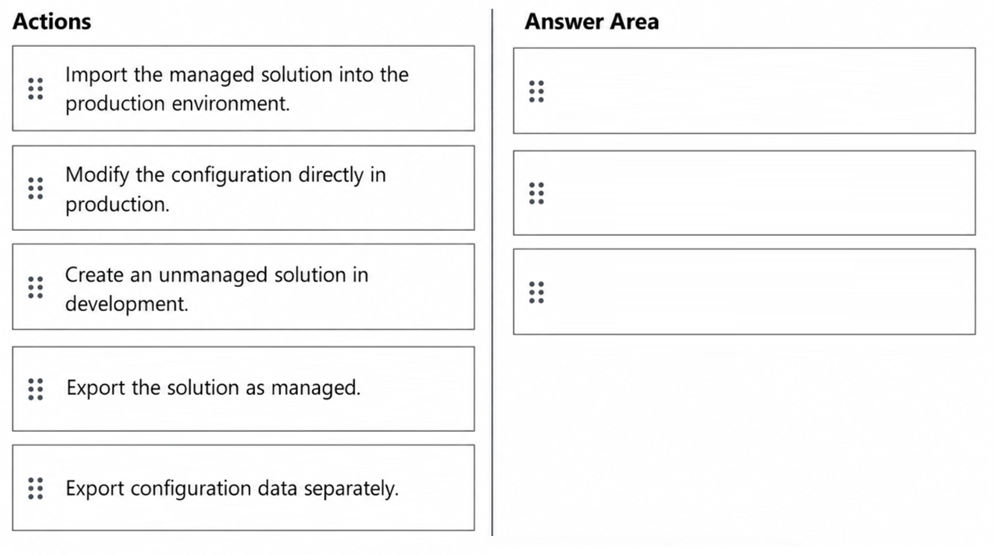
Correct answer: Item 1: C · Item 2: D · Item 3: A
QUESTION 13
DRAG DROP -
This is a case study. Case studies are not timed separately from other exam sections. You can use as much exam time as you would like to complete each case study. However, there might be additional case studies or other exam sections. Manage your time to ensure that you can complete all the exam sections in the time provided. Pay attention to the Exam Progress at the top of the screen so you have sufficient time to complete any exam sections that follow this case study.
To answer the case study questions, you will need to reference information that is provided in the case. Case studies and associated questions might contain exhibits or other resources that provide more information about the scenario described in the case. Information provided in an individual question does not apply to the other questions in the case study.
A Review Screen will appear at the end of this case study. From the Review Screen, you can review and change your answers before you move to the next exam section. After you leave this case study, you will NOT be able to return to it.
To start the case study.
To display the first question in this case study, select the 'Next' button. To the left of the question, a menu provides links to information such as business requirements, the existing environment, and problem statements. Please read through all this information before answering any questions. When you are ready to answer a question, select the 'Question' button to return to the question.
Background -
VanArsdel, Ltd. is a global company that provides outsourced customer support services for enterprise clients across multiple industries, including retail, healthcare, and financial services.
VanArsdel, Ltd. is implementing Microsoft Dynamics 365 Contact Center to modernize its contact center operations. The company aims to provide a unified omnichannel experience for customers and improve customer service representative (CSR) productivity through AI-driven tools and automation.
The implementation will support voice, chat, and digital messaging channels. The initial rollout focuses on voice capabilities and AI-assisted CSR experiences. The solution must be scalable and configurable using out-of-the-box functionality where possible.
The company employs approximately 500 CSRs, 50 supervisors, and a small team of system administrators responsible for configuration and maintenance. Some back-office CSRs are available for consultations with frontline CSRs.
VanArsdel, Ltd. currently operates multiple outdated CCaaS platforms across its divisions. The company is concerned about CSR adoption and therefore plans to adopt a phased approach. The company plans to use its existing CCaaS solution with Copilot Service workspace to enable adoption of the agent desktop while the voice channel and associated capabilities are developed.
Current environment -
Contact Center channels -
VanArsdel, Ltd. currently uses an outdated telephony system integrated with a third-party CRM. The system lacks support for modern APIs and does not provide advanced analytics or AI capabilities.
The company plans to replace the outdated system with Dynamics 365 Contact Center and Microsoft Teams Phone functionality.
Outbound communication capabilities are limited in the current system to SMS only and must be enhanced to support proactive engagement campaigns. A third-party tool is used to manage current campaigns.
CSR experience -
CSRs currently rely on multiple disconnected systems to manage customer interactions. This results in inefficiencies and increased handling times.
The new solution must provide a unified interface with embedded productivity tools, including:
AI-powered suggestions during live interactions.
Suggested responses based on the CSR’s interaction with the agent desktop and the conversation context.
Real-time transcription and sentiment analysis.
Integration with company-owned knowledge bases.
CSRs must be able to interact with customers through voice and digital channels within a single workspace. The sales director requires CSRs to be able to collect orders from their third-party order management tool from the Productivity panel. CSRs must be prevented from accessing payment information.
Data protection and compliance -
VanArsdel, Ltd. handles sensitive customer data, including personally identifiable information (PII) and payment details.
The company must comply with strict data protection regulations, including:
Masking sensitive data during live interactions.
Preventing National Identity and payment card information from being stored in transcripts and AI generated summaries.
Ensuring secure handling of customer information across all channels.
The current system does NOT provide adequate data masking capabilities.
Integration requirements -
The company uses several internal systems, including:
A customer account management system.
A billing platform.
A knowledge management system.
These systems must be integrated with Dynamics 365 Contact Center to provide CSRs with relevant information during interactions.
The company also has a third-party marketing platform. However, the company currently does NOT plan to integrate the platform and instead is evaluating Customer Insights - Journeys.
Business requirements -
Voice channel implementation -
VanArsdel, Ltd. must implement a voice channel that meets the following requirements:
Support inbound and outbound voice calls by using Microsoft Teams Phone.
Enhance call controls by using SDK APIs.
Allow supervisors to monitor and manage live calls.
Provide real-time insights into call performance.
The solution must support scalability to handle peak call volumes during seasonal demand.
Proactive engagement -
The company must implement proactive outbound engagement capabilities, including:
Proactive Dialer to adjust call pacing based on CSR availability and answer rates.
Trigger-based engagement based on customer actions.
Integration with customer data to personalize outreach.
Outbound campaigns must be configurable without requiring custom code.
Agent assist and AI capabilities
VanArsdel, Ltd. must enhance CSR productivity by implementing AI-powered assistance features, including:
Suggested responses during customer interactions.
Automated knowledge article recommendations.
Real-time transcription and summarization.
Real-time assistance sent to the CSR in the send message box during chat conversations.
The company also plans to extend Copilot capabilities by integrating custom plugins, tools, and connectors.
Additionally, a bot must be implemented to support CSRs by providing interactable contextual guidance during interactions.
Voice agent configuration -
The company must configure voice agents to support natural and efficient customer interactions.
The solution must include:
Real-time speech recognition.
Accurate transcription of customer conversations.
Configurable voice settings to optimize performance.
Voice agents must follow best practices to ensure high-quality interactions and minimize errors.
Technical requirements -
Channel Integration Framework -
VanArsdel, Ltd. requires a phased approach to deploying the voice channel. The company plans to use its existing CCaaS solution with Copilot Service workspace to enable adoption of the agent desktop while the voice channel and associated capabilities are developed. The company requires the Channel Integration Framework to be built to:
Click-to-act functionality for outbound communication.
Integration with third-party applications.
A consistent user experience for CSRs.
Sensitive data masking -
The solution must include sensitive data masking capabilities that:
Automatically detect and mask sensitive information during interactions.
Prevent exposure of sensitive data in logs and transcripts.
Allow administrators to configure masking rules.
Omnichannel JavaScript API -
Custom extensions must be developed by using the Omnichannel JavaScript API to:
Provide enhanced automation during a conversation.
Display conversation dynamically based on the defined business process.
Provide contextual information during customer interactions.
These extensions must be maintainable and align with best practices.
Supervisor experience -
Supervisors must have access to advanced analytics and monitoring tools, including:
Real-time dashboards for intraday CSR performance.
Historical insights into call volumes and trends.
Tools to manage and optimize CSR workloads.
The supervisor app must be used to provide actionable insights that improve operational efficiency.
Issues -
VanArsdel, Ltd. has identified the following issues in the current environment:
CSRs experience delays due to switching between multiple systems.
Sensitive customer data is exposed during interactions.
Outbound engagement capabilities are limited and not automated.
Supervisors lack visibility into real-time performance metrics.
Voice interactions lack transcription and AI-assisted features.
Problem statement -
VanArsdel, Ltd. must implement a modern contact center solution by using Dynamics 365 Contact Center to:
Improve CSR productivity through AI and automation.
Ensure compliance with data protection regulations.
Enhance customer engagement through proactive outreach.
Provide a unified and efficient CSR experience.
Enable supervisors to monitor and optimize operations effectively.
The solution must be scalable, secure, and aligned with best practices for configuring channels, AI capabilities, and integrations.
You need to ensure that CSRs can receive calls and view customer data in the first phase of the project.
Which three actions should you perform in sequence? To answer, move the appropriate actions from the list of actions to the answer area and arrange them in the correct order.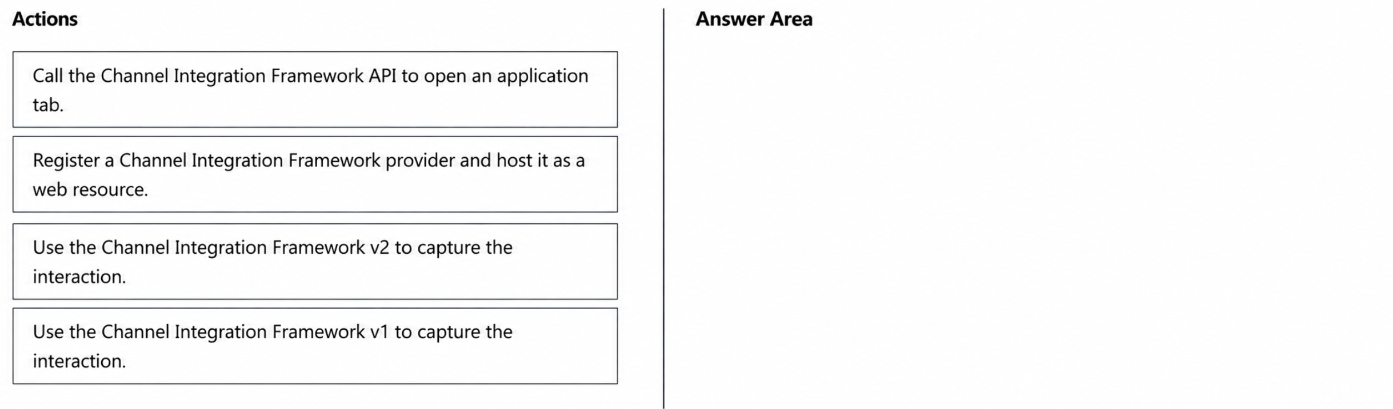
Correct answer: Item 1: B · Item 2: C · Item 3: A
QUESTION 14
DRAG DROP -
This is a case study. Case studies are not timed separately from other exam sections. You can use as much exam time as you would like to complete each case study. However, there might be additional case studies or other exam sections. Manage your time to ensure that you can complete all the exam sections in the time provided. Pay attention to the Exam Progress at the top of the screen so you have sufficient time to complete any exam sections that follow this case study.
To answer the case study questions, you will need to reference information that is provided in the case. Case studies and associated questions might contain exhibits or other resources that provide more information about the scenario described in the case. Information provided in an individual question does not apply to the other questions in the case study.
A Review Screen will appear at the end of this case study. From the Review Screen, you can review and change your answers before you move to the next exam section. After you leave this case study, you will NOT be able to return to it.
To start the case study.
To display the first question in this case study, select the 'Next' button. To the left of the question, a menu provides links to information such as business requirements, the existing environment, and problem statements. Please read through all this information before answering any questions. When you are ready to answer a question, select the 'Question' button to return to the question.
Background -
VanArsdel, Ltd. is a global company that provides outsourced customer support services for enterprise clients across multiple industries, including retail, healthcare, and financial services.
VanArsdel, Ltd. is implementing Microsoft Dynamics 365 Contact Center to modernize its contact center operations. The company aims to provide a unified omnichannel experience for customers and improve customer service representative (CSR) productivity through AI-driven tools and automation.
The implementation will support voice, chat, and digital messaging channels. The initial rollout focuses on voice capabilities and AI-assisted CSR experiences. The solution must be scalable and configurable using out-of-the-box functionality where possible.
The company employs approximately 500 CSRs, 50 supervisors, and a small team of system administrators responsible for configuration and maintenance. Some back-office CSRs are available for consultations with frontline CSRs.
VanArsdel, Ltd. currently operates multiple outdated CCaaS platforms across its divisions. The company is concerned about CSR adoption and therefore plans to adopt a phased approach. The company plans to use its existing CCaaS solution with Copilot Service workspace to enable adoption of the agent desktop while the voice channel and associated capabilities are developed.
Current environment -
Contact Center channels -
VanArsdel, Ltd. currently uses an outdated telephony system integrated with a third-party CRM. The system lacks support for modern APIs and does not provide advanced analytics or AI capabilities.
The company plans to replace the outdated system with Dynamics 365 Contact Center and Microsoft Teams Phone functionality.
Outbound communication capabilities are limited in the current system to SMS only and must be enhanced to support proactive engagement campaigns. A third-party tool is used to manage current campaigns.
CSR experience -
CSRs currently rely on multiple disconnected systems to manage customer interactions. This results in inefficiencies and increased handling times.
The new solution must provide a unified interface with embedded productivity tools, including:
AI-powered suggestions during live interactions.
Suggested responses based on the CSR’s interaction with the agent desktop and the conversation context.
Real-time transcription and sentiment analysis.
Integration with company-owned knowledge bases.
CSRs must be able to interact with customers through voice and digital channels within a single workspace. The sales director requires CSRs to be able to collect orders from their third-party order management tool from the Productivity panel. CSRs must be prevented from accessing payment information.
Data protection and compliance -
VanArsdel, Ltd. handles sensitive customer data, including personally identifiable information (PII) and payment details.
The company must comply with strict data protection regulations, including:
Masking sensitive data during live interactions.
Preventing National Identity and payment card information from being stored in transcripts and AI generated summaries.
Ensuring secure handling of customer information across all channels.
The current system does NOT provide adequate data masking capabilities.
Integration requirements -
The company uses several internal systems, including:
A customer account management system.
A billing platform.
A knowledge management system.
These systems must be integrated with Dynamics 365 Contact Center to provide CSRs with relevant information during interactions.
The company also has a third-party marketing platform. However, the company currently does NOT plan to integrate the platform and instead is evaluating Customer Insights - Journeys.
Business requirements -
Voice channel implementation -
VanArsdel, Ltd. must implement a voice channel that meets the following requirements:
Support inbound and outbound voice calls by using Microsoft Teams Phone.
Enhance call controls by using SDK APIs.
Allow supervisors to monitor and manage live calls.
Provide real-time insights into call performance.
The solution must support scalability to handle peak call volumes during seasonal demand.
Proactive engagement -
The company must implement proactive outbound engagement capabilities, including:
Proactive Dialer to adjust call pacing based on CSR availability and answer rates.
Trigger-based engagement based on customer actions.
Integration with customer data to personalize outreach.
Outbound campaigns must be configurable without requiring custom code.
Agent assist and AI capabilities
VanArsdel, Ltd. must enhance CSR productivity by implementing AI-powered assistance features, including:
Suggested responses during customer interactions.
Automated knowledge article recommendations.
Real-time transcription and summarization.
Real-time assistance sent to the CSR in the send message box during chat conversations.
The company also plans to extend Copilot capabilities by integrating custom plugins, tools, and connectors.
Additionally, a bot must be implemented to support CSRs by providing interactable contextual guidance during interactions.
Voice agent configuration -
The company must configure voice agents to support natural and efficient customer interactions.
The solution must include:
Real-time speech recognition.
Accurate transcription of customer conversations.
Configurable voice settings to optimize performance.
Voice agents must follow best practices to ensure high-quality interactions and minimize errors.
Technical requirements -
Channel Integration Framework -
VanArsdel, Ltd. requires a phased approach to deploying the voice channel. The company plans to use its existing CCaaS solution with Copilot Service workspace to enable adoption of the agent desktop while the voice channel and associated capabilities are developed. The company requires the Channel Integration Framework to be built to:
Click-to-act functionality for outbound communication.
Integration with third-party applications.
A consistent user experience for CSRs.
Sensitive data masking -
The solution must include sensitive data masking capabilities that:
Automatically detect and mask sensitive information during interactions.
Prevent exposure of sensitive data in logs and transcripts.
Allow administrators to configure masking rules.
Omnichannel JavaScript API -
Custom extensions must be developed by using the Omnichannel JavaScript API to:
Provide enhanced automation during a conversation.
Display conversation dynamically based on the defined business process.
Provide contextual information during customer interactions.
These extensions must be maintainable and align with best practices.
Supervisor experience -
Supervisors must have access to advanced analytics and monitoring tools, including:
Real-time dashboards for intraday CSR performance.
Historical insights into call volumes and trends.
Tools to manage and optimize CSR workloads.
The supervisor app must be used to provide actionable insights that improve operational efficiency.
Issues -
VanArsdel, Ltd. has identified the following issues in the current environment:
CSRs experience delays due to switching between multiple systems.
Sensitive customer data is exposed during interactions.
Outbound engagement capabilities are limited and not automated.
Supervisors lack visibility into real-time performance metrics.
Voice interactions lack transcription and AI-assisted features.
Problem statement -
VanArsdel, Ltd. must implement a modern contact center solution by using Dynamics 365 Contact Center to:
Improve CSR productivity through AI and automation.
Ensure compliance with data protection regulations.
Enhance customer engagement through proactive outreach.
Provide a unified and efficient CSR experience.
Enable supervisors to monitor and optimize operations effectively.
The solution must be scalable, secure, and aligned with best practices for configuring channels, AI capabilities, and integrations.
You need to configure the system to send messages to the CSR.
Which three actions should you perform in sequence? To answer, move the appropriate actions from the list of actions to the answer area and arrange them in the correct order.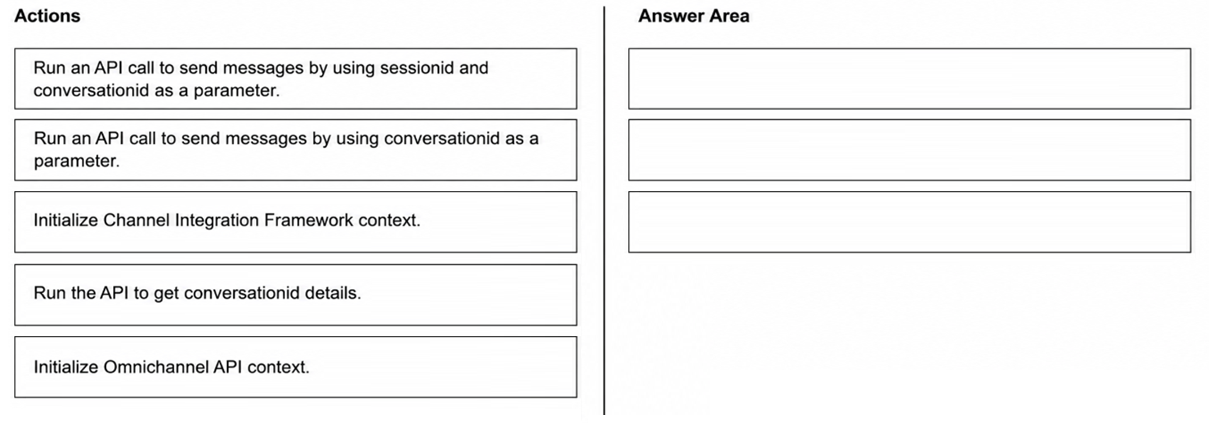
Correct answer: Item 1: E · Item 2: D · Item 3: A
QUESTION 15
DRAG DROP -
This is a case study. Case studies are not timed separately from other exam sections. You can use as much exam time as you would like to complete each case study. However, there might be additional case studies or other exam sections. Manage your time to ensure that you can complete all the exam sections in the time provided. Pay attention to the Exam Progress at the top of the screen so you have sufficient time to complete any exam sections that follow this case study.
To answer the case study questions, you will need to reference information that is provided in the case. Case studies and associated questions might contain exhibits or other resources that provide more information about the scenario described in the case. Information provided in an individual question does not apply to the other questions in the case study.
A Review Screen will appear at the end of this case study. From the Review Screen, you can review and change your answers before you move to the next exam section. After you leave this case study, you will NOT be able to return to it.
To start the case study.
To display the first question in this case study, select the 'Next' button. To the left of the question, a menu provides links to information such as business requirements, the existing environment, and problem statements. Please read through all this information before answering any questions. When you are ready to answer a question, select the 'Question' button to return to the question.
Background -
VanArsdel, Ltd. is a global company that provides outsourced customer support services for enterprise clients across multiple industries, including retail, healthcare, and financial services.
VanArsdel, Ltd. is implementing Microsoft Dynamics 365 Contact Center to modernize its contact center operations. The company aims to provide a unified omnichannel experience for customers and improve customer service representative (CSR) productivity through AI-driven tools and automation.
The implementation will support voice, chat, and digital messaging channels. The initial rollout focuses on voice capabilities and AI-assisted CSR experiences. The solution must be scalable and configurable using out-of-the-box functionality where possible.
The company employs approximately 500 CSRs, 50 supervisors, and a small team of system administrators responsible for configuration and maintenance. Some back-office CSRs are available for consultations with frontline CSRs.
VanArsdel, Ltd. currently operates multiple outdated CCaaS platforms across its divisions. The company is concerned about CSR adoption and therefore plans to adopt a phased approach. The company plans to use its existing CCaaS solution with Copilot Service workspace to enable adoption of the agent desktop while the voice channel and associated capabilities are developed.
Current environment -
Contact Center channels -
VanArsdel, Ltd. currently uses an outdated telephony system integrated with a third-party CRM. The system lacks support for modern APIs and does not provide advanced analytics or AI capabilities.
The company plans to replace the outdated system with Dynamics 365 Contact Center and Microsoft Teams Phone functionality.
Outbound communication capabilities are limited in the current system to SMS only and must be enhanced to support proactive engagement campaigns. A third-party tool is used to manage current campaigns.
CSR experience -
CSRs currently rely on multiple disconnected systems to manage customer interactions. This results in inefficiencies and increased handling times.
The new solution must provide a unified interface with embedded productivity tools, including:
AI-powered suggestions during live interactions.
Suggested responses based on the CSR’s interaction with the agent desktop and the conversation context.
Real-time transcription and sentiment analysis.
Integration with company-owned knowledge bases.
CSRs must be able to interact with customers through voice and digital channels within a single workspace. The sales director requires CSRs to be able to collect orders from their third-party order management tool from the Productivity panel. CSRs must be prevented from accessing payment information.
Data protection and compliance -
VanArsdel, Ltd. handles sensitive customer data, including personally identifiable information (PII) and payment details.
The company must comply with strict data protection regulations, including:
Masking sensitive data during live interactions.
Preventing National Identity and payment card information from being stored in transcripts and AI generated summaries.
Ensuring secure handling of customer information across all channels.
The current system does NOT provide adequate data masking capabilities.
Integration requirements -
The company uses several internal systems, including:
A customer account management system.
A billing platform.
A knowledge management system.
These systems must be integrated with Dynamics 365 Contact Center to provide CSRs with relevant information during interactions.
The company also has a third-party marketing platform. However, the company currently does NOT plan to integrate the platform and instead is evaluating Customer Insights - Journeys.
Business requirements -
Voice channel implementation -
VanArsdel, Ltd. must implement a voice channel that meets the following requirements:
Support inbound and outbound voice calls by using Microsoft Teams Phone.
Enhance call controls by using SDK APIs.
Allow supervisors to monitor and manage live calls.
Provide real-time insights into call performance.
The solution must support scalability to handle peak call volumes during seasonal demand.
Proactive engagement -
The company must implement proactive outbound engagement capabilities, including:
Proactive Dialer to adjust call pacing based on CSR availability and answer rates.
Trigger-based engagement based on customer actions.
Integration with customer data to personalize outreach.
Outbound campaigns must be configurable without requiring custom code.
Agent assist and AI capabilities
VanArsdel, Ltd. must enhance CSR productivity by implementing AI-powered assistance features, including:
Suggested responses during customer interactions.
Automated knowledge article recommendations.
Real-time transcription and summarization.
Real-time assistance sent to the CSR in the send message box during chat conversations.
The company also plans to extend Copilot capabilities by integrating custom plugins, tools, and connectors.
Additionally, a bot must be implemented to support CSRs by providing interactable contextual guidance during interactions.
Voice agent configuration -
The company must configure voice agents to support natural and efficient customer interactions.
The solution must include:
Real-time speech recognition.
Accurate transcription of customer conversations.
Configurable voice settings to optimize performance.
Voice agents must follow best practices to ensure high-quality interactions and minimize errors.
Technical requirements -
Channel Integration Framework -
VanArsdel, Ltd. requires a phased approach to deploying the voice channel. The company plans to use its existing CCaaS solution with Copilot Service workspace to enable adoption of the agent desktop while the voice channel and associated capabilities are developed. The company requires the Channel Integration Framework to be built to:
Click-to-act functionality for outbound communication.
Integration with third-party applications.
A consistent user experience for CSRs.
Sensitive data masking -
The solution must include sensitive data masking capabilities that:
Automatically detect and mask sensitive information during interactions.
Prevent exposure of sensitive data in logs and transcripts.
Allow administrators to configure masking rules.
Omnichannel JavaScript API -
Custom extensions must be developed by using the Omnichannel JavaScript API to:
Provide enhanced automation during a conversation.
Display conversation dynamically based on the defined business process.
Provide contextual information during customer interactions.
These extensions must be maintainable and align with best practices.
Supervisor experience -
Supervisors must have access to advanced analytics and monitoring tools, including:
Real-time dashboards for intraday CSR performance.
Historical insights into call volumes and trends.
Tools to manage and optimize CSR workloads.
The supervisor app must be used to provide actionable insights that improve operational efficiency.
Issues -
VanArsdel, Ltd. has identified the following issues in the current environment:
CSRs experience delays due to switching between multiple systems.
Sensitive customer data is exposed during interactions.
Outbound engagement capabilities are limited and not automated.
Supervisors lack visibility into real-time performance metrics.
Voice interactions lack transcription and AI-assisted features.
Problem statement -
VanArsdel, Ltd. must implement a modern contact center solution by using Dynamics 365 Contact Center to:
Improve CSR productivity through AI and automation.
Ensure compliance with data protection regulations.
Enhance customer engagement through proactive outreach.
Provide a unified and efficient CSR experience.
Enable supervisors to monitor and optimize operations effectively.
The solution must be scalable, secure, and aligned with best practices for configuring channels, AI capabilities, and integrations.
You need to configure the Dynamics 365 Contact Center solution based on the data protection and compliance requirements.
Which configurations should you apply? To answer, move the appropriate configurations to the correct contexts. You may use each configuration once, more than once, or not at all. You may need to move the split bar between panes or scroll to view content.
NOTE: Each correct selection is worth one point.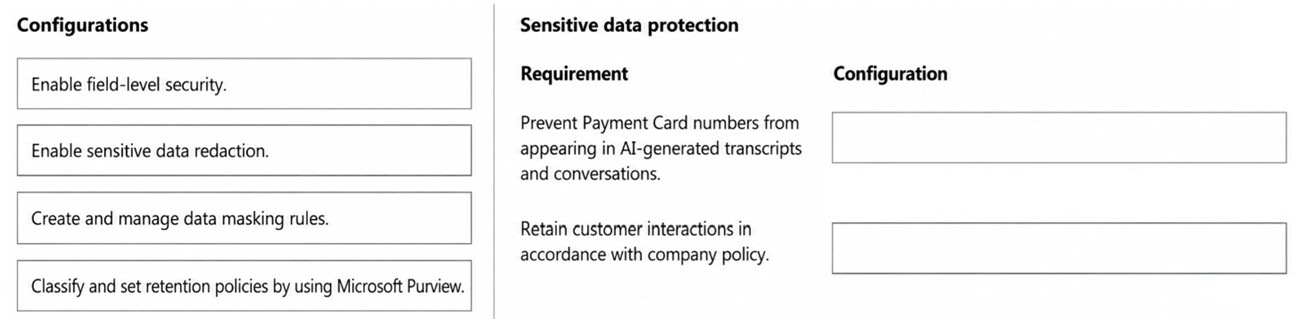
Correct answer: Item 1: B · Item 2: D
QUESTION 16
DRAG DROP -
A company supports multiple communication channels. Customer service representatives (CSRs) handle multiple work items concurrently based on configured workload limits.
The company must be able to control how CSRs handle workload across channels.
The solution must:
Limit how much work a CSR can handle at the same time.
Prevent CSRs from receiving new work items until their conversations are closed.
You need to configure workload management for the CSRs.
How should you configure the workloads? To answer, move the appropriate configurations to the correct requirements. You may use each configuration once, more than once, or not at all. You may need to move the split bat between panes or scroll to view content.
NOTE: Each correct selection is worth one point.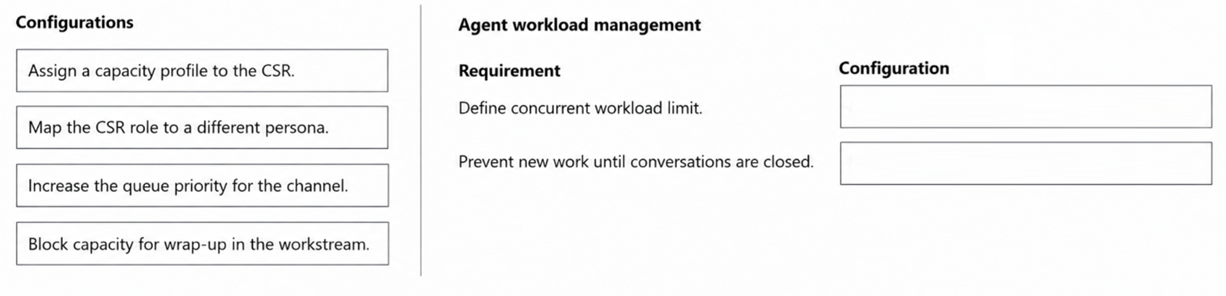
Correct answer: Item 1: A · Item 2: D
QUESTION 17
A company plans to improve its customer experience.
The company must be able to collect information from its customers before a conversation starts and pass values to the client application.
You need to configure the chat channels to meet the requirements.
What are two possible ways to achieve this goal? Each correct answer presents a complete solution.
NOTE: Each correct selection is worth one point.
Correct answer: A, B
QUESTION 18
A company uses Dynamics 365 live chat on its website.
The digital team wants the chat experience to use the existing brand kit and style guide of the company and support a more tailored web experience.
The company requires a solution that enables it to control the chat experience through customization.
You need to expand chat behavior beyond default capabilities.
What are two possible ways to achieve this goal? Each correct answer presents a complete solution.
NOTE: Each correct selection is worth one point.
Correct answer: A, B
QUESTION 19
A company has a quality management program for its contact center to ensure excellence for its customer experience.
The company must be able to review conversations and retain records for compliance in support of the program.
You need to configure the voice interactions to meet the requirements.
What are two possible ways to achieve this goal? Each correct answer presents a complete solution.
NOTE: Each correct selection is worth one point.
Correct answer: A, B
QUESTION 20
DRAG DROP -
A company is evaluating cost drivers for a Dynamics 365 Contact Center deployment that has the following license types:
• Dynamics 365 Contact Center (Digital + Voice)
• Dynamics 365 Contact Center Voice
The company must be able to associate platform costs for the following with their billing models:
• Copilot-generated responses
• Customer service representative (CSR) platform access
• Call recording and telephony minutes
• Included IVR minutes per user
You need to identify the billing method for each cost component.
Which billing method should you select for each component? To answer, move the appropriate billing methods to the correct Contact Center feature. You may use each billing method once, more than once, or not at all. You may need to move the split bar between panes or scroll to view content.
NOTE: Each correct selection is worth one point.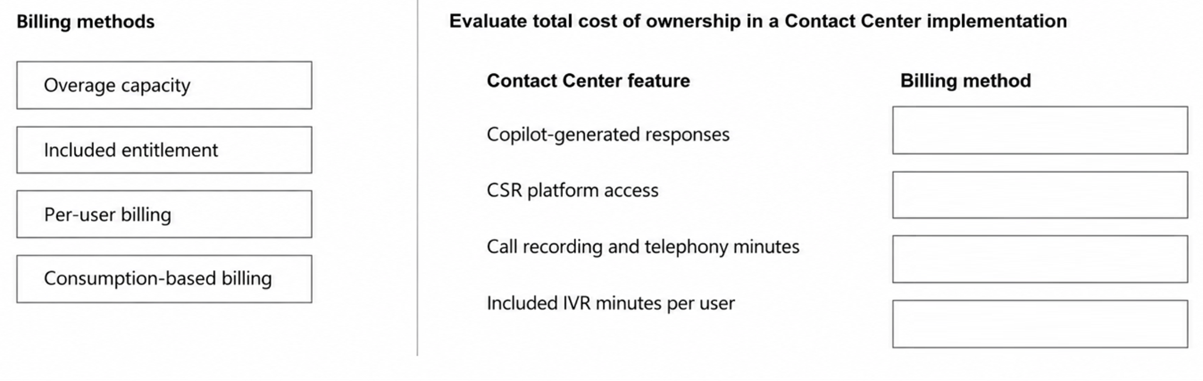
Correct answer: Item 1: D · Item 2: C · Item 3: D · Item 4: B
Choose AB-250 in Revizo and work through original, question-by-question practice on your iPhone. Review results, revisit what needs attention and keep your next session tied to one specific certification objective.
Practise AB-250 with RevizoNo. Revizo is an independent iPhone app for certification practice. Refer to the provider's official resources for current exam policies and registration.
Use the exam code to select the matching certification in Revizo, then build short, focused sessions around the areas you want to review.
No. Revizo provides original practice questions for certification study. Use the provider's official objectives, documentation and policies as the source of truth for your preparation.
Use the current Microsoft objectives, documentation and registration guidance as your source of truth. Revizo is designed to support focused practice, not replace the provider's official materials.
Check the official Microsoft exam page for the latest objectives, registration details and policies.