Revizo / Google / GCP-PDE

GOOGLE CERTIFICATION STUDY GUIDE

GCP-PDE practice questions.
Prepare with a clearer plan.

Demonstrates ability to design, build, and operationalize data processing systems on Google Cloud.

Download Revizo
Revizo certification practice question on iPhone

What to know about GCP-PDE.

Demonstrates ability to design, build, and operationalize data processing systems on Google Cloud.

Format
Multiple choice and case study questions
Duration
120 minutes
Passing score
700/1000
Recommended experience
1+ years of data engineering experience

Exam details are based on the available Google catalogue information. Confirm current requirements with the exam provider before booking.

How to prepare for GCP-PDE.

Use the provider's current objectives as your source of truth, then organise your Revizo sessions around Google Cloud products, platform concepts and the practical decisions named in the certification. The GCP-PDE exam is listed as Multiple choice and case study questions; your starting point should reflect 1+ years of data engineering experience.

01

Map the official objectives.

Read the current Google objectives and make a short list of the areas you need to revisit before booking GCP-PDE.

02

Practise one area at a time.

Select GCP-PDE in Revizo and use focused question sessions to test one topic or decision type at a time, rather than relying on a single long cram session.

03

Review, then repeat.

Use your results to return to incorrect answers, revisit the official material behind them and repeat short GCP-PDE practice sessions until the gaps are clearer.

FREE PRACTICE PREVIEW

Read the first 20
GCP-PDE questions.

Review each question, its correct answer and any available source explanation before continuing your certification study in Revizo.

FIRST 20 QUESTIONS

Answers & available explanations

QUESTION 1

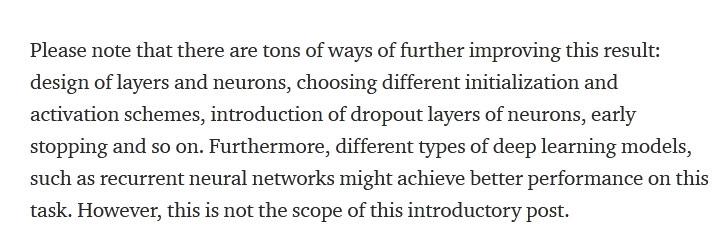
Your company built a TensorFlow neutral-network model with a large number of neurons and layers. The model fits well for the training data. However, when tested against new data, it performs poorly. What method can you employ to address this?

  1. AA. Threading
  2. BB. Serialization
  3. CC. Dropout Methods
  4. DD. Dimensionality Reduction
Show answer & explanation

Correct answer: C

ExplanationReference:
https://medium.com/mlreview/a-simple-deep-learning-model-for-stock-price-prediction-using-tensorflow-30505541d877

QUESTION 2

You are building a model to make clothing recommendations. You know a user's fashion preference is likely to change over time, so you build a data pipeline to stream new data back to the model as it becomes available. How should you use this data to train the model?

  1. AA. Continuously retrain the model on just the new data.
  2. BB. Continuously retrain the model on a combination of existing data and the new data.
  3. CC. Train on the existing data while using the new data as your test set.
  4. DD. Train on the new data while using the existing data as your test set.
Show answer & explanation

Correct answer: B

Explanation

QUESTION 3

You designed a database for patient records as a pilot project to cover a few hundred patients in three clinics. Your design used a single database table to represent all patients and their visits, and you used self-joins to generate reports. The server resource utilization was at 50%. Since then, the scope of the project has expanded. The database must now store 100 times more patient records. You can no longer run the reports, because they either take too long or they encounter errors with insufficient compute resources. How should you adjust the database design?

  1. AA. Add capacity (memory and disk space) to the database server by the order of 200.
  2. BB. Shard the tables into smaller ones based on date ranges, and only generate reports with prespecified date ranges.
  3. CC. Normalize the master patient-record table into the patient table and the visits table, and create other necessary tables to avoid self-join.
  4. DD. Partition the table into smaller tables, with one for each clinic. Run queries against the smaller table pairs, and use unions for consolidated reports.
Show answer & explanation

Correct answer: C

Explanation

QUESTION 4

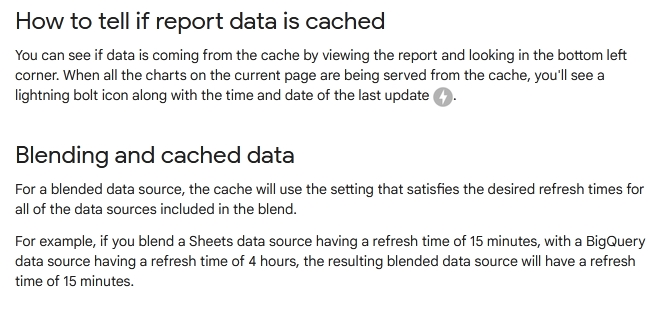
You create an important report for your large team in Google Data Studio 360. The report uses Google BigQuery as its data source. You notice that visualizations are not showing data that is less than 1 hour old. What should you do?

  1. AA. Disable caching by editing the report settings.
  2. BB. Disable caching in BigQuery by editing table details.
  3. CC. Refresh your browser tab showing the visualizations.
  4. DD. Clear your browser history for the past hour then reload the tab showing the virtualizations.
Show answer & explanation

Correct answer: A

ExplanationReference:
https://support.google.com/datastudio/answer/7020039?hl=en

QUESTION 5

An external customer provides you with a daily dump of data from their database. The data flows into Google Cloud Storage GCS as comma-separated values
(CSV) files. You want to analyze this data in Google BigQuery, but the data could have rows that are formatted incorrectly or corrupted. How should you build this pipeline?

  1. AA. Use federated data sources, and check data in the SQL query.
  2. BB. Enable BigQuery monitoring in Google Stackdriver and create an alert.
  3. CC. Import the data into BigQuery using the gcloud CLI and set max_bad_records to 0.
  4. DD. Run a Google Cloud Dataflow batch pipeline to import the data into BigQuery, and push errors to another dead-letter table for analysis.
Show answer & explanation

Correct answer: D

Explanation

QUESTION 6

Your weather app queries a database every 15 minutes to get the current temperature. The frontend is powered by Google App Engine and server millions of users. How should you design the frontend to respond to a database failure?

  1. AA. Issue a command to restart the database servers.
  2. BB. Retry the query with exponential backoff, up to a cap of 15 minutes.
  3. CC. Retry the query every second until it comes back online to minimize staleness of data.
  4. DD. Reduce the query frequency to once every hour until the database comes back online.
Show answer & explanation

Correct answer: B

Explanation

QUESTION 7

You are creating a model to predict housing prices. Due to budget constraints, you must run it on a single resource-constrained virtual machine. Which learning algorithm should you use?

  1. AA. Linear regression
  2. BB. Logistic classification
  3. CC. Recurrent neural network
  4. DD. Feedforward neural network
Show answer & explanation

Correct answer: A

Explanation

QUESTION 8

You are building new real-time data warehouse for your company and will use Google BigQuery streaming inserts. There is no guarantee that data will only be sent in once but you do have a unique ID for each row of data and an event timestamp. You want to ensure that duplicates are not included while interactively querying data. Which query type should you use?

  1. AA. Include ORDER BY DESK on timestamp column and LIMIT to 1.
  2. BB. Use GROUP BY on the unique ID column and timestamp column and SUM on the values.
  3. CC. Use the LAG window function with PARTITION by unique ID along with WHERE LAG IS NOT NULL.
  4. DD. Use the ROW_NUMBER window function with PARTITION by unique ID along with WHERE row equals 1.
Show answer & explanation

Correct answer: D

Explanation

QUESTION 9

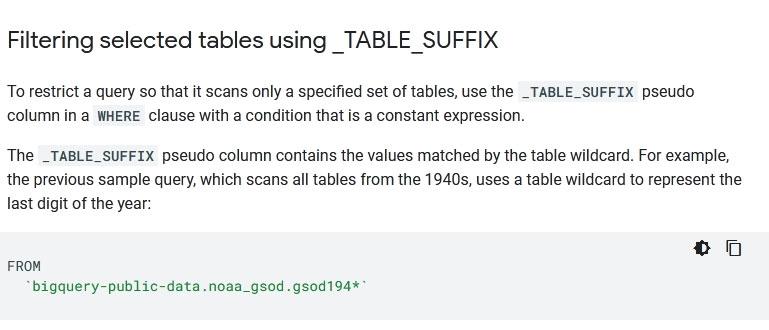
Your company is using WILDCARD tables to query data across multiple tables with similar names. The SQL statement is currently failing with the following error:
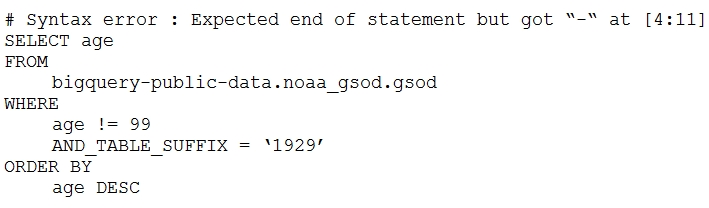
Which table name will make the SQL statement work correctly?

  1. AA. 'bigquery-public-data.noaa_gsod.gsod'
  2. BB. bigquery-public-data.noaa_gsod.gsod*
  3. CC. 'bigquery-public-data.noaa_gsod.gsod'*
  4. DD. 'bigquery-public-data.noaa_gsod.gsod*`
Show answer & explanation

Correct answer: D

ExplanationReference:
https://cloud.google.com/bigquery/docs/wildcard-tables

QUESTION 10

Your company is in a highly regulated industry. One of your requirements is to ensure individual users have access only to the minimum amount of information required to do their jobs. You want to enforce this requirement with Google BigQuery. Which three approaches can you take? (Choose three.)

  1. AA. Disable writes to certain tables.
  2. BB. Restrict access to tables by role.
  3. CC. Ensure that the data is encrypted at all times.
  4. DD. Restrict BigQuery API access to approved users.
  5. EE. Segregate data across multiple tables or databases.
  6. FF. Use Google Stackdriver Audit Logging to determine policy violations.
Show answer & explanation

Correct answer: B, D, F

Explanationcorrect option -> B. Restrict access to tables by role. Reference: https://cloud.google.com/bigquery/docs/table-access-controls-intro correct option -> D. Restrict BigQuery API access to approved users. ***Only approved users will have access which means other users will have minimum amount of information required to do their job.*** Reference: https://cloud.google.com/bigquery/docs/access-control correct option -> F. Use Google Stackdriver Audit Logging to determine policy violations. Reference: https://cloud.google.com/bigquery/docs/table-access-controls-intro#logging A. Disable writes to certain tables. ---> Read is still available(not minimal access) C. Ensure that the data is encrypted at all times. ---> Data is encrypted by default. E. Segregate data across multiple tables or databases. ---> Normalization is of no help here.

QUESTION 11

You are designing a basket abandonment system for an ecommerce company. The system will send a message to a user based on these rules:
✑ No interaction by the user on the site for 1 hour
Has added more than $30 worth of products to the basket

✑ Has not completed a transaction
You use Google Cloud Dataflow to process the data and decide if a message should be sent. How should you design the pipeline?

  1. AA. Use a fixed-time window with a duration of 60 minutes.
  2. BB. Use a sliding time window with a duration of 60 minutes.
  3. CC. Use a session window with a gap time duration of 60 minutes.
  4. DD. Use a global window with a time based trigger with a delay of 60 minutes.
Show answer & explanation

Correct answer: C

Explanation

QUESTION 12

Your company handles data processing for a number of different clients. Each client prefers to use their own suite of analytics tools, with some allowing direct query access via Google BigQuery. You need to secure the data so that clients cannot see each other's data. You want to ensure appropriate access to the data.
Which three steps should you take? (Choose three.)

  1. AA. Load data into different partitions.
  2. BB. Load data into a different dataset for each client.
  3. CC. Put each client's BigQuery dataset into a different table.
  4. DD. Restrict a client's dataset to approved users.
  5. EE. Only allow a service account to access the datasets.
  6. FF. Use the appropriate identity and access management (IAM) roles for each client's users.
Show answer & explanation

Correct answer: B, D, F

Explanation

QUESTION 13

You want to process payment transactions in a point-of-sale application that will run on Google Cloud Platform. Your user base could grow exponentially, but you do not want to manage infrastructure scaling.
Which Google database service should you use?

  1. AA. Cloud SQL
  2. BB. BigQuery
  3. CC. Cloud Bigtable
  4. DD. Cloud Datastore
Show answer & explanation

Correct answer: D

Explanationcloud sql --> incorrect https://cloud.google.com/sql#section-8 --> you will need to manually do scalability Scalability --> Easily scale up as your data grows—add processor cores, RAM and storage, and scale out by adding read replicas to handle increasing read traffic. Read replicas support high availability, can have their own read replicas, and can be located across regions and platforms. big query , big table --> doesn't support ACID Cloud DataStore --> CORRECT ( https://cloud.google.com/datastore/) check features section ACID transactions Ensure the integrity of your data by executing multiple datastore operations in a single transaction with ACID characteristics, so all the grouped operations succeed or all fail. Fully managed Datastore is fully managed, which means Google automatically handles sharding and replication in order to provide you with a highly available and consistent database.

QUESTION 14

You want to use a database of information about tissue samples to classify future tissue samples as either normal or mutated. You are evaluating an unsupervised anomaly detection method for classifying the tissue samples. Which two characteristic support this method? (Choose two.)

  1. AA. There are very few occurrences of mutations relative to normal samples.
  2. BB. There are roughly equal occurrences of both normal and mutated samples in the database.
  3. CC. You expect future mutations to have different features from the mutated samples in the database.
  4. DD. You expect future mutations to have similar features to the mutated samples in the database.
  5. EE. You already have labels for which samples are mutated and which are normal in the database.
Show answer & explanation

Correct answer: A, C

ExplanationAnomaly detection has two basic assumptions: ->Anomalies only occur very rarely in the data. (a) ->Their features differ from the normal instances significantly. (c) link -> https://towardsdatascience.com/anomaly-detection-for-dummies-15f148e559c1#:~:text=Unsupervised%20Anomaly%20Detection%20for%20Univariate%20%26%20Multivariate%20Data.&text=Anomaly%20detection%20has%20two%20basic,from%20the%20normal%20instances%20significantly.

QUESTION 15

You need to store and analyze social media postings in Google BigQuery at a rate of 10,000 messages per minute in near real-time. Initially, design the application to use streaming inserts for individual postings. Your application also performs data aggregations right after the streaming inserts. You discover that the queries after streaming inserts do not exhibit strong consistency, and reports from the queries might miss in-flight data. How can you adjust your application design?

  1. AA. Re-write the application to load accumulated data every 2 minutes.
  2. BB. Convert the streaming insert code to batch load for individual messages.
  3. CC. Load the original message to Google Cloud SQL, and export the table every hour to BigQuery via streaming inserts.
  4. DD. Estimate the average latency for data availability after streaming inserts, and always run queries after waiting twice as long.
Show answer & explanation

Correct answer: D

Explanation

QUESTION 16

Your startup has never implemented a formal security policy. Currently, everyone in the company has access to the datasets stored in Google BigQuery. Teams have freedom to use the service as they see fit, and they have not documented their use cases. You have been asked to secure the data warehouse. You need to discover what everyone is doing. What should you do first?

  1. AA. Use Google Stackdriver Audit Logs to review data access.
  2. BB. Get the identity and access management IIAM) policy of each table
  3. CC. Use Stackdriver Monitoring to see the usage of BigQuery query slots.
  4. DD. Use the Google Cloud Billing API to see what account the warehouse is being billed to.
Show answer & explanation

Correct answer: A

Explanation

QUESTION 17

Your company is migrating their 30-node Apache Hadoop cluster to the cloud. They want to re-use Hadoop jobs they have already created and minimize the management of the cluster as much as possible. They also want to be able to persist data beyond the life of the cluster. What should you do?

  1. AA. Create a Google Cloud Dataflow job to process the data.
  2. BB. Create a Google Cloud Dataproc cluster that uses persistent disks for HDFS.
  3. CC. Create a Hadoop cluster on Google Compute Engine that uses persistent disks.
  4. DD. Create a Cloud Dataproc cluster that uses the Google Cloud Storage connector.
  5. EE. Create a Hadoop cluster on Google Compute Engine that uses Local SSD disks.
Show answer & explanation

Correct answer: D

Explanation

QUESTION 18

Business owners at your company have given you a database of bank transactions. Each row contains the user ID, transaction type, transaction location, and transaction amount. They ask you to investigate what type of machine learning can be applied to the data. Which three machine learning applications can you use? (Choose three.)

  1. AA. Supervised learning to determine which transactions are most likely to be fraudulent.
  2. BB. Unsupervised learning to determine which transactions are most likely to be fraudulent.
  3. CC. Clustering to divide the transactions into N categories based on feature similarity.
  4. DD. Supervised learning to predict the location of a transaction.
  5. EE. Reinforcement learning to predict the location of a transaction.
  6. FF. Unsupervised learning to predict the location of a transaction.
Show answer & explanation

Correct answer: B, C, D

ExplanationThings to understand: Supervised learning will only predict the column that is labeled. In this case, there is not Fraud or not Fraud column inside which he will train on. So Option A, wrong. option D: Supervised learning for column (transaction location) is possible as column exist to train on. Option C: Custering N-type is possible and also an unsupervised learning to make cluster of similar pattern. Option B: Its a weaker point here, User should be able to know which clusters are fraud in history. As it doesn't give enough information about past analysis whether user knows potential frauds or not. Ignore this option, if question asked for 2 right options only.

QUESTION 19

Your company's on-premises Apache Hadoop servers are approaching end-of-life, and IT has decided to migrate the cluster to Google Cloud Dataproc. A like-for- like migration of the cluster would require 50 TB of Google Persistent Disk per node. The CIO is concerned about the cost of using that much block storage. You want to minimize the storage cost of the migration. What should you do?

  1. AA. Put the data into Google Cloud Storage.
  2. BB. Use preemptible virtual machines (VMs) for the Cloud Dataproc cluster.
  3. CC. Tune the Cloud Dataproc cluster so that there is just enough disk for all data.
  4. DD. Migrate some of the cold data into Google Cloud Storage, and keep only the hot data in Persistent Disk.
Show answer & explanation

Correct answer: A

Explanation

QUESTION 20

You work for a car manufacturer and have set up a data pipeline using Google Cloud Pub/Sub to capture anomalous sensor events. You are using a push subscription in Cloud Pub/Sub that calls a custom HTTPS endpoint that you have created to take action of these anomalous events as they occur. Your custom
HTTPS endpoint keeps getting an inordinate amount of duplicate messages. What is the most likely cause of these duplicate messages?

  1. AA. The message body for the sensor event is too large.
  2. BB. Your custom endpoint has an out-of-date SSL certificate.
  3. CC. The Cloud Pub/Sub topic has too many messages published to it.
  4. DD. Your custom endpoint is not acknowledging messages within the acknowledgement deadline.
Show answer & explanation

Correct answer: D

ExplanationThe custom endpoint is not acknowledging the message, that is the reason for Pub/Sub to send the message again and again. Not B.

Build a focused GCP-PDE practice routine.

Choose GCP-PDE in Revizo and work through original, question-by-question practice on your iPhone. Review results, revisit what needs attention and keep your next session tied to one specific certification objective.

Practise GCP-PDE with Revizo

GCP-PDE practice questions.

Is Revizo the official Google exam?

No. Revizo is an independent iPhone app for certification practice. Refer to the provider's official resources for current exam policies and registration.

How should I use these GCP-PDE practice questions?

Use the exam code to select the matching certification in Revizo, then build short, focused sessions around the areas you want to review.

Are Revizo questions copied from live examinations?

No. Revizo provides original practice questions for certification study. Use the provider's official objectives, documentation and policies as the source of truth for your preparation.

What should I use alongside GCP-PDE practice questions?

Use the current Google objectives, documentation and registration guidance as your source of truth. Revizo is designed to support focused practice, not replace the provider's official materials.

Where can I confirm current GCP-PDE requirements?

Check the official Google exam page for the latest objectives, registration details and policies.