Revizo / Google / GCP-PCD

GOOGLE CERTIFICATION STUDY GUIDE

GCP-PCD practice questions.
Prepare with a clearer plan.

Validates skills in designing, developing, and deploying applications on Google Cloud.

Download Revizo
Revizo certification practice question on iPhone

What to know about GCP-PCD.

Validates skills in designing, developing, and deploying applications on Google Cloud.

Format
Multiple choice and case study questions
Duration
120 minutes
Passing score
700/1000
Recommended experience
1+ years of Google Cloud development

Exam details are based on the available Google catalogue information. Confirm current requirements with the exam provider before booking.

How to prepare for GCP-PCD.

Use the provider's current objectives as your source of truth, then organise your Revizo sessions around Google Cloud products, platform concepts and the practical decisions named in the certification. The GCP-PCD exam is listed as Multiple choice and case study questions; your starting point should reflect 1+ years of Google Cloud development.

01

Map the official objectives.

Read the current Google objectives and make a short list of the areas you need to revisit before booking GCP-PCD.

02

Practise one area at a time.

Select GCP-PCD in Revizo and use focused question sessions to test one topic or decision type at a time, rather than relying on a single long cram session.

03

Review, then repeat.

Use your results to return to incorrect answers, revisit the official material behind them and repeat short GCP-PCD practice sessions until the gaps are clearer.

FREE PRACTICE PREVIEW

Read the first 20
GCP-PCD questions.

Review each question, its correct answer and any available source explanation before continuing your certification study in Revizo.

FIRST 20 QUESTIONS

Answers & available explanations

QUESTION 1

You want to upload files from an on-premises virtual machine to Google Cloud Storage as part of a data migration. These files will be consumed by Cloud
DataProc Hadoop cluster in a GCP environment.
Which command should you use?

  1. AA. gsutil cp [LOCAL_OBJECT] gs://[DESTINATION_BUCKET_NAME]/
  2. BB. gcloud cp [LOCAL_OBJECT] gs://[DESTINATION_BUCKET_NAME]/
  3. CC. hadoop fs cp [LOCAL_OBJECT] gs://[DESTINATION_BUCKET_NAME]/
  4. DD. gcloud dataproc cp [LOCAL_OBJECT] gs://[DESTINATION_BUCKET_NAME]/
Show answer & explanation

Correct answer: A

ExplanationThe gsutil cp command allows you to copy data between your local file. storage. boto files generated by running 'gsutil config'

QUESTION 2

You migrated your applications to Google Cloud Platform and kept your existing monitoring platform. You now find that your notification system is too slow for time critical problems.
What should you do?

  1. AA. Replace your entire monitoring platform with Stackdriver.
  2. BB. Install the Stackdriver agents on your Compute Engine instances.
  3. CC. Use Stackdriver to capture and alert on logs, then ship them to your existing platform.
  4. DD. Migrate some traffic back to your old platform and perform AB testing on the two platforms concurrently.
Show answer & explanation

Correct answer: C

ExplanationThe task does not indicate that we should get rid of the old software. The pain point is slowness for time critical problems only. Thus we would use Stackdriver for the time critical alerts and still utilize the old platform for further analysis/storing of logs or whatever its business case is.

QUESTION 3

You are planning to migrate a MySQL database to the managed Cloud SQL database for Google Cloud. You have Compute Engine virtual machine instances that will connect with this Cloud SQL instance. You do not want to whitelist IPs for the Compute Engine instances to be able to access Cloud SQL.
What should you do?

  1. AA. Enable private IP for the Cloud SQL instance.
  2. BB. Whitelist a project to access Cloud SQL, and add Compute Engine instances in the whitelisted project.
  3. CC. Create a role in Cloud SQL that allows access to the database from external instances, and assign the Compute Engine instances to that role.
  4. DD. Create a CloudSQL instance on one project. Create Compute engine instances in a different project. Create a VPN between these two projects to allow internal access to CloudSQL.
Show answer & explanation

Correct answer: A

ExplanationEnabling private IP allows your Cloud SQL instance to be accessed via internal IP addresses within your Virtual Private Cloud (VPC) network. This way, your Compute Engine instances can connect to the Cloud SQL instance without the need to whitelist external IPs, ensuring secure and private communication within your GCP environment.

QUESTION 4

You have deployed an HTTP(s) Load Balancer with the gcloud commands shown below.
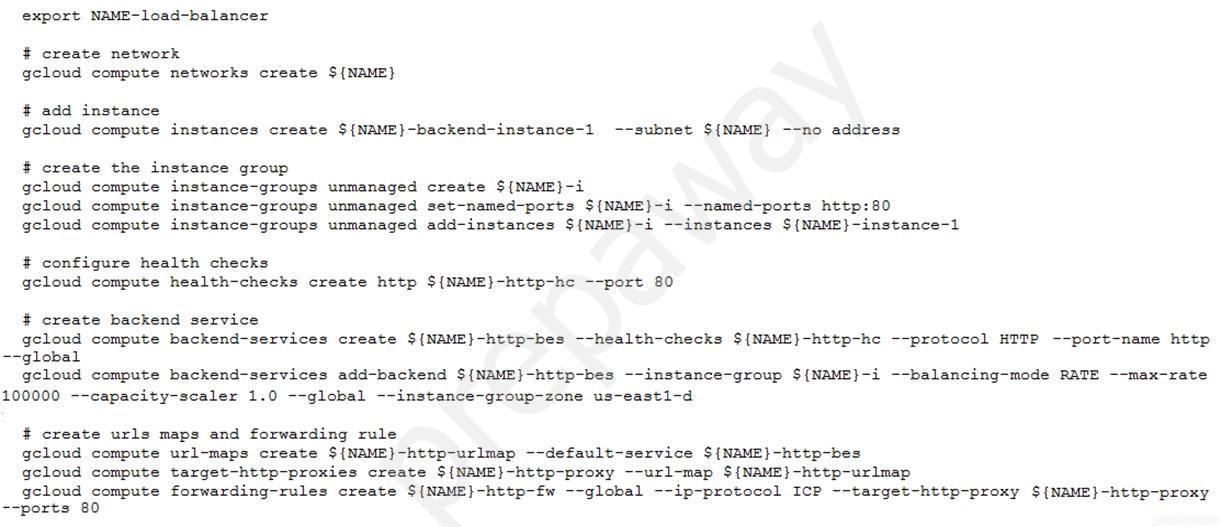
Health checks to port 80 on the Compute Engine virtual machine instance are failing and no traffic is sent to your instances. You want to resolve the problem.
Which commands should you run?

  1. AA. gcloud compute instances add-access-config ${NAME}-backend-instance-1
  2. BB. gcloud compute instances add-tags ${NAME}-backend-instance-1 --tags http-server
  3. CC. gcloud compute firewall-rules create allow-lb --network load-balancer --allow tcp --source-ranges 130.211.0.0/22,35.191.0.0/16 --direction INGRESS
  4. DD. gcloud compute firewall-rules create allow-lb --network load-balancer --allow tcp --destination-ranges 130.211.0.0/22,35.191.0.0/16 --direction EGRESS
Show answer & explanation

Correct answer: C

ExplanationReference:
https://cloud.google.com/vpc/docs/special-configurations

QUESTION 5

Your website is deployed on Compute Engine. Your marketing team wants to test conversion rates between 3 different website designs.
Which approach should you use?

  1. AA. Deploy the website on App Engine and use traffic splitting.
  2. BB. Deploy the website on App Engine as three separate services.
  3. CC. Deploy the website on Cloud Functions and use traffic splitting.
  4. DD. Deploy the website on Cloud Functions as three separate functions.
Show answer & explanation

Correct answer: A

ExplanationReference:
https://cloud.google.com/appengine/docs/standard/python/splitting-traffic

QUESTION 6

You need to copy directory local-scripts and all of its contents from your local workstation to a Compute Engine virtual machine instance.
Which command should you use?

  1. AA. gsutil cp --project ג€my-gcp-projectג€ -r ~/local-scripts/ gcp-instance-name:~/server-scripts/ --zone ג€us-east1-bג€
  2. BB. gsutil cp --project ג€my-gcp-projectג€ -R ~/local-scripts/ gcp-instance-name:~/server-scripts/ --zone ג€us-east1-bג€
  3. CC. gcloud compute scp --project ג€my-gcp-projectג€ --recurse ~/local-scripts/ gcp-instance-name:~/server-scripts/ --zone ג€us-east1-bג€
  4. DD. gcloud compute mv --project ג€my-gcp-projectג€ --recurse ~/local-scripts/ gcp-instance-name:~/server-scripts/ --zone ג€us-east1-bג€
Show answer & explanation

Correct answer: C

ExplanationReference:
https://cloud.google.com/sdk/gcloud/reference/compute/copy-files

QUESTION 7

You are deploying your application to a Compute Engine virtual machine instance with the Stackdriver Monitoring Agent installed. Your application is a unix process on the instance. You want to be alerted if the unix process has not run for at least 5 minutes. You are not able to change the application to generate metrics or logs.
Which alert condition should you configure?

  1. AA. Uptime check
  2. BB. Process health
  3. CC. Metric absence
  4. DD. Metric threshold
Show answer & explanation

Correct answer: B

ExplanationReference:
https://cloud.google.com/monitoring/alerts/concepts-indepth

QUESTION 8

You have two tables in an ANSI-SQL compliant database with identical columns that you need to quickly combine into a single table, removing duplicate rows from the result set.
What should you do?

  1. AA. Use the JOIN operator in SQL to combine the tables.
  2. BB. Use nested WITH statements to combine the tables.
  3. CC. Use the UNION operator in SQL to combine the tables.
  4. DD. Use the UNION ALL operator in SQL to combine the tables.
Show answer & explanation

Correct answer: C

ExplanationReference:
https://www.techonthenet.com/sql/union_all.php

QUESTION 9

You have an application deployed in production. When a new version is deployed, some issues don't arise until the application receives traffic from users in production. You want to reduce both the impact and the number of users affected.
Which deployment strategy should you use?

  1. AA. Blue/green deployment
  2. BB. Canary deployment
  3. CC. Rolling deployment
  4. DD. Recreate deployment
Show answer & explanation

Correct answer: B

ExplanationIn this strategy, the new version of the application (the "canary") is rolled out to a small subset of users before it is made available to the entire user base. This allows you to monitor the performance and stability of the new version in the real-world production environment with actual traffic, but only affects a small group of users. If issues arise, the canary deployment can be rolled back with minimal impact.

QUESTION 10

Your company wants to expand their users outside the United States for their popular application. The company wants to ensure 99.999% availability of the database for their application and also wants to minimize the read latency for their users across the globe.
Which two actions should they take? (Choose two.)

  1. AA. Create a multi-regional Cloud Spanner instance with "nam-asia-eur1" configuration.
  2. BB. Create a multi-regional Cloud Spanner instance with "nam3" configuration.
  3. CC. Create a cluster with at least 3 Spanner nodes.
  4. DD. Create a cluster with at least 1 Spanner node.
  5. EE. Create a minimum of two Cloud Spanner instances in separate regions with at least one node.
  6. FF. Create a Cloud Dataflow pipeline to replicate data across different databases.
Show answer & explanation

Correct answer: A, C

ExplanationThis configuration provides a multi-regional setup across North America, Asia, and Europe, ensuring high availability and low read latency for users distributed globally. Having at least 3 Spanner nodes ensures that the database is highly available and can handle failover scenarios effectively, contributing to the overall goal of 99.999% availability.

QUESTION 11

You need to migrate an internal file upload API with an enforced 500-MB file size limit to App Engine.
What should you do?

  1. AA. Use FTP to upload files.
  2. BB. Use CPanel to upload files.
  3. CC. Use signed URLs to upload files.
  4. DD. Change the API to be a multipart file upload API.
Show answer & explanation

Correct answer: C

ExplanationReference:
https://wiki.christophchamp.com/index.php?title=Google_Cloud_Platform

QUESTION 12

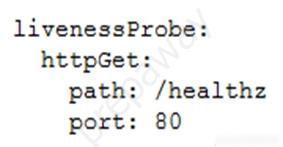
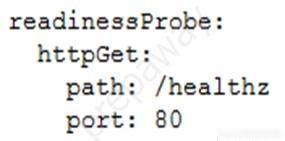
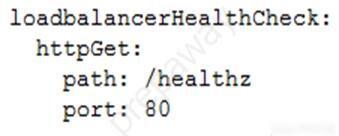
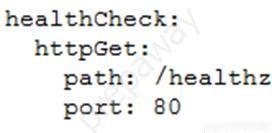
You are planning to deploy your application in a Google Kubernetes Engine (GKE) cluster. The application exposes an HTTP-based health check at /healthz. You want to use this health check endpoint to determine whether traffic should be routed to the pod by the load balancer.
Which code snippet should you include in your Pod configuration?
A.
B.
C.
D.
    Show answer & explanation

    Correct answer: B

    ExplanationFor the GKE ingress controller to use your readinessProbes as health checks, the Pods for an Ingress must exist at the time of Ingress creation. If your replicas are scaled to 0, the default health check will apply.

    QUESTION 13

    Your teammate has asked you to review the code below. Its purpose is to efficiently add a large number of small rows to a BigQuery table.
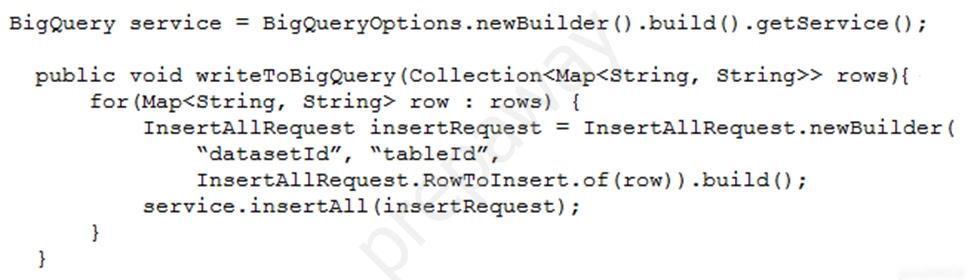
    Which improvement should you suggest your teammate make?

    1. AA. Include multiple rows with each request.
    2. BB. Perform the inserts in parallel by creating multiple threads.
    3. CC. Write each row to a Cloud Storage object, then load into BigQuery.
    4. DD. Write each row to a Cloud Storage object in parallel, then load into BigQuery.
    Show answer & explanation

    Correct answer: A

    ExplanationIn fact the loop build a single InsertReqeust and send it. But we can build all request in a list and use InsertAllRequest.newBuilder(tableId).setRows(rows).build() to send. https://cloud.google.com/bigquery/streaming-data-into-bigquery#streaminginsertexamples

    QUESTION 14

    You are developing a JPEG image-resizing API hosted on Google Kubernetes Engine (GKE). Callers of the service will exist within the same GKE cluster. You want clients to be able to get the IP address of the service.
    What should you do?

    1. AA. Define a GKE Service. Clients should use the name of the A record in Cloud DNS to find the service's cluster IP address.
    2. BB. Define a GKE Service. Clients should use the service name in the URL to connect to the service.
    3. CC. Define a GKE Endpoint. Clients should get the endpoint name from the appropriate environment variable in the client container.
    4. DD. Define a GKE Endpoint. Clients should get the endpoint name from Cloud DNS.
    Show answer & explanation

    Correct answer: B

    Explanationit's B - Clients are in the cluster and therefore can use service dns names. https://kubernetes.io/docs/concepts/services-networking/dns-pod-service/ "Every Service defined in the cluster (including the DNS server itself) is assigned a DNS name. By default, a client Pod's DNS search list includes the Pod's own namespace and the cluster's default domain."

    QUESTION 15

    You are using Cloud Build to build and test application source code stored in Cloud Source Repositories. The build process requires a build tool not available in the Cloud Build environment.
    What should you do?

    1. AA. Download the binary from the internet during the build process.
    2. BB. Build a custom cloud builder image and reference the image in your build steps.
    3. CC. Include the binary in your Cloud Source Repositories repository and reference it in your build scripts.
    4. DD. Ask to have the binary added to the Cloud Build environment by filing a feature request against the Cloud Build public Issue Tracker.
    Show answer & explanation

    Correct answer: B

    Explanation

    QUESTION 16

    You are deploying your application to a Compute Engine virtual machine instance. Your application is configured to write its log files to disk. You want to view the logs in Stackdriver Logging without changing the application code.
    What should you do?

    1. AA. Install the Stackdriver Logging Agent and configure it to send the application logs.
    2. BB. Use a Stackdriver Logging Library to log directly from the application to Stackdriver Logging.
    3. CC. Provide the log file folder path in the metadata of the instance to configure it to send the application logs.
    4. DD. Change the application to log to /var/log so that its logs are automatically sent to Stackdriver Logging.
    Show answer & explanation

    Correct answer: A

    Explanation

    QUESTION 17

    Your service adds text to images that it reads from Cloud Storage. During busy times of the year, requests to Cloud Storage fail with an HTTP 429 'Too Many
    Requests' status code.
    How should you handle this error?

    1. AA. Add a cache-control header to the objects.
    2. BB. Request a quota increase from the GCP Console.
    3. CC. Retry the request with a truncated exponential backoff strategy.
    4. DD. Change the storage class of the Cloud Storage bucket to Multi-regional.
    Show answer & explanation

    Correct answer: C

    ExplanationReference:
    https://developers.google.com/gmail/api/v1/reference/quota

    QUESTION 18

    You are building an API that will be used by Android and iOS apps. The API must:
    * Support HTTPs
    * Minimize bandwidth cost
    * Integrate easily with mobile apps
    Which API architecture should you use?

    1. AA. RESTful APIs
    2. BB. MQTT for APIs
    3. CC. gRPC-based APIs
    4. DD. SOAP-based APIs
    Show answer & explanation

    Correct answer: C

    ExplanationgRPC is a modern, high-performance framework that uses HTTP/2, which provides significant advantages like multiplexed streams, header compression, and efficient use of bandwidth. It is well-suited for mobile apps due to its ability to reduce bandwidth usage and improve performance, especially for real-time communication. Additionally, gRPC has native support for multiple programming languages, making it easier to integrate with both Android and iOS apps.

    QUESTION 19

    Your application takes an input from a user and publishes it to the user's contacts. This input is stored in a table in Cloud Spanner. Your application is more sensitive to latency and less sensitive to consistency.
    How should you perform reads from Cloud Spanner for this application?

    1. AA. Perform Read-Only transactions.
    2. BB. Perform stale reads using single-read methods.
    3. CC. Perform strong reads using single-read methods.
    4. DD. Perform stale reads using read-write transactions.
    Show answer & explanation

    Correct answer: B

    ExplanationAs mentioned here https://cloud.google.com/spanner/docs/reference/rest/v1/TransactionOptions read-write transaction type has no options, and there is no way to make stale reads with this transaction type, so D) is definitely wrong. In the question, low latency is more critical than consistency, so C) is not an option. Read-Only transactions can do stale reads as well as Single Read methods, but in the documentation https://cloud.google.com/spanner/docs/transactions#read-only_transactions , they encourage to use SingleRead methods where possible.

    QUESTION 20

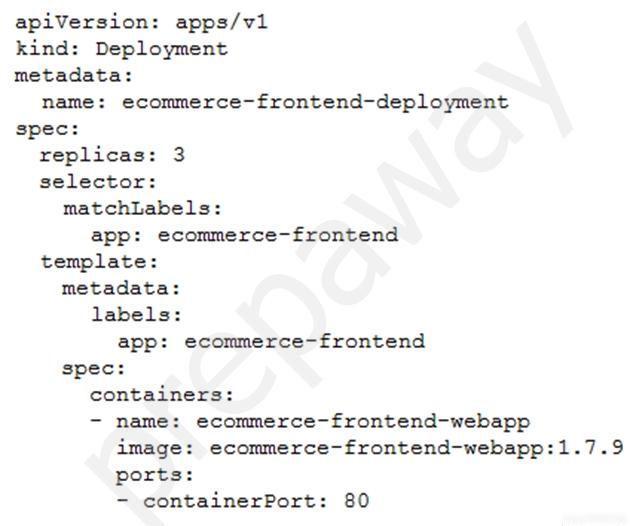
    Your application is deployed in a Google Kubernetes Engine (GKE) cluster. When a new version of your application is released, your CI/CD tool updates the spec.template.spec.containers[0].image value to reference the Docker image of your new application version. When the Deployment object applies the change, you want to deploy at least 1 replica of the new version and maintain the previous replicas until the new replica is healthy.
    Which change should you make to the GKE Deployment object shown below?
    1. AA. Set the Deployment strategy to RollingUpdate with maxSurge set to 0, maxUnavailable set to 1.
    2. BB. Set the Deployment strategy to RollingUpdate with maxSurge set to 1, maxUnavailable set to 0.
    3. CC. Set the Deployment strategy to Recreate with maxSurge set to 0, maxUnavailable set to 1.
    4. DD. Set the Deployment strategy to Recreate with maxSurge set to 1, maxUnavailable set to 0.
    Show answer & explanation

    Correct answer: B

    ExplanationRollingUpdate: New pods are added gradually, and old pods are terminated gradually Recreate: All old pods are terminated before any new pods are added Question ask us to retain current version hence rolling update is better option here.

    Build a focused GCP-PCD practice routine.

    Choose GCP-PCD in Revizo and work through original, question-by-question practice on your iPhone. Review results, revisit what needs attention and keep your next session tied to one specific certification objective.

    Practise GCP-PCD with Revizo

    GCP-PCD practice questions.

    Is Revizo the official Google exam?

    No. Revizo is an independent iPhone app for certification practice. Refer to the provider's official resources for current exam policies and registration.

    How should I use these GCP-PCD practice questions?

    Use the exam code to select the matching certification in Revizo, then build short, focused sessions around the areas you want to review.

    Are Revizo questions copied from live examinations?

    No. Revizo provides original practice questions for certification study. Use the provider's official objectives, documentation and policies as the source of truth for your preparation.

    What should I use alongside GCP-PCD practice questions?

    Use the current Google objectives, documentation and registration guidance as your source of truth. Revizo is designed to support focused practice, not replace the provider's official materials.

    Where can I confirm current GCP-PCD requirements?

    Check the official Google exam page for the latest objectives, registration details and policies.