Revizo / Cisco / 350-701

CISCO CERTIFICATION STUDY GUIDE

350-701 practice questions.
Prepare with a clearer plan.

Validates knowledge of implementing and operating core security technologies, including network security, cloud security, content security, endpoint protection and detection, secure network access, visibility, and enforcements.

Download Revizo
Revizo certification practice question on iPhone

What to know about 350-701.

Validates knowledge of implementing and operating core security technologies, including network security, cloud security, content security, endpoint protection and detection, secure network access, visibility, and enforcements.

Format
Multiple choice questions
Duration
120 minutes
Passing score
Pass/Fail
Recommended experience
Cisco CCNA or equivalent networking knowledge

Exam details are based on the available Cisco catalogue information. Confirm current requirements with the exam provider before booking.

How to prepare for 350-701.

Use the provider's current objectives as your source of truth, then organise your Revizo sessions around networking concepts, platform capabilities and operational decisions named in the certification. The 350-701 exam is listed as Multiple choice questions; your starting point should reflect Cisco CCNA or equivalent networking knowledge.

01

Map the official objectives.

Read the current Cisco objectives and make a short list of the areas you need to revisit before booking 350-701.

02

Practise one area at a time.

Select 350-701 in Revizo and use focused question sessions to test one topic or decision type at a time, rather than relying on a single long cram session.

03

Review, then repeat.

Use your results to return to incorrect answers, revisit the official material behind them and repeat short 350-701 practice sessions until the gaps are clearer.

FREE PRACTICE PREVIEW

Read the first 20
350-701 questions.

Review each question, its correct answer and any available source explanation before continuing your certification study in Revizo.

FIRST 20 QUESTIONS

Answers & available explanations

QUESTION 1

Which functions of an SDN architecture require southbound APIs to enable communication?

  1. AA. SDN controller and the network elements
  2. BB. management console and the SDN controller
  3. CC. management console and the cloud
  4. DD. SDN controller and the cloud
Show answer & explanation

Correct answer: A

ExplanationSouthbound APIs enable communication between the SDN controller and network elements (switches, routers, firewalls) to program the data plane. See https://www.cisco.com/c/en/us/solutions/software-defined-networking/overview.html

QUESTION 2

Which two request methods of REST API are valid on the Cisco ASA Platform? (Choose two.)

  1. AA. put
  2. BB. options
  3. CC. get
  4. DD. push
  5. EE. connect
Show answer & explanation

Correct answer: A, C

ExplanationThe Cisco ASA REST API supports GET to retrieve objects and PUT to add or update configuration on existing objects. See https://www.cisco.com/c/en/us/td/docs/security/asa/api/quick-start/qsg-asa-api.html

QUESTION 3

The main function of northbound APIs in the SDN architecture is to enable communication between which two areas of a network?

  1. AA. SDN controller and the cloud
  2. BB. management console and the SDN controller
  3. CC. management console and the cloud
  4. DD. SDN controller and the management solution
Show answer & explanation

Correct answer: B

ExplanationNorthbound APIs connect applications and management consoles to the SDN controller, allowing orchestration above the control plane. See https://www.cisco.com/c/en/us/solutions/software-defined-networking/overview.html

QUESTION 4

What is a feature of the open platform capabilities of Cisco DNA Center?

  1. AA. application adapters
  2. BB. domain integration
  3. CC. intent-based APIs
  4. DD. automation adapters
Show answer & explanation

Correct answer: C

ExplanationCisco DNA Center open platform capabilities include intent-based APIs that let administrators express desired outcomes rather than device-level CLI commands. See https://www.cisco.com/c/en/us/products/collateral/cloud-systems-management/dna-center/datasheet-c78-739398.html

QUESTION 5


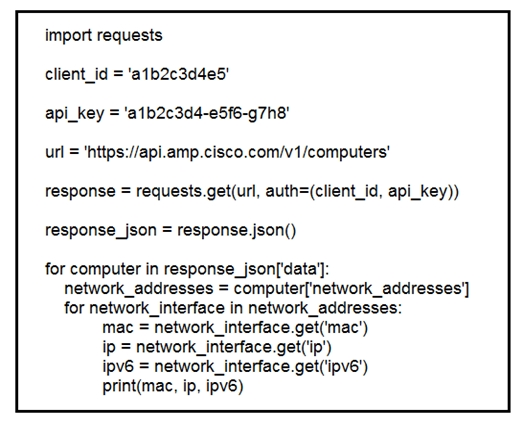
Refer to the exhibit. What does the API do when connected to a Cisco security appliance?

  1. AA. create an SNMP pull mechanism for managing AMP
  2. BB. gather network telemetry information from AMP for endpoints
  3. CC. get the process and PID information from the computers in the network
  4. DD. gather the network interface information about the computers AMP sees
Show answer & explanation

Correct answer: D

ExplanationThe GET /v1/computers AMP API call returns endpoint inventory including network interface information for computers seen by AMP. See https://api-docs.amp.cisco.com/api_actions/details?api_action=GET+%2Fv1%2Fcomputers

QUESTION 6

Which form of attack is launched using botnets?

  1. AA. TCP flood
  2. BB. DDOS
  3. CC. DOS
  4. DD. virus
Show answer & explanation

Correct answer: B

ExplanationBotnets are commonly used to launch distributed denial-of-service (DDoS) attacks by coordinating large numbers of compromised hosts to flood targets.

QUESTION 7

In which form of attack is alternate encoding, such as hexadecimal representation, most often observed?

  1. AA. smurf
  2. BB. distributed denial of service
  3. CC. cross-site scripting
  4. DD. rootkit exploit
Show answer & explanation

Correct answer: C

ExplanationCross-site scripting attacks frequently use alternate encoding such as hexadecimal or URL encoding to bypass input filters and inject malicious scripts into web pages.

QUESTION 8

Which flaw does an attacker leverage when exploiting SQL injection vulnerabilities?

  1. AA. user input validation in a web page or web application
  2. BB. Linux and Windows operating systems
  3. CC. database
  4. DD. web page images
Show answer & explanation

Correct answer: A

ExplanationSQL injection exploits insufficient validation or sanitization of user-supplied input that is incorporated into database queries.

QUESTION 9

What is the difference between deceptive phishing and spear phishing?

  1. AA. Deceptive phishing is an attacked aimed at a specific user in the organization who holds a C-level role.
  2. BB. A spear phishing campaign is aimed at a specific person versus a group of people.
  3. CC. Spear phishing is when the attack is aimed at the C-level executives of an organization.
  4. DD. Deceptive phishing hijacks and manipulates the DNS server of the victim and redirects the user to a false webpage.
Show answer & explanation

Correct answer: B

ExplanationSpear phishing targets a specific individual, whereas deceptive phishing uses broadly convincing messages sent to many recipients.

QUESTION 10

Which two behavioral patterns characterize a ping of death attack? (Choose two.)

  1. AA. The attack is fragmented into groups of 16 octets before transmission.
  2. BB. The attack is fragmented into groups of 8 octets before transmission.
  3. CC. Short synchronized bursts of traffic are used to disrupt TCP connections.
  4. DD. Malformed packets are used to crash systems.
  5. EE. Publicly accessible DNS servers are typically used to execute the attack.
Show answer & explanation

Correct answer: B, D

ExplanationA ping of death sends oversized or malformed ICMP packets, often fragmented into 8-octet pieces, that crash systems when reassembled.

QUESTION 11

Which two mechanisms are used to control phishing attacks? (Choose two.)

  1. AA. Enable browser alerts for fraudulent websites.
  2. BB. Define security group memberships.
  3. CC. Revoke expired CRL of the websites.
  4. DD. Use antispyware software.
  5. EE. Implement email filtering techniques.
Show answer & explanation

Correct answer: A, E

ExplanationPhishing mitigation includes enabling browser alerts for fraudulent websites and implementing email filtering to block malicious messages before they reach users.

QUESTION 12

Which attack is commonly associated with C and C++ programming languages?

  1. AA. cross-site scripting
  2. BB. water holing
  3. CC. DDoS
  4. DD. buffer overflow
Show answer & explanation

Correct answer: D

ExplanationBuffer overflow attacks are closely associated with C and C++ because these languages do not automatically enforce memory bounds on arrays and buffers.

QUESTION 13

Which two prevention techniques are used to mitigate SQL injection attacks? (Choose two.)

  1. AA. Check integer, float, or Boolean string parameters to ensure accurate values.
  2. BB. Use prepared statements and parameterized queries.
  3. CC. Secure the connection between the web and the app tier.
  4. DD. Write SQL code instead of using object-relational mapping libraries.
  5. EE. Block SQL code execution in the web application database login.
Show answer & explanation

Correct answer: A, B

ExplanationSQL injection prevention relies on parameterized queries/prepared statements and validating integer, float, and Boolean parameters before use in queries.

QUESTION 14

Which two kinds of attacks are prevented by multifactor authentication? (Choose two.)

  1. AA. phishing
  2. BB. brute force
  3. CC. man-in-the-middle
  4. DD. DDOS
  5. EE. tear drop
Show answer & explanation

Correct answer: A, B

ExplanationMultifactor authentication mitigates phishing and brute-force attacks by requiring additional factors beyond a single password.

QUESTION 15

What are two rootkit types? (Choose two.)

  1. AA. registry
  2. BB. buffer mode
  3. CC. user mode
  4. DD. bootloader
  5. EE. virtual
Show answer & explanation

Correct answer: C, D

ExplanationCommon rootkit types include user-mode rootkits that hook OS APIs and bootloader/kernel rootkits that load before the operating system.

QUESTION 16

How is DNS tunneling used to exfiltrate data out of a corporate network?

  1. AA. It leverages the DNS server by permitting recursive lookups to spread the attack to other DNS servers
  2. BB. It encodes the payload with random characters that are broken into short strings and the DNS server rebuilds the exfiltrated data
  3. CC. It redirects DNS requests to a malicious server used to steal user credentials, which allows further damage and theft on the network
  4. DD. It corrupts DNS servers by replacing the actual IP address with a rogue address to collect information or start other attacks
Show answer & explanation

Correct answer: B

ExplanationDNS tunneling encodes exfiltrated data into DNS queries/responses, often as short encoded strings that a malicious authoritative server reassembles.

QUESTION 17

Which type of attack is social engineering?

  1. AA. trojan
  2. BB. MITM
  3. CC. phishing
  4. DD. malware
Show answer & explanation

Correct answer: C

ExplanationPhishing is a form of social engineering that manipulates users into revealing credentials or performing unsafe actions.

QUESTION 18

What are two DDoS attack categories? (Choose two.)

  1. AA. protocol
  2. BB. source-based
  3. CC. database
  4. DD. sequential
  5. EE. volume-based
Show answer & explanation

Correct answer: A, E

ExplanationDDoS attacks are commonly categorized as volume-based floods and protocol-based attacks that exploit weaknesses in network protocols.

QUESTION 19

In which type of attack does the attacker insert their machine between two hosts that are communicating with each other?

  1. AA. man-in-the-middle
  2. BB. LDAP injection
  3. CC. insecure API
  4. DD. cross-site scripting
Show answer & explanation

Correct answer: A

ExplanationA man-in-the-middle attack places the attacker between two communicating hosts to intercept or alter traffic.

QUESTION 20

How does Cisco Advanced Phishing Protection protect users?

  1. AA. It utilizes sensors that send messages securely.
  2. BB. It uses machine learning and real-time behavior analytics.
  3. CC. It validates the sender by using DKIM.
  4. DD. It determines which identities are perceived by the sender.
Show answer & explanation

Correct answer: B

ExplanationCisco Advanced Phishing Protection uses machine learning and real-time behavioral analytics to detect identity deception and phishing threats.

Build a focused 350-701 practice routine.

Choose 350-701 in Revizo and work through original, question-by-question practice on your iPhone. Review results, revisit what needs attention and keep your next session tied to one specific certification objective.

Practise 350-701 with Revizo

350-701 practice questions.

Is Revizo the official Cisco exam?

No. Revizo is an independent iPhone app for certification practice. Refer to the provider's official resources for current exam policies and registration.

How should I use these 350-701 practice questions?

Use the exam code to select the matching certification in Revizo, then build short, focused sessions around the areas you want to review.

Are Revizo questions copied from live examinations?

No. Revizo provides original practice questions for certification study. Use the provider's official objectives, documentation and policies as the source of truth for your preparation.

What should I use alongside 350-701 practice questions?

Use the current Cisco objectives, documentation and registration guidance as your source of truth. Revizo is designed to support focused practice, not replace the provider's official materials.

Where can I confirm current 350-701 requirements?

Check the official Cisco exam page for the latest objectives, registration details and policies.