Revizo / Cisco / 350-401

CISCO CERTIFICATION STUDY GUIDE

350-401 practice questions.
Prepare with a clearer plan.

Validates knowledge of implementing core enterprise network technologies, including dual stack (IPv4 and IPv6) architecture, virtualization, infrastructure, network assurance, security, and automation.

Download Revizo
Revizo certification practice question on iPhone

What to know about 350-401.

Validates knowledge of implementing core enterprise network technologies, including dual stack (IPv4 and IPv6) architecture, virtualization, infrastructure, network assurance, security, and automation.

Format
Multiple choice questions
Duration
120 minutes
Passing score
Pass/Fail
Recommended experience
Cisco CCNA or equivalent networking knowledge

Exam details are based on the available Cisco catalogue information. Confirm current requirements with the exam provider before booking.

How to prepare for 350-401.

Use the provider's current objectives as your source of truth, then organise your Revizo sessions around networking concepts, platform capabilities and operational decisions named in the certification. The 350-401 exam is listed as Multiple choice questions; your starting point should reflect Cisco CCNA or equivalent networking knowledge.

01

Map the official objectives.

Read the current Cisco objectives and make a short list of the areas you need to revisit before booking 350-401.

02

Practise one area at a time.

Select 350-401 in Revizo and use focused question sessions to test one topic or decision type at a time, rather than relying on a single long cram session.

03

Review, then repeat.

Use your results to return to incorrect answers, revisit the official material behind them and repeat short 350-401 practice sessions until the gaps are clearer.

FREE PRACTICE PREVIEW

Read the first 20
350-401 questions.

Review each question, its correct answer and any available source explanation before continuing your certification study in Revizo.

FIRST 20 QUESTIONS

Answers & available explanations

QUESTION 1

What is the difference between a RIB and a FIB?

  1. AA. The FIB is populated based on RIB content.
  2. BB. The RIB maintains a mirror image of the FIB.
  3. CC. The RIB is used to make IP source prefix-based switching decisions.
  4. DD. The FIB is where all IP routing information is stored.
Show answer & explanation

Correct answer: A

ExplanationThe FIB is built from the RIB; the RIB (control plane) selects best routes that are programmed into the FIB (data plane).

QUESTION 2

Which QoS component alters a packet to change the way that traffic is treated in the network?

  1. AA. policing
  2. BB. classification
  3. CC. marking
  4. DD. shaping
Show answer & explanation

Correct answer: C

ExplanationMarking alters fields (DSCP/CoS) in a packet to change how downstream devices treat the traffic.

QUESTION 3

DRAG DROP -
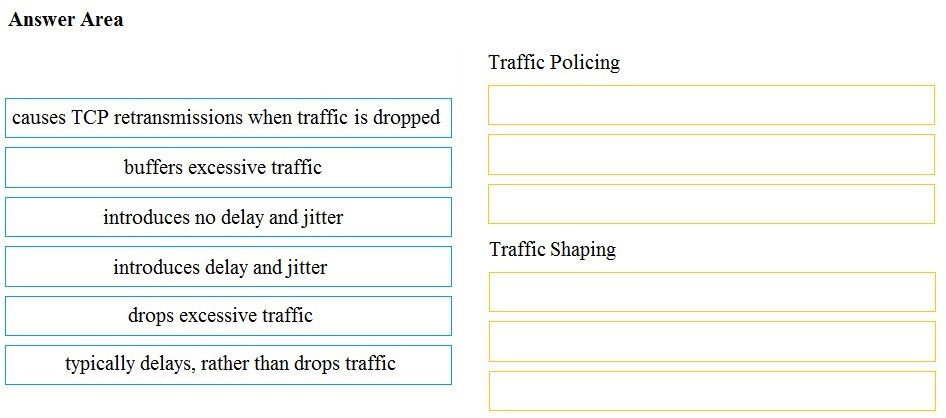
Drag and drop the descriptions from the left onto the correct QoS components on the right.
Select and Place:
Item 1

  1. AA. causes TCP retransmissions when traffic is dropped
  2. BB. buffers excessive traffic
  3. CC. introduces no delay and jitter
  4. DD. introduces delay and jitter
  5. EE. drops excessive traffic
  6. FF. typically delays, rather than drops traffic

Item 2

  1. AA. causes TCP retransmissions when traffic is dropped
  2. BB. buffers excessive traffic
  3. CC. introduces no delay and jitter
  4. DD. introduces delay and jitter
  5. EE. drops excessive traffic
  6. FF. typically delays, rather than drops traffic
Show answer & explanation

Correct answer: Item 1: E, A, C · Item 2: B, D, F

ExplanationTraffic policing drops excessive traffic that exceeds the configured rate, which causes TCP retransmissions, and because it does not buffer packets it introduces no added delay or jitter. Traffic shaping instead buffers excessive traffic and releases it later, so it typically delays rather than drops traffic, which introduces delay and jitter.

QUESTION 4

Which statement about Cisco Express Forwarding is true?

  1. AA. The CPU of a router becomes directly involved with packet-switching decisions.
  2. BB. It uses a fast cache that is maintained in a router data plane.
  3. CC. It maintains two tables in the data plane: the FIB and adjacency table.
  4. DD. It makes forwarding decisions by a process that is scheduled through the IOS scheduler.
Show answer & explanation

Correct answer: C

ExplanationCEF maintains the FIB and adjacency table in the data plane for fast, topology-driven forwarding.

QUESTION 5

What is a benefit of deploying an on-premises infrastructure versus a cloud infrastructure deployment?

  1. AA. ability to quickly increase compute power without the need to install additional hardware
  2. BB. less power and cooling resources needed to run infrastructure on-premises
  3. CC. faster deployment times because additional infrastructure does not need to be purchased
  4. DD. lower latency between systems that are physically located near each other
Show answer & explanation

Correct answer: D

ExplanationOn-premises systems located physically near each other achieve lower latency than cloud-hosted resources.

QUESTION 6

DRAG DROP -
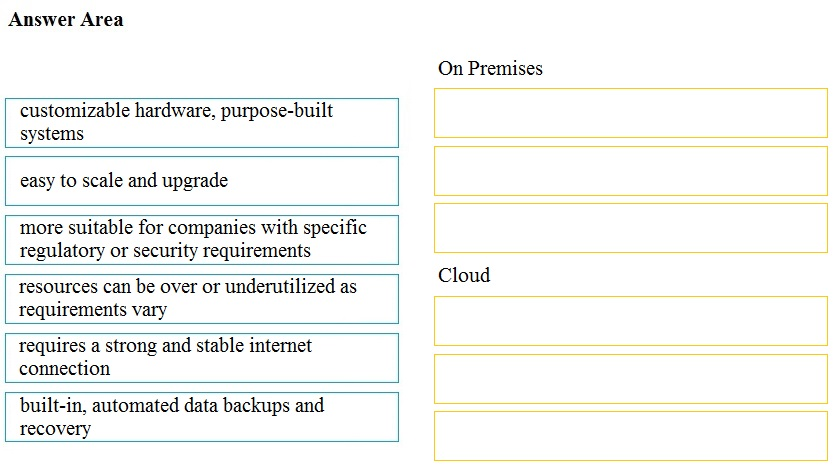
Drag and drop the characteristics from the left onto the appropriate infrastructure deployment types on the right.
Select and Place:
Item 1

  1. AA. customizable hardware, purpose-built systems
  2. BB. easy to scale and upgrade
  3. CC. more suitable for companies with specific regulatory or security requirements
  4. DD. resources can be over or underutilized as requirements vary
  5. EE. requires a strong and stable internet connection
  6. FF. built-in, automated data backups and recovery

Item 2

  1. AA. customizable hardware, purpose-built systems
  2. BB. easy to scale and upgrade
  3. CC. more suitable for companies with specific regulatory or security requirements
  4. DD. resources can be over or underutilized as requirements vary
  5. EE. requires a strong and stable internet connection
  6. FF. built-in, automated data backups and recovery
Show answer & explanation

Correct answer: Item 1: A, C, D · Item 2: B, E, F

ExplanationOn-premises deployments use customizable, purpose-built hardware, are more suitable for organizations with strict regulatory or security requirements, and can leave resources over- or under-utilized because capacity is fixed. Cloud deployments scale and upgrade easily, depend on a strong and stable internet connection, and provide built-in, automated data backup and recovery.

QUESTION 7

How does QoS traffic shaping alleviate network congestion?

  1. AA. It drops packets when traffic exceeds a certain bitrate.
  2. BB. It buffers and queues packets above the committed rate.
  3. CC. It fragments large packets and queues them for delivery.
  4. DD. It drops packets randomly from lower priority queues.
Show answer & explanation

Correct answer: B

ExplanationShaping buffers and queues traffic above the committed rate, smoothing bursts rather than dropping.

QUESTION 8

An engineer is describing QoS to a client.
Which two facts apply to traffic policing? (Choose two.)

  1. AA. Policing should be performed as close to the source as possible.
  2. BB. Policing adapts to network congestion by queuing excess traffic.
  3. CC. Policing should be performed as close to the destination as possible.
  4. DD. Policing drops traffic that exceeds the defined rate.
  5. EE. Policing typically delays the traffic, rather than drops it.
Show answer & explanation

Correct answer: A, D

ExplanationPolicing is best done close to the source and drops (or re-marks) traffic exceeding the defined rate.

QUESTION 9

Which component handles the orchestration plane of the Cisco SD-WAN?

  1. AA. vBond
  2. BB. vSmart
  3. CC. vManage
  4. DD. WAN Edge
Show answer & explanation

Correct answer: A

ExplanationvBond is the orchestration plane that authenticates and brings up devices in Cisco SD-WAN.

QUESTION 10

What are two device roles in Cisco SD-Access fabric? (Choose two.)

  1. AA. edge node
  2. BB. vBond controller
  3. CC. access switch
  4. DD. core switch
  5. EE. border node
Show answer & explanation

Correct answer: A, E

ExplanationEdge nodes and border nodes are device roles in the SD-Access fabric.

QUESTION 11

What is the role of the vSmart controller in a Cisco SD-WAN environment?

  1. AA. It performs authentication and authorization.
  2. BB. It manages the control plane.
  3. CC. It is the centralized network management system.
  4. DD. It manages the data plane.
Show answer & explanation

Correct answer: B

ExplanationvSmart is the control plane of Cisco SD-WAN, distributing OMP routes and policy.

QUESTION 12

When a wired client connects to an edge switch in a Cisco SD-Access fabric, which component decides whether the client has access to the network?

  1. AA. edge node
  2. BB. Identity Services Engine
  3. CC. RADIUS server
  4. DD. control-plane node
Show answer & explanation

Correct answer: B

ExplanationCisco ISE performs authentication/authorization and decides client network access in SD-Access.

QUESTION 13

Which benefit is offered by a cloud infrastructure deployment but is lacking in an on-premises deployment?

  1. AA. virtualization
  2. BB. supported systems
  3. CC. storage capacity
  4. DD. efficient scalability
Show answer & explanation

Correct answer: D

ExplanationEfficient (elastic) scalability is a cloud benefit not readily available on-premises.

QUESTION 14

Which action is the vSmart controller responsible for in a Cisco SD-WAN deployment?

  1. AA. onboard WAN Edge nodes into the Cisco SD-WAN fabric
  2. BB. gather telemetry data from WAN Edge routers
  3. CC. distribute policies that govern data forwarding performed within the Cisco SD-WAN fabric
  4. DD. handle, maintain, and gather configuration and status for nodes within the Cisco SD-WAN fabric
Show answer & explanation

Correct answer: C

ExplanationvSmart distributes the policies that govern data forwarding within the SD-WAN fabric.

QUESTION 15

Where is radio resource management performed in a Cisco SD-Access wireless solution?

  1. AA. DNA Center
  2. BB. control plane node
  3. CC. wireless controller
  4. DD. Cisco CMX
Show answer & explanation

Correct answer: C

ExplanationRadio resource management is handled by the wireless LAN controller in SD-Access wireless.

QUESTION 16

DRAG DROP -
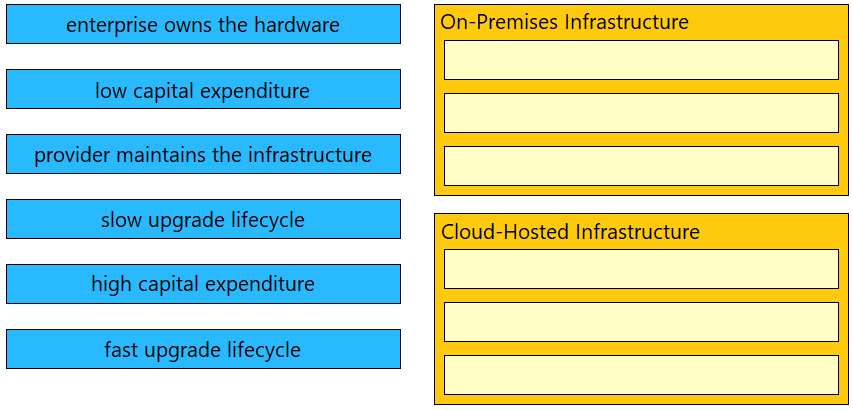
Drag and drop the characteristics from the left onto the infrastructure types on the right.
Select and Place:
Item 1

  1. AA. enterprise owns the hardware
  2. BB. low capital expenditure
  3. CC. provider maintains the infrastructure
  4. DD. slow upgrade lifecycle
  5. EE. high capital expenditure
  6. FF. fast upgrade lifecycle

Item 2

  1. AA. enterprise owns the hardware
  2. BB. low capital expenditure
  3. CC. provider maintains the infrastructure
  4. DD. slow upgrade lifecycle
  5. EE. high capital expenditure
  6. FF. fast upgrade lifecycle
Show answer & explanation

Correct answer: Item 1: A, D, E · Item 2: B, C, F

ExplanationWith on-premises infrastructure the enterprise owns the hardware, capital expenditure is high, and the upgrade lifecycle is slow. With cloud-hosted infrastructure capital expenditure is low, the provider maintains the infrastructure, and the upgrade lifecycle is fast.

QUESTION 17

How does the RIB differ from the FIB?

  1. AA. The FIB maintains network topologies and routing tables. The RIB is a list of routes to particular network destinations.
  2. BB. The FIB includes many routes to a single destination. The RIB is the best route to a single destination.
  3. CC. The RIB is used to create network topologies and routing tables. The FIB is a list of routes to particular network destinations.
  4. DD. The RIB includes many routes to the same destination prefix. The FIB contains only the best route.
Show answer & explanation

Correct answer: D

ExplanationThe RIB can hold multiple routes to a prefix; the FIB holds only the chosen best route.

QUESTION 18

Which technology is used to provide Layer 2 and Layer 3 logical networks in the Cisco SD-Access architecture?

  1. AA. underlay network
  2. BB. VPN routing/forwarding
  3. CC. easy virtual network
  4. DD. overlay network
Show answer & explanation

Correct answer: D

ExplanationThe overlay network provides Layer 2 and Layer 3 logical networks in SD-Access.

QUESTION 19

What is the difference between CEF and process switching?

  1. AA. CEF processes packets that are too complex for process switching to manage.
  2. BB. Process switching is faster than CEF.
  3. CC. CEF uses the FIB and the adjacency table to make forwarding decisions, whereas process switching punts each packet.
  4. DD. CEF is more CPU-intensive than process switching.
Show answer & explanation

Correct answer: C

ExplanationCEF uses the FIB and adjacency table; process switching punts every packet to the CPU.

QUESTION 20

What are two considerations when using SSO as a network redundancy feature? (Choose two.)

  1. AA. requires synchronization between supervisors in order to guarantee continuous connectivity
  2. BB. the multicast state is preserved during switchover
  3. CC. must be combined with NSF to support uninterrupted Layer 3 operations
  4. DD. both supervisors must be configured separately
  5. EE. must be combined with NSF to support uninterrupted Layer 2 operations
Show answer & explanation

Correct answer: A, C

ExplanationSSO requires supervisor synchronization and is combined with NSF for uninterrupted Layer 3 operation.

Build a focused 350-401 practice routine.

Choose 350-401 in Revizo and work through original, question-by-question practice on your iPhone. Review results, revisit what needs attention and keep your next session tied to one specific certification objective.

Practise 350-401 with Revizo

350-401 practice questions.

Is Revizo the official Cisco exam?

No. Revizo is an independent iPhone app for certification practice. Refer to the provider's official resources for current exam policies and registration.

How should I use these 350-401 practice questions?

Use the exam code to select the matching certification in Revizo, then build short, focused sessions around the areas you want to review.

Are Revizo questions copied from live examinations?

No. Revizo provides original practice questions for certification study. Use the provider's official objectives, documentation and policies as the source of truth for your preparation.

What should I use alongside 350-401 practice questions?

Use the current Cisco objectives, documentation and registration guidance as your source of truth. Revizo is designed to support focused practice, not replace the provider's official materials.

Where can I confirm current 350-401 requirements?

Check the official Cisco exam page for the latest objectives, registration details and policies.