Focus
AWS CERTIFICATION STUDY GUIDE
MLA-C01 practice questions.
Prepare with a clearer plan.
Validates foundational skills in machine learning engineering and deployment on AWS.
Download Revizo
What to know about MLA-C01.
Validates foundational skills in machine learning engineering and deployment on AWS.
- Format
- Multiple choice and multiple response questions
- Duration
- 170 minutes
- Passing score
- 720/1000
- Recommended experience
- 1+ years of ML engineering experience on AWS
Exam details are based on the available AWS catalogue information. Confirm current requirements with the exam provider before booking.
Make MLA-C01 revision practical and lifecycle-based.
Organise study around the lifecycle of an ML workload: preparation, training, deployment, monitoring and iteration. Use each practice question to explain the decision it is testing.
Focus
Model development
Training, evaluation and selection decisions for a stated problem.Focus
Deployment and operations
Serving, monitoring, security and operational improvement.MLA-C01 is an associate machine learning engineering path. It differs from foundational AI preparation by focusing on practical ML lifecycle decisions.
How to prepare for MLA-C01.
Use the provider's current objectives as your source of truth, then organise your Revizo sessions around AWS services, cloud concepts and the decisions expected in the certification. The MLA-C01 exam is listed as Multiple choice and multiple response questions; your starting point should reflect 1+ years of ML engineering experience on AWS.
Map the official objectives.
Read the current AWS objectives and make a short list of the areas you need to revisit before booking MLA-C01.
Practise one area at a time.
Select MLA-C01 in Revizo and use focused question sessions to test one topic or decision type at a time, rather than relying on a single long cram session.
Review, then repeat.
Use your results to return to incorrect answers, revisit the official material behind them and repeat short MLA-C01 practice sessions until the gaps are clearer.
FREE PRACTICE PREVIEW
Read the first 20
MLA-C01 questions.
Review each question, its correct answer and any available source explanation before continuing your certification study in Revizo.
FIRST 20 QUESTIONS
Answers & available explanations
QUESTION 1
Case Study -
A company is building a web-based AI application by using Amazon SageMaker. The application will provide the following capabilities and features: ML experimentation, training, a central model registry, model deployment, and model monitoring.
The application must ensure secure and isolated use of training data during the ML lifecycle. The training data is stored in Amazon S3.
The company needs to use the central model registry to manage different versions of models in the application.
Which action will meet this requirement with the LEAST operational overhead?
Show answer & explanation
Correct answer: C
Explanation
QUESTION 2
Case Study -
A company is building a web-based AI application by using Amazon SageMaker. The application will provide the following capabilities and features: ML experimentation, training, a central model registry, model deployment, and model monitoring.
The application must ensure secure and isolated use of training data during the ML lifecycle. The training data is stored in Amazon S3.
The company is experimenting with consecutive training jobs.
How can the company MINIMIZE infrastructure startup times for these jobs?
Show answer & explanation
Correct answer: B
Explanation
QUESTION 3
Case Study -
A company is building a web-based AI application by using Amazon SageMaker. The application will provide the following capabilities and features: ML experimentation, training, a central model registry, model deployment, and model monitoring.
The application must ensure secure and isolated use of training data during the ML lifecycle. The training data is stored in Amazon S3.
The company must implement a manual approval-based workflow to ensure that only approved models can be deployed to production endpoints.
Which solution will meet this requirement?
Show answer & explanation
Correct answer: D
Explanation
QUESTION 4
Case Study -
A company is building a web-based AI application by using Amazon SageMaker. The application will provide the following capabilities and features: ML experimentation, training, a central model registry, model deployment, and model monitoring.
The application must ensure secure and isolated use of training data during the ML lifecycle. The training data is stored in Amazon S3.
The company needs to run an on-demand workflow to monitor bias drift for models that are deployed to real-time endpoints from the application.
Which action will meet this requirement?
Show answer & explanation
Correct answer: A
Explanation
QUESTION 5
HOTSPOT -
A company stores historical data in .csv files in Amazon S3. Only some of the rows and columns in the .csv files are populated. The columns are not labeled. An ML engineer needs to prepare and store the data so that the company can use the data to train ML models.
Select and order the correct steps from the following list to perform this task. Each step should be selected one time or not at all. (Select and order three.)
• Create an Amazon SageMaker batch transform job for data cleaning and feature engineering.
• Store the resulting data back in Amazon S3.
• Use Amazon Athena to infer the schemas and available columns.
• Use AWS Glue crawlers to infer the schemas and available columns.
• Use AWS Glue DataBrew for data cleaning and feature engineering.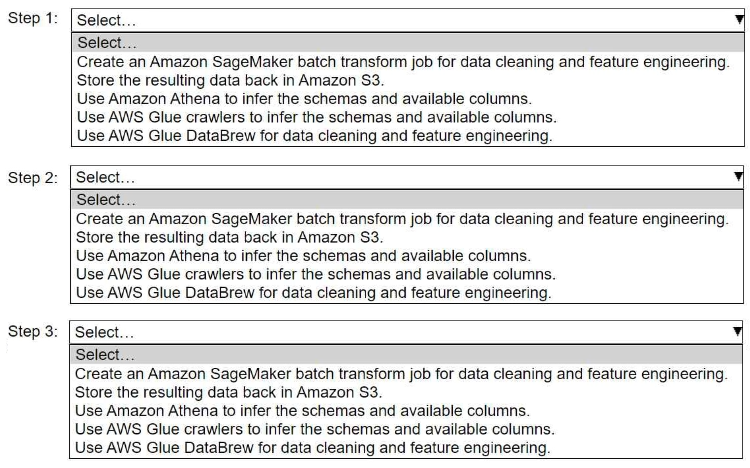
Item 1
Item 2
Item 3
Show answer & explanation
Correct answer: Item 1: D · Item 2: E · Item 3: B
Explanation
QUESTION 6
HOTSPOT -
An ML engineer needs to use Amazon SageMaker Feature Store to create and manage features to train a model.
Select and order the steps from the following list to create and use the features in Feature Store. Each step should be selected one time. (Select and order three.)
• Access the store to build datasets for training.
• Create a feature group.
• Ingest the records.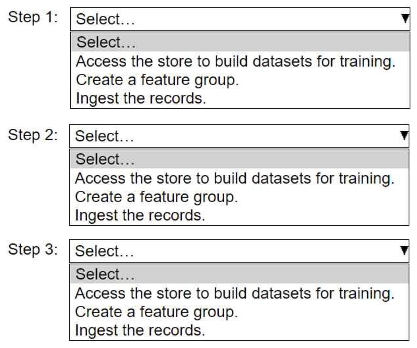
Item 1
Item 2
Item 3
Show answer & explanation
Correct answer: Item 1: B · Item 2: C · Item 3: A
Explanation
QUESTION 7
HOTSPOT -
A company wants to host an ML model on Amazon SageMaker. An ML engineer is configuring a continuous integration and continuous delivery (Cl/CD) pipeline in AWS CodePipeline to deploy the model. The pipeline must run automatically when new training data for the model is uploaded to an Amazon S3 bucket.
Select and order the pipeline's correct steps from the following list. Each step should be selected one time or not at all. (Select and order three.)
• An S3 event notification invokes the pipeline when new data is uploaded.
• S3 Lifecycle rule invokes the pipeline when new data is uploaded.
• SageMaker retrains the model by using the data in the S3 bucket.
• The pipeline deploys the model to a SageMaker endpoint.
• The pipeline deploys the model to SageMaker Model Registry.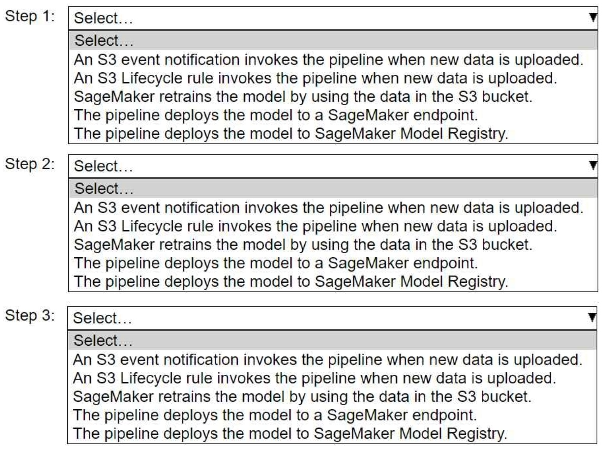
Item 1
Item 2
Item 3
Show answer & explanation
Correct answer: Item 1: A · Item 2: C · Item 3: D
Explanation
QUESTION 8
HOTSPOT -
An ML engineer is building a generative AI application on Amazon Bedrock by using large language models (LLMs).
Select the correct generative AI term from the following list for each description. Each term should be selected one time or not at all. (Select three.)
• Embedding
• Retrieval Augmented Generation (RAG)
• Temperature
• Token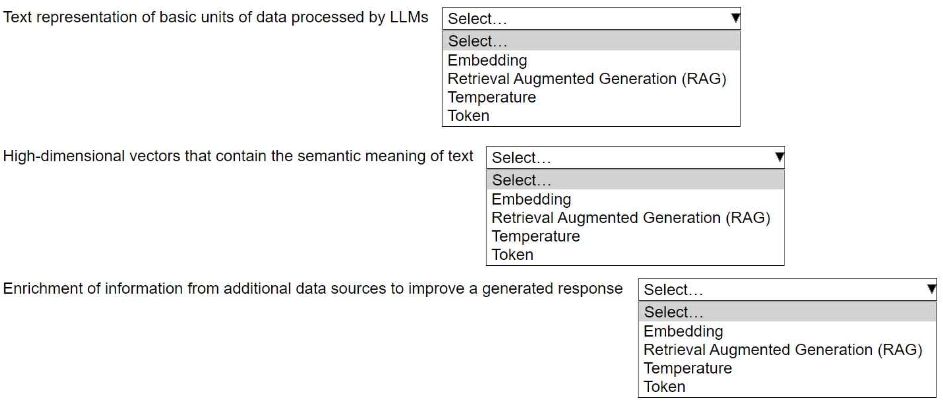
Item 1
Item 2
Item 3
Show answer & explanation
Correct answer: Item 1: D · Item 2: A · Item 3: B
Explanation
QUESTION 9
HOTSPOT -
An ML engineer is working on an ML model to predict the prices of similarly sized homes. The model will base predictions on several features The ML engineer will use the following feature engineering techniques to estimate the prices of the homes:
• Feature splitting
• Logarithmic transformation
• One-hot encoding
• Standardized distribution
Select the correct feature engineering techniques for the following list of features. Each feature engineering technique should be selected one time or not at all (Select three.)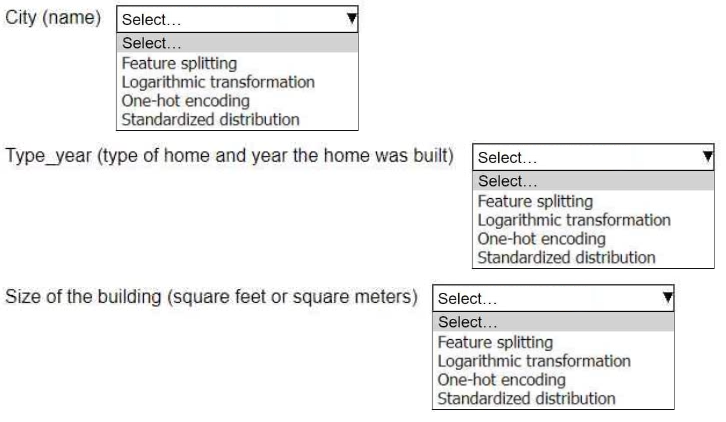
Item 1
Item 2
Item 3
Show answer & explanation
Correct answer: Item 1: C · Item 2: A · Item 3: B
Explanation
QUESTION 10
Case study -
An ML engineer is developing a fraud detection model on AWS. The training dataset includes transaction logs, customer profiles, and tables from an on-premises MySQL database. The transaction logs and customer profiles are stored in Amazon S3.
The dataset has a class imbalance that affects the learning of the model's algorithm. Additionally, many of the features have interdependencies. The algorithm is not capturing all the desired underlying patterns in the data.
Which AWS service or feature can aggregate the data from the various data sources?
Show answer & explanation
Correct answer: A
Explanation
QUESTION 11
Case study -
An ML engineer is developing a fraud detection model on AWS. The training dataset includes transaction logs, customer profiles, and tables from an on-premises MySQL database. The transaction logs and customer profiles are stored in Amazon S3.
The dataset has a class imbalance that affects the learning of the model's algorithm. Additionally, many of the features have interdependencies. The algorithm is not capturing all the desired underlying patterns in the data.
After the data is aggregated, the ML engineer must implement a solution to automatically detect anomalies in the data and to visualize the result.
Which solution will meet these requirements?
Show answer & explanation
Correct answer: C
Explanation
QUESTION 12
Case study -
An ML engineer is developing a fraud detection model on AWS. The training dataset includes transaction logs, customer profiles, and tables from an on-premises MySQL database. The transaction logs and customer profiles are stored in Amazon S3.
The dataset has a class imbalance that affects the learning of the model's algorithm. Additionally, many of the features have interdependencies. The algorithm is not capturing all the desired underlying patterns in the data.
The training dataset includes categorical data and numerical data. The ML engineer must prepare the training dataset to maximize the accuracy of the model.
Which action will meet this requirement with the LEAST operational overhead?
Show answer & explanation
Correct answer: C
Explanation
QUESTION 13
Case study -
An ML engineer is developing a fraud detection model on AWS. The training dataset includes transaction logs, customer profiles, and tables from an on-premises MySQL database. The transaction logs and customer profiles are stored in Amazon S3.
The dataset has a class imbalance that affects the learning of the model's algorithm. Additionally, many of the features have interdependencies. The algorithm is not capturing all the desired underlying patterns in the data.
Before the ML engineer trains the model, the ML engineer must resolve the issue of the imbalanced data.
Which solution will meet this requirement with the LEAST operational effort?
Show answer & explanation
Correct answer: D
Explanation
QUESTION 14
Case study -
An ML engineer is developing a fraud detection model on AWS. The training dataset includes transaction logs, customer profiles, and tables from an on-premises MySQL database. The transaction logs and customer profiles are stored in Amazon S3.
The dataset has a class imbalance that affects the learning of the model's algorithm. Additionally, many of the features have interdependencies. The algorithm is not capturing all the desired underlying patterns in the data.
The ML engineer needs to use an Amazon SageMaker built-in algorithm to train the model.
Which algorithm should the ML engineer use to meet this requirement?
Show answer & explanation
Correct answer: A
Explanation
QUESTION 15
A company has deployed an XGBoost prediction model in production to predict if a customer is likely to cancel a subscription. The company uses Amazon SageMaker Model Monitor to detect deviations in the F1 score.
During a baseline analysis of model quality, the company recorded a threshold for the F1 score. After several months of no change, the model's F1 score decreases significantly.
What could be the reason for the reduced F1 score?
Show answer & explanation
Correct answer: A
Explanation
QUESTION 16
A company has a team of data scientists who use Amazon SageMaker notebook instances to test ML models. When the data scientists need new permissions, the company attaches the permissions to each individual role that was created during the creation of the SageMaker notebook instance.
The company needs to centralize management of the team's permissions.
Which solution will meet this requirement?
Show answer & explanation
Correct answer: A
Explanation
QUESTION 17
An ML engineer needs to use an ML model to predict the price of apartments in a specific location.
Which metric should the ML engineer use to evaluate the model's performance?
Show answer & explanation
Correct answer: D
Explanation
QUESTION 18
An ML engineer has trained a neural network by using stochastic gradient descent (SGD). The neural network performs poorly on the test set. The values for training loss and validation loss remain high and show an oscillating pattern. The values decrease for a few epochs and then increase for a few epochs before repeating the same cycle.
What should the ML engineer do to improve the training process?
Show answer & explanation
Correct answer: D
Explanation
QUESTION 19
An ML engineer needs to process thousands of existing CSV objects and new CSV objects that are uploaded. The CSV objects are stored in a central Amazon S3 bucket and have the same number of columns. One of the columns is a transaction date. The ML engineer must query the data based on the transaction date.
Which solution will meet these requirements with the LEAST operational overhead?
Show answer & explanation
Correct answer: A
Explanation
QUESTION 20
A company has a large, unstructured dataset. The dataset includes many duplicate records across several key attributes.
Which solution on AWS will detect duplicates in the dataset with the LEAST code development?
Show answer & explanation
Correct answer: D
Explanation
Build a focused MLA-C01 practice routine.
Choose MLA-C01 in Revizo and work through original, question-by-question practice on your iPhone. Review results, revisit what needs attention and keep your next session tied to one specific certification objective.
Practise MLA-C01 with RevizoMLA-C01 practice questions.
Is Revizo the official AWS exam?
No. Revizo is an independent iPhone app for certification practice. Refer to the provider's official resources for current exam policies and registration.
How should I use these MLA-C01 practice questions?
Use the exam code to select the matching certification in Revizo, then build short, focused sessions around the areas you want to review.
Are Revizo questions copied from live examinations?
No. Revizo provides original practice questions for certification study. Use the provider's official objectives, documentation and policies as the source of truth for your preparation.
What should I use alongside MLA-C01 practice questions?
Use the current AWS objectives, documentation and registration guidance as your source of truth. Revizo is designed to support focused practice, not replace the provider's official materials.
Where can I confirm current MLA-C01 requirements?
Check the official AWS exam page for the latest objectives, registration details and policies.