Revizo / AWS / ANS-C01

AWS CERTIFICATION STUDY GUIDE

ANS-C01 practice questions.
Prepare with a clearer plan.

Demonstrates advanced skills in designing and implementing AWS and hybrid IT network architectures.

Download Revizo
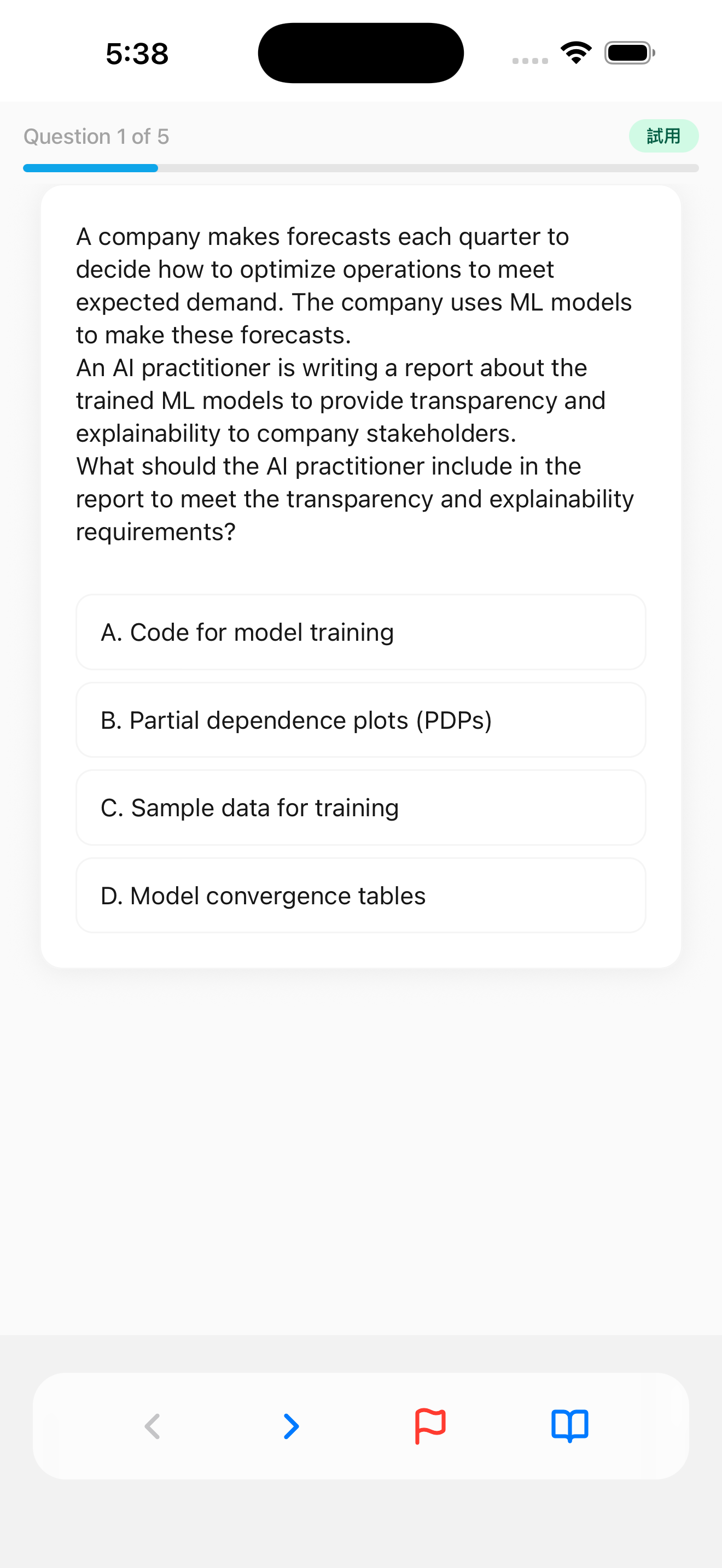
Revizo certification practice question on iPhone

What to know about ANS-C01.

Demonstrates advanced skills in designing and implementing AWS and hybrid IT network architectures.

Format
Multiple choice and multiple response questions
Duration
170 minutes
Passing score
750/1000
Recommended experience
2+ years of networking experience on AWS

Exam details are based on the available AWS catalogue information. Confirm current requirements with the exam provider before booking.

How to prepare for ANS-C01.

Use the provider's current objectives as your source of truth, then organise your Revizo sessions around AWS services, cloud concepts and the decisions expected in the certification. The ANS-C01 exam is listed as Multiple choice and multiple response questions; your starting point should reflect 2+ years of networking experience on AWS.

01

Map the official objectives.

Read the current AWS objectives and make a short list of the areas you need to revisit before booking ANS-C01.

02

Practise one area at a time.

Select ANS-C01 in Revizo and use focused question sessions to test one topic or decision type at a time, rather than relying on a single long cram session.

03

Review, then repeat.

Use your results to return to incorrect answers, revisit the official material behind them and repeat short ANS-C01 practice sessions until the gaps are clearer.

FREE PRACTICE PREVIEW

Read the first 20
ANS-C01 questions.

Review each question, its correct answer and any available source explanation before continuing your certification study in Revizo.

FIRST 20 QUESTIONS

Answers & available explanations

QUESTION 1

A company is planning to create a service that requires encryption in transit. The traffic must not be decrypted between the client and the backend of the service. The company will implement the service by using the gRPC protocol over TCP port 443. The service will scale up to thousands of simultaneous connections. The backend of the service will be hosted on an Amazon Elastic Kubernetes Service (Amazon EKS) duster with the Kubernetes Cluster Autoscaler and the Horizontal Pod Autoscaler configured. The company needs to use mutual TLS for two-way authentication between the client and the backend.
Which solution will meet these requirements?

  1. AA. Install the AWS Load Balancer Controller for Kubernetes. Using that controller, configure a Network Load Balancer with a TCP listener on port 443 to forward traffic to the IP addresses of the backend service Pods.
  2. BB. Install the AWS Load Balancer Controller for Kubernetes. Using that controller, configure an Application Load Balancer with an HTTPS listener on port 443 to forward traffic to the IP addresses of the backend service Pods.
  3. CC. Create a target group. Add the EKS managed node group's Auto Scaling group as a target Create an Application Load Balancer with an HTTPS listener on port 443 to forward traffic to the target group.
  4. DD. Create a target group. Add the EKS managed node group’s Auto Scaling group as a target. Create a Network Load Balancer with a TLS listener on port 443 to forward traffic to the target group.
Show answer & explanation

Correct answer: A

Explanation"Application Load Balancers do not support mutual TLS authentication (mTLS). For mTLS support, create a TCP listener using a Network Load Balancer or a Classic Load Balancer and implement mTLS on the target." Ref: https://docs.aws.amazon.com/elasticloadbalancing/latest/application/create-https-listener.html "Network Load Balancers do not support TLS renegotiation or mutual TLS authentication (mTLS). For mTLS support, create a TCP listener instead of a TLS listener. The load balancer passes the request through as is, so you can implement mTLS on the target." Ref: https://docs.aws.amazon.com/elasticloadbalancing/latest/network/create-tls-listener.html

QUESTION 2

A company is deploying a new application in the AWS Cloud. The company wants a highly available web server that will sit behind an Elastic Load Balancer. The load balancer will route requests to multiple target groups based on the URL in the request. All traffic must use HTTPS. TLS processing must be offloaded to the load balancer. The web server must know the user’s IP address so that the company can keep accurate logs for security purposes.
Which solution will meet these requirements?

  1. AA. Deploy an Application Load Balancer with an HTTPS listener. Use path-based routing rules to forward the traffic to the correct target group. Include the X-Forwarded-For request header with traffic to the targets.
  2. BB. Deploy an Application Load Balancer with an HTTPS listener for each domain. Use host-based routing rules to forward the traffic to the correct target group for each domain. Include the X-Forwarded-For request header with traffic to the targets.
  3. CC. Deploy a Network Load Balancer with a TLS listener. Use path-based routing rules to forward the traffic to the correct target group. Configure client IP address preservation for traffic to the targets.
  4. DD. Deploy a Network Load Balancer with a TLS listener for each domain. Use host-based routing rules to forward the traffic to the correct target group for each domain. Configure client IP address preservation for traffic to the targets.
Show answer & explanation

Correct answer: A

Explanation

QUESTION 3

A company has developed an application on AWS that will track inventory levels of vending machines and initiate the restocking process automatically. The company plans to integrate this application with vending machines and deploy the vending machines in several markets around the world. The application resides in a VPC in the us-east-1 Region. The application consists of an Amazon Elastic Container Service (Amazon ECS) cluster behind an Application Load Balancer (ALB). The communication from the vending machines to the application happens over HTTPS.
The company is planning to use an AWS Global Accelerator accelerator and configure static IP addresses of the accelerator in the vending machines for application endpoint access. The application must be accessible only through the accelerator and not through a direct connection over the internet to the ALB endpoint.
Which solution will meet these requirements?

  1. AA. Configure the ALB in a private subnet of the VPC. Attach an internet gateway without adding routes in the subnet route tables to point to the internet gateway. Configure the accelerator with endpoint groups that include the ALB endpoint. Configure the ALB’s security group to only allow inbound traffic from the internet on the ALB listener port.
  2. BB. Configure the ALB in a private subnet of the VPC. Configure the accelerator with endpoint groups that include the ALB endpoint. Configure the ALB's security group to only allow inbound traffic from the internet on the ALB listener port.
  3. CC. Configure the ALB in a public subnet of the VPAttach an internet gateway. Add routes in the subnet route tables to point to the internet gateway. Configure the accelerator with endpoint groups that include the ALB endpoint. Configure the ALB's security group to only allow inbound traffic from the accelerator's IP addresses on the ALB listener port.
  4. DD. Configure the ALB in a private subnet of the VPC. Attach an internet gateway. Add routes in the subnet route tables to point to the internet gateway. Configure the accelerator with endpoint groups that include the ALB endpoint. Configure the ALB's security group to only allow inbound traffic from the accelerator's IP addresses on the ALB listener port.
Show answer & explanation

Correct answer: A

Explanation

QUESTION 4

A global delivery company is modernizing its fleet management system. The company has several business units. Each business unit designs and maintains applications that are hosted in its own AWS account in separate application VPCs in the same AWS Region. Each business unit's applications are designed to get data from a central shared services VPC.
The company wants the network connectivity architecture to provide granular security controls. The architecture also must be able to scale as more business units consume data from the central shared services VPC in the future.
Which solution will meet these requirements in the MOST secure manner?

  1. AA. Create a central transit gateway. Create a VPC attachment to each application VPC. Provide full mesh connectivity between all the VPCs by using the transit gateway.
  2. BB. Create VPC peering connections between the central shared services VPC and each application VPC in each business unit's AWS account.
  3. CC. Create VPC endpoint services powered by AWS PrivateLink in the central shared services VPCreate VPC endpoints in each application VPC.
  4. DD. Create a central transit VPC with a VPN appliance from AWS Marketplace. Create a VPN attachment from each VPC to the transit VPC. Provide full mesh connectivity among all the VPCs.
Show answer & explanation

Correct answer: C

Explanation

QUESTION 5

A company uses a 4 Gbps AWS Direct Connect dedicated connection with a link aggregation group (LAG) bundle to connect to five VPCs that are deployed in the us-east-1 Region. Each VPC serves a different business unit and uses its own private VIF for connectivity to the on-premises environment. Users are reporting slowness when they access resources that are hosted on AWS.
A network engineer finds that there are sudden increases in throughput and that the Direct Connect connection becomes saturated at the same time for about an hour each business day. The company wants to know which business unit is causing the sudden increase in throughput. The network engineer must find out this information and implement a solution to resolve the problem.
Which solution will meet these requirements?

  1. AA. Review the Amazon CloudWatch metrics for VirtualInterfaceBpsEgress and VirtualInterfaceBpsIngress to determine which VIF is sending the highest throughput during the period in which slowness is observed. Create a new 10 Gbps dedicated connection. Shift traffic from the existing dedicated connection to the new dedicated connection.
  2. BB. Review the Amazon CloudWatch metrics for VirtualInterfaceBpsEgress and VirtualInterfaceBpsIngress to determine which VIF is sending the highest throughput during the period in which slowness is observed. Upgrade the bandwidth of the existing dedicated connection to 10 Gbps.
  3. CC. Review the Amazon CloudWatch metrics for ConnectionBpsIngress and ConnectionPpsEgress to determine which VIF is sending the highest throughput during the period in which slowness is observed. Upgrade the existing dedicated connection to a 5 Gbps hosted connection.
  4. DD. Review the Amazon CloudWatch metrics for ConnectionBpsIngress and ConnectionPpsEgress to determine which VIF is sending the highest throughput during the period in which slowness is observed. Create a new 10 Gbps dedicated connection. Shift traffic from the existing dedicated connection to the new dedicated connection.
Show answer & explanation

Correct answer: A

Explanation

QUESTION 6

A software-as-a-service (SaaS) provider hosts its solution on Amazon EC2 instances within a VPC in the AWS Cloud. All of the provider's customers also have their environments in the AWS Cloud.
A recent design meeting revealed that the customers have IP address overlap with the provider's AWS deployment. The customers have stated that they will not share their internal IP addresses and that they do not want to connect to the provider's SaaS service over the internet.
Which combination of steps is part of a solution that meets these requirements? (Choose two.)

  1. AA. Deploy the SaaS service endpoint behind a Network Load Balancer.
  2. BB. Configure an endpoint service, and grant the customers permission to create a connection to the endpoint service.
  3. CC. Deploy the SaaS service endpoint behind an Application Load Balancer.
  4. DD. Configure a VPC peering connection to the customer VPCs. Route traffic through NAT gateways.
  5. EE. Deploy an AWS Transit Gateway, and connect the SaaS VPC to it. Share the transit gateway with the customers. Configure routing on the transit gateway.
Show answer & explanation

Correct answer: A, B

ExplanationOption A, deploying the SaaS service endpoint behind a Network Load Balancer (NLB), allows the provider to present a single IP address to customers, while maintaining a highly available and scalable architecture. This is achieved by mapping the NLB's IP address to the SaaS service endpoint. Option B, configuring an endpoint service, enables customers to connect to the SaaS service endpoint using their own private IP addresses. This allows customers to avoid IP address overlap with the provider's AWS deployment and provides a secure, private connection to the SaaS service without traversing the internet.

QUESTION 7

A network engineer is designing the architecture for a healthcare company's workload that is moving to the AWS Cloud. All data to and from the on-premises environment must be encrypted in transit. All traffic also must be inspected in the cloud before the traffic is allowed to leave the cloud and travel to the on-premises environment or to the internet.
The company will expose components of the workload to the internet so that patients can reserve appointments. The architecture must secure these components and protect them against DDoS attacks. The architecture also must provide protection against financial liability for services that scale out during a DDoS event.
Which combination of steps should the network engineer take to meet all these requirements for the workload? (Choose three.)

  1. AA. Use Traffic Mirroring to copy all traffic to a fleet of traffic capture appliances.
  2. BB. Set up AWS WAF on all network components.
  3. CC. Configure an AWS Lambda function to create Deny rules in security groups to block malicious IP addresses.
  4. DD. Use AWS Direct Connect with MACsec support for connectivity to the cloud.
  5. EE. Use Gateway Load Balancers to insert third-party firewalls for inline traffic inspection.
  6. FF. Configure AWS Shield Advanced and ensure that it is configured on all public assets.
Show answer & explanation

Correct answer: D, E, F

ExplanationD) - All data to and from the on-premises environment must be encrypted in transit. (Use AWS Direct Connect with MACsec support for connectivity to the cloud.) E) - All traffic also must be inspected in the cloud before the traffic is allowed to leave the cloud and travel to the on-premises environment (Use Gateway Load Balancers to insert third-party firewalls for inline traffic inspection.) F) - The architecture also must provide protection against financial liability for services that scale out during a DDoS event.(Configure AWS Shield Advanced and ensure that it is configured on all public assets)

QUESTION 8

A retail company is running its service on AWS. The company’s architecture includes Application Load Balancers (ALBs) in public subnets. The ALB target groups are configured to send traffic to backend Amazon EC2 instances in private subnets. These backend EC2 instances can call externally hosted services over the internet by using a NAT gateway.
The company has noticed in its billing that NAT gateway usage has increased significantly. A network engineer needs to find out the source of this increased usage.
Which options can the network engineer use to investigate the traffic through the NAT gateway? (Choose two.)

  1. AA. Enable VPC flow logs on the NAT gateway's elastic network interface. Publish the logs to a log group in Amazon CloudWatch Logs. Use CloudWatch Logs Insights to query and analyze the logs.
  2. BB. Enable NAT gateway access logs. Publish the logs to a log group in Amazon CloudWatch Logs. Use CloudWatch Logs Insights to query and analyze the logs.
  3. CC. Configure Traffic Mirroring on the NAT gateway's elastic network interface. Send the traffic to an additional EC2 instance. Use tools such as tcpdump and Wireshark to query and analyze the mirrored traffic.
  4. DD. Enable VPC flow logs on the NAT gateway's elastic network interface. Publish the logs to an Amazon S3 bucket. Create a custom table for the S3 bucket in Amazon Athena to describe the log structure. Use Athena to query and analyze the logs.
  5. EE. Enable NAT gateway access logs. Publish the logs to an Amazon S3 bucket. Create a custom table for the S3 bucket in Amazon Athena to describe the log structure. Use Athena to query and analyze the logs.
Show answer & explanation

Correct answer: A, D

ExplanationA. Yes, this would work. B. Not a real thing, wrong C. We don't need to do packet inspection to analyze costs. This won't help with costs at all. D. The most obvious right answer. E. Like B, not a real thing.

QUESTION 9

A banking company is successfully operating its public mobile banking stack on AWS. The mobile banking stack is deployed in a VPC that includes private subnets and public subnets. The company is using IPv4 networking and has not deployed or supported IPv6 in the environment. The company has decided to adopt a third-party service provider's API and must integrate the API with the existing environment. The service provider’s API requires the use of IPv6.
A network engineer must turn on IPv6 connectivity for the existing workload that is deployed in a private subnet. The company does not want to permit IPv6 traffic from the public internet and mandates that the company's servers must initiate all IPv6 connectivity. The network engineer turns on IPv6 in the VPC and in the private subnets.
Which solution will meet these requirements?

  1. AA. Create an internet gateway and a NAT gateway in the VPC. Add a route to the existing subnet route tables to point IPv6 traffic to the NAT gateway.
  2. BB. Create an internet gateway and a NAT instance in the VPC. Add a route to the existing subnet route tables to point IPv6 traffic to the NAT instance.
  3. CC. Create an egress-only Internet gateway in the VPAdd a route to the existing subnet route tables to point IPv6 traffic to the egress-only internet gateway.
  4. DD. Create an egress-only internet gateway in the VPC. Configure a security group that denies all inbound traffic. Associate the security group with the egress-only internet gateway.
Show answer & explanation

Correct answer: C

ExplanationA. NAT Gateway does not support IPv6 B. NAT Instance will be on Public subnet where IPv6 is not enabled. C. Works D. You don't to explicitly deny inbound access to EO GW. It is its default functionality.

QUESTION 10

A company has deployed an AWS Network Firewall firewall into a VPC. A network engineer needs to implement a solution to deliver Network Firewall flow logs to the company’s Amazon OpenSearch Service (Amazon Elasticsearch Service) cluster in the shortest possible time.
Which solution will meet these requirements?

  1. AA. Create an Amazon S3 bucket. Create an AWS Lambda function to load logs into the Amazon OpenSearch Service (Amazon Elasticsearch Service) cluster. Enable Amazon Simple Notification Service (Amazon SNS) notifications on the S3 bucket to invoke the Lambda function. Configure flow logs for the firewall. Set the S3 bucket as the destination.
  2. BB. Create an Amazon Kinesis Data Firehose delivery stream that includes the Amazon OpenSearch Service (Amazon Elasticsearch Service) cluster as the destination. Configure flow logs for the firewall Set the Kinesis Data Firehose delivery stream as the destination for the Network Firewall flow logs.
  3. CC. Configure flow logs for the firewall. Set the Amazon OpenSearch Service (Amazon Elasticsearch Service) cluster as the destination for the Network Firewall flow logs.
  4. DD. Create an Amazon Kinesis data stream that includes the Amazon OpenSearch Service (Amazon Elasticsearch Service) cluster as the destination. Configure flow logs for the firewall. Set the Kinesis data stream as the destination for the Network Firewall flow logs.
Show answer & explanation

Correct answer: B

Explanation

QUESTION 11

A company is using custom DNS servers that run BIND for name resolution in its VPCs. The VPCs are deployed across multiple AWS accounts that are part of the same organization in AWS Organizations. All the VPCs are connected to a transit gateway. The BIND servers are running in a central VPC and are configured to forward all queries for an on-premises DNS domain to DNS servers that are hosted in an on-premises data center. To ensure that all the VPCs use the custom DNS servers, a network engineer has configured a VPC DHCP options set in all the VPCs that specifies the custom DNS servers to be used as domain name servers.
Multiple development teams in the company want to use Amazon Elastic File System (Amazon EFS). A development team has created a new EFS file system but cannot mount the file system to one of its Amazon EC2 instances. The network engineer discovers that the EC2 instance cannot resolve the IP address for the EFS mount point fs-33444567d.efs.us-east-1.amazonaws.com. The network engineer needs to implement a solution so that development teams throughout the organization can mount EFS file systems.
Which combination of steps will meet these requirements? (Choose two.)

  1. AA. Configure the BIND DNS servers in the central VPC to forward queries for efs.us-east-1.amazonaws.com to the Amazon provided DNS server (169.254.169.253).
  2. BB. Create an Amazon Route 53 Resolver outbound endpoint in the central VPC. Update all the VPC DHCP options sets to use AmazonProvidedDNS for name resolution.
  3. CC. Create an Amazon Route 53 Resolver inbound endpoint in the central VPUpdate all the VPC DHCP options sets to use the Route 53 Resolver inbound endpoint in the central VPC for name resolution.
  4. DD. Create an Amazon Route 53 Resolver rule to forward queries for the on-premises domain to the on-premises DNS servers. Share the rule with the organization by using AWS Resource Access Manager (AWS RAM). Associate the rule with all the VPCs.
  5. EE. Create an Amazon Route 53 private hosted zone for the efs.us-east-1.amazonaws.com domain. Associate the private hosted zone with the VPC where the EC2 instance is deployed. Create an A record for fs-33444567d.efs.us-east-1.amazonaws.com in the private hosted zone. Configure the A record to return the mount target of the EFS mount point.
Show answer & explanation

Correct answer: B, D

Explanationhttps://aws.amazon.com/blogs/security/simplify-dns-management-in-a-multiaccount-environment-with-route-53-resolver/ "You can mount an Amazon EFS file system on an Amazon EC2 instance using DNS names. The file system DNS name automatically resolves to the mount target’s IP address in the Availability Zone of the connecting Amazon EC2 instance. To be able to do that, the VPC must use the default DNS provided by Amazon to resolve EFS DNS names. If you plan to use EFS in your environment, I recommend that you resolve EFS DNS names locally and avoid sending these queries to central DNS because clients in that case would not receive answers optimized for their availability zone, which might result in higher operation latencies and less durability." So, option B) answers EFS resolution from VPC. Combination of Option B) and D) explains resolution from on-prem

QUESTION 12

An ecommerce company is hosting a web application on Amazon EC2 instances to handle continuously changing customer demand. The EC2 instances are part of an Auto Scaling group. The company wants to implement a solution to distribute traffic from customers to the EC2 instances. The company must encrypt all traffic at all stages between the customers and the application servers. No decryption at intermediate points is allowed.
Which solution will meet these requirements?

  1. AA. Create an Application Load Balancer (ALB). Add an HTTPS listener to the ALB. Configure the Auto Scaling group to register instances with the ALB's target group.
  2. BB. Create an Amazon CloudFront distribution. Configure the distribution with a custom SSL/TLS certificate. Set the Auto Scaling group as the distribution's origin.
  3. CC. Create a Network Load Balancer (NLB). Add a TCP listener to the NLB. Configure the Auto Scaling group to register instances with the NLB's target group.
  4. DD. Create a Gateway Load Balancer (GLB). Configure the Auto Scaling group to register instances with the GLB's target group.
Show answer & explanation

Correct answer: C

ExplanationIf you need to pass encrypted traffic to the targets without the load balancer decrypting it, create a TCP listener on port 443 instead of creating a TLS listener. https://docs.aws.amazon.com/elasticloadbalancing/latest/network/create-tls-listener.html

QUESTION 13

A company has two on-premises data center locations. There is a company-managed router at each data center. Each data center has a dedicated AWS Direct Connect connection to a Direct Connect gateway through a private virtual interface. The router for the first location is advertising 110 routes to the Direct Connect gateway by using BGP, and the router for the second location is advertising 60 routes to the Direct Connect gateway by using BGP. The Direct Connect gateway is attached to a company VPC through a virtual private gateway.
A network engineer receives reports that resources in the VPC are not reachable from various locations in either data center. The network engineer checks the VPC route table and sees that the routes from the first data center location are not being populated into the route table. The network engineer must resolve this issue in the most operationally efficient manner.
What should the network engineer do to meet these requirements?

  1. AA. Remove the Direct Connect gateway, and create a new private virtual interface from each company router to the virtual private gateway of the VPC.
  2. BB. Change the router configurations to summarize the advertised routes.
  3. CC. Open a support ticket to increase the quota on advertised routes to the VPC route table.
  4. DD. Create an AWS Transit Gateway. Attach the transit gateway to the VPC, and connect the Direct Connect gateway to the transit gateway.
Show answer & explanation

Correct answer: B

ExplanationYou can announce a maximum of 100 prefixes to AWS. These routes can be automatically be propagated into subnet route tables. In order to advertise more than 100 prefixes, you should summarize the prefixes into larger range to reduce number of prefixes

QUESTION 14

A company has expanded its network to the AWS Cloud by using a hybrid architecture with multiple AWS accounts. The company has set up a shared AWS account for the connection to its on-premises data centers and the company offices. The workloads consist of private web-based services for internal use. These services run in different AWS accounts. Office-based employees consume these services by using a DNS name in an on-premises DNS zone that is named example.internal.
The process to register a new service that runs on AWS requires a manual and complicated change request to the internal DNS. The process involves many teams.
The company wants to update the DNS registration process by giving the service creators access that will allow them to register their DNS records. A network engineer must design a solution that will achieve this goal. The solution must maximize cost-effectiveness and must require the least possible number of configuration changes.
Which combination of steps should the network engineer take to meet these requirements? (Choose three.)

  1. AA. Create a record for each service in its local private hosted zone (serviceA.account1.aws.example.internal). Provide this DNS record to the employees who need access.
  2. BB. Create an Amazon Route 53 Resolver inbound endpoint in the shared account VPC. Create a conditional forwarder for a domain named aws.example.internal on the on-premises DNS servers. Set the forwarding IP addresses to the inbound endpoint's IP addresses that were created.
  3. CC. Create an Amazon Route 53 Resolver rule to forward any queries made to onprem.example.internal to the on-premises DNS servers.
  4. DD. Create an Amazon Route 53 private hosted zone named aws.example.internal in the shared AWS account to resolve queries for this domain.
  5. EE. Launch two Amazon EC2 instances in the shared AWS account. Install BIND on each instance. Create a DNS conditional forwarder on each BIND server to forward queries for each subdomain under aws.example.internal to the appropriate private hosted zone in each AWS account. Create a conditional forwarder for a domain named aws.example.internal on the on-premises DNS servers. Set the forwarding IP addresses to the IP addresses of the BIND servers.
  6. FF. Create a private hosted zone in the shared AWS account for each account that runs the service. Configure the private hosted zone to contain aws.example.internal in the domain (account1.aws.example.internal). Associate the private hosted zone with the VPC that runs the service and the shared account VPC.
Show answer & explanation

Correct answer: B, D, F

ExplanationB. Create an Amazon Route 53 Resolver inbound endpoint in the shared account VPC. Create a conditional forwarder for a domain named aws.example.internal on the on-premises DNS servers. Set the forwarding IP addresses to the inbound endpoint's IP addresses that were created. This will enable DNS resolution between on-premises networks and AWS. D. Create an Amazon Route 53 private hosted zone named aws.example.internal in the shared AWS account to resolve queries for this domain. This allows you to simplify DNS management for your AWS services and resources within your shared account. F. Create a private hosted zone in the shared AWS account for each account that runs the service. Configure the private hosted zone to contain aws.example.internal in the domain (account1.aws.example.internal). Associate the private hosted zone with the VPC that runs the service and the shared account VPC. This allows individual AWS accounts to maintain their DNS entries.

QUESTION 15

A company has multiple AWS accounts. Each account contains one or more VPCs. A new security guideline requires the inspection of all traffic between VPCs.
The company has deployed a transit gateway that provides connectivity between all VPCs. The company also has deployed a shared services VPC with Amazon EC2 instances that include IDS services for stateful inspection. The EC2 instances are deployed across three Availability Zones. The company has set up VPC associations and routing on the transit gateway. The company has migrated a few test VPCs to the new solution for traffic inspection.
Soon after the configuration of routing, the company receives reports of intermittent connections for traffic that crosses Availability Zones.
What should a network engineer do to resolve this issue?

  1. AA. Modify the transit gateway VPC attachment on the shared services VPC by enabling cross-Availability Zone load balancing.
  2. BB. Modify the transit gateway VPC attachment on the shared services VPC by enabling appliance mode support.
  3. CC. Modify the transit gateway by selecting VPN equal-cost multi-path (ECMP) routing support.
  4. DD. Modify the transit gateway by selecting multicast support.
Show answer & explanation

Correct answer: B

Explanation

QUESTION 16

A company is using a NAT gateway to allow internet connectivity for private subnets in a VPC in the us-west-2 Region. After a security audit, the company needs to remove the NAT gateway.
In the private subnets, the company has resources that use the unified Amazon CloudWatch agent. A network engineer must create a solution to ensure that the unified CloudWatch agent continues to work after the removal of the NAT gateway.
Which combination of steps should the network engineer take to meet these requirements? (Choose three.)

  1. AA. Validate that private DNS is enabled on the VPC by setting the enableDnsHostnames VPC attribute and the enableDnsSupport VPC attribute to true.
  2. BB. Create a new security group with an entry to allow outbound traffic that uses the TCP protocol on port 443 to destination 0.0.0.0/0
  3. CC. Create a new security group with entries to allow inbound traffic that uses the TCP protocol on port 443 from the IP prefixes of the private subnets.
  4. DD. Create the following interface VPC endpoints in the VPC: com.amazonaws.us-west-2.logs and com.amazonaws.us-west-2.monitoring. Associate the new security group with the endpoint network interfaces.
  5. EE. Create the following interface VPC endpoint in the VPC: com.amazonaws.us-west-2.cloudwatch. Associate the new security group with the endpoint network interfaces.
  6. FF. Associate the VPC endpoint or endpoints with route tables that the private subnets use.
Show answer & explanation

Correct answer: A, C, D

ExplanationAn interface VPC endpoint provides reliable, scalable connectivity to CloudWatch without requiring a NAT gateway. https://docs.aws.amazon.com/AmazonCloudWatch/latest/monitoring/cloudwatch-and-interface-VPC.html https://docs.aws.amazon.com/vpc/latest/privatelink/aws-services-privatelink-support.html To use private DNS, you must enable DNS hostnames and DNS resolution for your VPC. The security group for the interface endpoint must allow communication between the endpoint network interface and the resources in your VPC that must communicate with the service. https://docs.aws.amazon.com/vpc/latest/privatelink/create-interface-endpoint.html

QUESTION 17

An international company provides early warning about tsunamis. The company plans to use IoT devices to monitor sea waves around the world. The data that is collected by the IoT devices must reach the company’s infrastructure on AWS as quickly as possible. The company is using three operation centers around the world. Each operation center is connected to AWS through Its own AWS Direct Connect connection. Each operation center is connected to the internet through at least two upstream internet service providers.
The company has its own provider-independent (PI) address space. The IoT devices use TCP protocols for reliable transmission of the data they collect. The IoT devices have both landline and mobile internet connectivity. The infrastructure and the solution will be deployed in multiple AWS Regions. The company will use Amazon Route 53 for DNS services.
A network engineer needs to design connectivity between the IoT devices and the services that run in the AWS Cloud.
Which solution will meet these requirements with the HIGHEST availability?

  1. AA. Set up an Amazon CloudFront distribution with origin failover. Create an origin group for each Region where the solution is deployed.
  2. BB. Set up Route 53 latency-based routing. Add latency alias records. For the latency alias records, set the value of Evaluate Target Health to Yes.
  3. CC. Set up an accelerator in AWS Global Accelerator. Configure Regional endpoint groups and health checks.
  4. DD. Set up Bring Your Own IP (BYOIP) addresses. Use the same PI addresses for each Region where the solution is deployed.
Show answer & explanation

Correct answer: C

Explanation

QUESTION 18

A company is planning a migration of its critical workloads from an on-premises data center to Amazon EC2 instances. The plan includes a new 10 Gbps AWS Direct Connect dedicated connection from the on-premises data center to a VPC that is attached to a transit gateway. The migration must occur over encrypted paths between the on-premises data center and the AWS Cloud.
Which solution will meet these requirements while providing the HIGHEST throughput?

  1. AA. Configure a public VIF on the Direct Connect connection. Configure an AWS Site-to-Site VPN connection to the transit gateway as a VPN attachment.
  2. BB. Configure a transit VIF on the Direct Connect connection. Configure an IPsec VPN connection to an EC2 instance that is running third-party VPN software.
  3. CC. Configure MACsec for the Direct Connect connection. Configure a transit VIF to a Direct Connect gateway that is associated with the transit gateway.
  4. DD. Configure a public VIF on the Direct Connect connection. Configure two AWS Site-to-Site VPN connections to the transit gateway. Enable equal-cost multi-path (ECMP) routing.
Show answer & explanation

Correct answer: C

Explanationhttps://docs.aws.amazon.com/directconnect/latest/UserGuide/MACsec.html

QUESTION 19

A network engineer must develop an AWS CloudFormation template that can create a virtual private gateway, a customer gateway, a VPN connection, and static routes in a route table. During testing of the template, the network engineer notes that the CloudFormation template has encountered an error and is rolling back.
What should the network engineer do to resolve the error?

  1. AA. Change the order of resource creation in the CloudFormation template.
  2. BB. Add the DependsOn attribute to the resource declaration for the virtual private gateway. Specify the route table entry resource.
  3. CC. Add a wait condition in the template to wait for the creation of the virtual private gateway.
  4. DD. Add the DependsOn attribute to the resource declaration for the route table entry. Specify the virtual private gateway resource.
Show answer & explanation

Correct answer: D

Explanation

QUESTION 20

A company operates its IT services through a multi-site hybrid infrastructure. The company deploys resources on AWS in the us-east-1 Region and in the eu-west-2 Region. The company also deploys resources in its own data centers that are located in the United States (US) and in the United Kingdom (UK). In both AWS Regions, the company uses a transit gateway to connect 15 VPCs to each other. The company has created a transit gateway peering connection between the two transit gateways. The VPC CIDR blocks do not overlap with each other or with IP addresses used within the data centers. The VPC CIDR prefixes can also be aggregated either on a Regional level or for the company's entire AWS environment.
The data centers are connected to each other by a private WAN connection. IP routing information is exchanged dynamically through Interior BGP (iBGP) sessions. The data centers maintain connectivity to AWS through one AWS Direct Connect connection in the US and one Direct Connect connection in the UK. Each Direct Connect connection is terminated on a Direct Connect gateway and is associated with a local transit gateway through a transit VIF.
Traffic follows the shortest geographical path from source to destination. For example, packets from the UK data center that are targeted to resources in eu-west-2 travel across the local Direct Connect connection. In cases of cross-Region data transfers, such as from the UK data center to VPCs in us-east-1, the private WAN connection must be used to minimize costs on AWS. A network engineer has configured each transit gateway association on the Direct Connect gateway to advertise VPC-specific CIDR IP prefixes only from the local Region. The routes toward the other Region must be learned through BGP from the routers in the other data center in the original, non-aggregated form.
The company recently experienced a problem with cross-Region data transfers because of issues with its private WAN connection. The network engineer needs to modify the routing setup to prevent similar interruptions in the future. The solution cannot modify the original traffic routing goal when the network is operating normally.
Which modifications will meet these requirements? (Choose two.)

  1. AA. Remove all the VPC CIDR prefixes from the list of subnets advertised through the local Direct Connect connection. Add the company's entire AWS environment aggregate route to the list of subnets advertised through the local Direct Connect connection.
  2. BB. Add the CIDR prefixes from the other Region VPCs and the local VPC CIDR blocks to the list of subnets advertised through the local Direct Connect connection. Configure data center routers to make routing decisions based on the BGP communities received.
  3. CC. Add the aggregate IP prefix for the other Region and the local VPC CIDR blocks to the list of subnets advertised through the local Direct Connect connection.
  4. DD. Add the aggregate IP prefix for the company's entire AWS environment and the local VPC CIDR blocks to the list of subnets advertised through the local Direct Connect connection.
  5. EE. Remove all the VPC CIDR prefixes from the list of subnets advertised through the local Direct Connect connection. Add both Regional aggregate IP prefixes to the list of subnets advertised through the Direct Connect connection on both sides of the network. Configure data center routers to make routing decisions based on the BGP communities received.
Show answer & explanation

Correct answer: C, D

ExplanationC. This ensures that the BGP advertisements include both the aggregate IP prefix for the other Region and the specific CIDR blocks for the local VPCs. This is useful for ensuring optimal routing and maintaining connectivity during cross-Region data transfers. D. this approach ensures that BGP advertisements include both the aggregate IP prefix for the entire AWS environment and the specific CIDR blocks for the local VPCs. This provides a more comprehensive view of the AWS environment, allowing the data center routers to make routing decisions based on the received BGP advertisements. By combining these modifications, you create a setup that allows for optimal routing and fault tolerance during cross-Region data transfers while still respecting the original traffic routing goals when the network is operating normally.

Build a focused ANS-C01 practice routine.

Choose ANS-C01 in Revizo and work through original, question-by-question practice on your iPhone. Review results, revisit what needs attention and keep your next session tied to one specific certification objective.

Practise ANS-C01 with Revizo

ANS-C01 practice questions.

Is Revizo the official AWS exam?

No. Revizo is an independent iPhone app for certification practice. Refer to the provider's official resources for current exam policies and registration.

How should I use these ANS-C01 practice questions?

Use the exam code to select the matching certification in Revizo, then build short, focused sessions around the areas you want to review.

Are Revizo questions copied from live examinations?

No. Revizo provides original practice questions for certification study. Use the provider's official objectives, documentation and policies as the source of truth for your preparation.

What should I use alongside ANS-C01 practice questions?

Use the current AWS objectives, documentation and registration guidance as your source of truth. Revizo is designed to support focused practice, not replace the provider's official materials.

Where can I confirm current ANS-C01 requirements?

Check the official AWS exam page for the latest objectives, registration details and policies.